
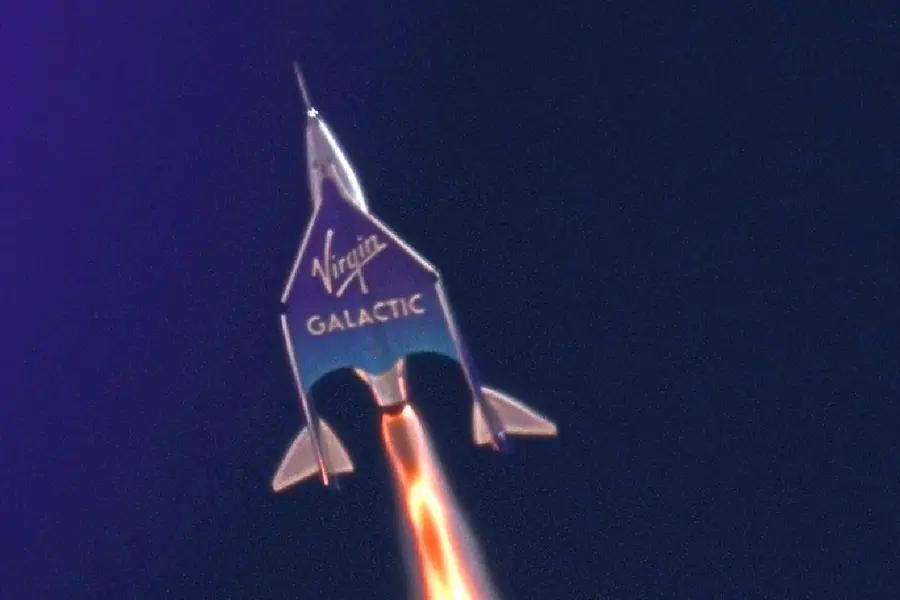
A Gen-Z-led non-profit called Operation Period is planning the world’s first dedicated mission to study menstruation in microgravity, flying its own founders on a 2027 Virgin Galactic suborbital flight.
For the very first time, a special space mission is being planned to study how menstruation, the monthly bleeding that women experience, actually works in space conditions. In space, there is very little gravity. This is called microgravity, where things float instead of staying down. Until now, nobody has properly studied periods in such conditions, which is surprising when we think about it.
Around forty-six years ago, NASA engineers asked astronaut Sally Ride a strange question. They wanted to know if one hundred tampons would be enough for her six-day mission. Tampons are products women use to absorb blood during their periods. Today, many people laugh at this incident, but it shows one serious truth. According to a report by Space.com, even after so many years, no proper scientific research has ever been done specifically on menstruation in space.
Also Read: Hidden Martian secret revealed: New rock type found in Meteorite
A non-profit organisation called Operation Period now wants to change this. It is led by young Gen-Z researchers, meaning people born in the late 1990s and early 2000s. Their main belief is "menstrual freedom." This simply means that every person who menstruates should easily get period products whenever they need them, without any shame or difficulty.
The group is also trying to understand why so many people cannot get these products on time. To study this in space, they have planned a mission called Operation Period-01, or OP-01. In 2027, the founders themselves will travel to space and do the research during a Virgin Galactic suborbital flight.
Now, what is a suborbital flight? It is a short trip to space that does not go all the way around the Earth. The spacecraft crosses the Kármán Line, which is about 100 kilometres above sea level. This line is considered the official boundary of space. After crossing it, passengers feel a few minutes of weightlessness, where their bodies float freely. Then the spacecraft slowly comes back down to Earth. Unlike bigger missions, it does not circle the planet.
Also Read: Morning tall, evening short? Science reveals the surprising reason your height changes every day
While working on Earth, Operation Period found that there are big gaps in space medicine. Manju Bangalore, the co-founder and a research astronaut, told Space.com about their goal clearly. She said she wants everyone who menstruates to live with dignity, confidence, and equal chances to reach their full potential, and this includes astronauts too.
Manju Bangalore has a strong background. She studied physics and space engineering and trained in bioastronautics, which is the study of how space affects the human body. She even worked at NASA. Along with co-founder Priya Abiram, she has stayed committed to this cause for nine years. Through this mission, both women will become among the youngest South Asian women ever to travel to space.
Manju shared that she always loved space since childhood. She never imagined that her passion for space and her work in menstrual health would join together like this. She feels grateful and proud to lead such a historic mission.
Virgin Galactic, the company providing the flight, is also happy to support this work. Their director, Amber Favaregh, said the mission shows how spaceflight can help important health research that nobody paid attention to before. The knowledge gained could help both future space travel and life here on Earth.
At present, many female astronauts choose to stop their periods during missions. They use hormonal IUDs, which are small devices placed inside the uterus, or birth control pills. This helps prevent bleeding in space. But because there is so little research, astronauts do not have enough freedom to decide what is truly best for their own bodies.
This information becomes even more important for long missions, such as living on the Moon for many days. Manju said that the small amount of research available suggests periods in space are generally safe. But for longer trips, the data is simply not enough. Without proper data, mission planners cannot arrange the right medical support.
Carrying too many backup products is also a problem, because weight and storage space are very limited in spacecraft. So future missions need accurate data to know exactly what is needed.
Interestingly, this research will help people on Earth too. Manju gave one shocking example. Some companies measured the absorbency of period products using saline, which is salt water, instead of real menstrual blood. This gave wrong results. Because of this, doctors may have missed many cases of heavy bleeding. Even today, about twenty percent of menstruating people in the United States face heavy bleeding.
The team has not revealed every detail yet, but they say this is only the first step. They hope to do bigger missions in future and collect more data.
Public interest grew after a viral video, watched by millions, showed Manju testing how menstrual fluid behaves in low gravity. That video reduced shame around periods and opened honest conversations. This mission bravely begins a discussion that waited far too long.
The author is an award-winning science communicator and a Defence, Aerospace & Geopolitical Analyst.
Published: 20 Jun 2026, 12:24 pm IST
Related Topics
Disclaimer: Kindly avoid objectionable, derogatory, unlawful and lewd comments, while responding to reports. Such comments are punishable under cyber laws. Please keep away from personal attacks. The opinions expressed here are the personal opinions of readers and not that of Mathrubhumi.
