
This marks India's heaviest communication satellite launch to Geosynchronous Transfer Orbit (GTO) from home soil.
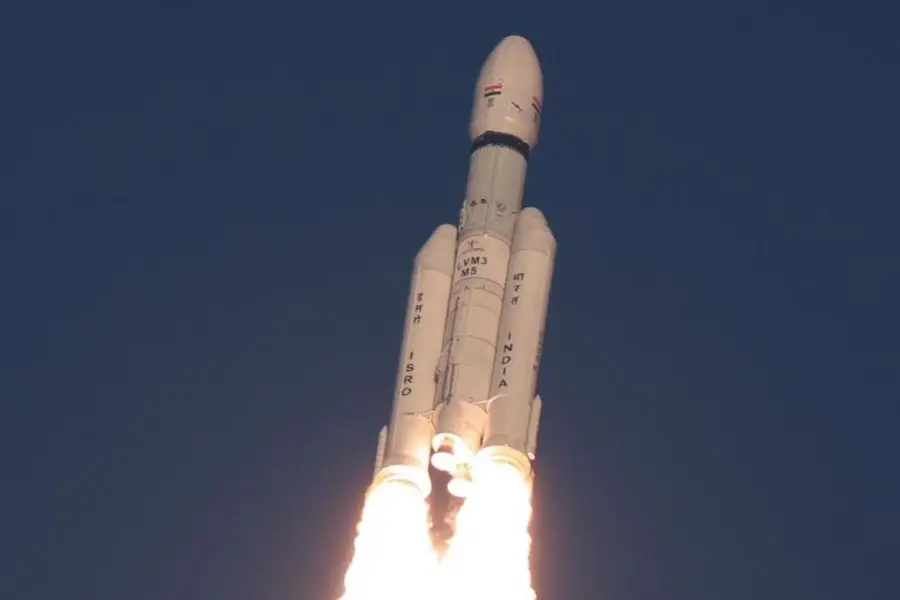
Sriharikota: India’s heaviest communication satellite, CMS-03, weighing 4,410 kg, was successfully launched into the intended Geosynchronous Transfer Orbit (GTO) on Sunday by the Indian Space Research Organisation (ISRO) aboard the LVM3-M5 rocket, also known as ‘Bahubali’ for its heavy-lift capability. The communication satellite is designed to provide multi-band telecommunication services across a wide oceanic region, including the Indian landmass.
The successful launch marked the fifth operational flight of the LVM3 vehicle and an important milestone for ISRO, demonstrating full indigenous capability in launching heavy payloads from Indian soil. ISRO Chairman V Narayanan highlighted the precise injection of the satellite into the required orbit, expressing pride in the mission’s success, especially following the prestigious Chandrayaan-3 mission.
The LVM3-M5 rocket, standing 43.5 meters tall and weighing 642 tonnes at liftoff, features two solid motor strap-ons (S200), a liquid core stage (L110) powered by two Vikas engines, and an indigenously developed cryogenic upper stage (C25). The mission successfully tested the C25 engine’s thrust chamber ignition in orbit, a first for ISRO that enhances its ability to place multiple satellites with greater precision.
CMS-03 is a replacement for the GSAT 7 series launched in 2013 and is expected to deliver communication services for at least 15 years. It supports civilian and strategic applications with upgraded encryption and operates across UHF, S, C, and Ku bands, enhancing network-centric naval operations and maritime domain awareness in the Indian Ocean Region.
This launch aligns with ISRO’s vision of Atmanirbhar Bharat (self-reliant India) and further consolidates the agency’s leadership in space technology. Notably, ISRO has progressively expanded its launch capability from the Polar Satellite Launch Vehicle (PSLV) for smaller payloads to LVM3 for heavier satellites, negating reliance on foreign launch sites.
With inputs from PTI
Published: 02 Nov 2025, 05:29 pm IST
Related Topics
Disclaimer: Kindly avoid objectionable, derogatory, unlawful and lewd comments, while responding to reports. Such comments are punishable under cyber laws. Please keep away from personal attacks. The opinions expressed here are the personal opinions of readers and not that of Mathrubhumi.
