
Oceanographer Dr Simon Boxall says 'rogue waves', enormous water crests up to 100 feet tall, are responsible for many disappearances. Boxall and his team reconstructed shipwrecks to demonstrate this phenomenon.
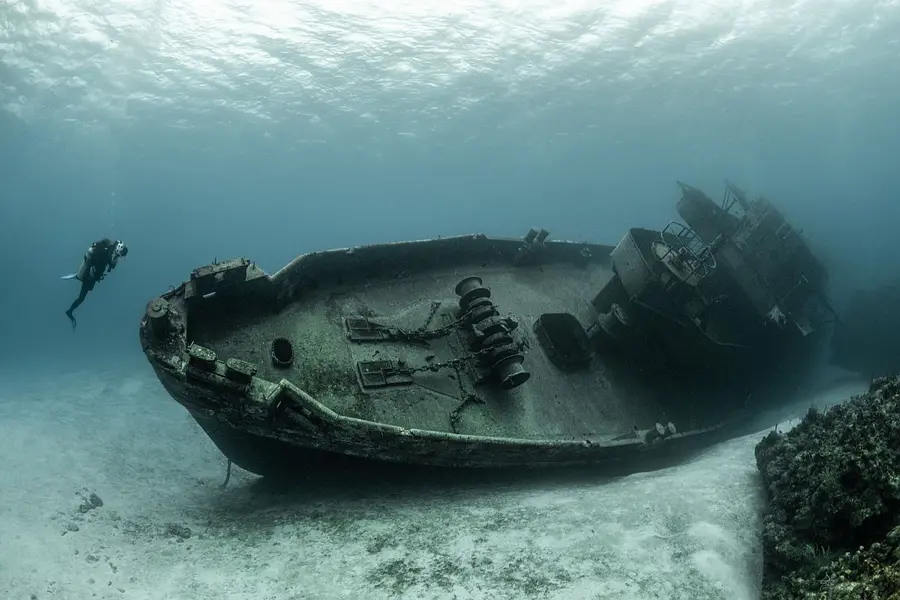
The mystery of the Bermuda Triangle, a region of the Atlantic Ocean located between Florida, Puerto Rico, and Bermuda, has been a source of fascination and speculation for generations, with many positing supernatural, alien, or other unexplained phenomena. However, recent revelations, from oceanographer Dr Simon Boxall of the University of Southampton, suggest that the mystery can be fundamentally explained by science and rational explanations, particularly through the phenomenon of 'rogue waves'.
Dr Simon Boxall posits that 'monster rogue waves' formed under 'perfect storm' conditions are the likely culprit behind the disappearances of many ships and crews in the Bermuda Triangle. These rogue waves are enormous crests of water that can measure up to '100 feet (30 meters) tall'.
How are rogue waves formed?
Rogue waves are not like normal waves; they form when waves from two or three different storms interact and come together. If two troughs or two peaks occur at the same time, they catch up and amplify, turning a typical 10-meter wave into a 20-meter wave, or even a 30-meter wave if three different wave systems converge. Boxall compares this to splashing in a bathtub, where bringing a couple of waves together creates a "big plop".
These steep, high waves can be incredibly destructive. If two rogue waves follow in quick succession, a ship can find itself suspended between them -- with one wave at its bow and another at its stern. This leaves the ship's centre unsupported by buoyant water, causing it to snap in half.
Boxall notes that a large vessel, such as a supertanker or a big cargo vessel around 400 meters long, can be destroyed by a 30-meter wave if the distance between the peaks is only 200-300 meters. If this happens, a ship can sink in a matter of two or three minutes.
What's the evidence backing this theory?
To support this theory, Boxall and his team reconstructed a scale model of the USS Cyclops, a large collier that disappeared in the Bermuda Triangle in March 1918 with all 309 passengers and crew. Their experiments showed that due to the vessel's flat base and large size, rogue waves could quickly overwhelm it, causing it to break apart.
Rogue waves are nearly impossible to measure, but satellite technology is helping researchers pinpoint when they occur.
Beyond rogue waves: Other explanations
While rogue waves offer a compelling scientific explanation for many disappearances, Boxall also credits the majority of losses to other factors: weather, human error, and inexperience. Most mariners and pilots would typically avoid the stormy conditions that give rise to rogue waves, as these waves do not "come out of the blue".
Even for flights that vanished in the region, Boxall argues for rational and scientific explanations. He points to the 1945 disappearance of Navy bombers on a training flight (Flight 19) and a subsequent rescue plane, which has long been a prime example of the Bermuda Triangle's mystery.
Boxall states that the person in charge of the training flight was known for being difficult, misread the land, and misread his position. There is evidence of radio messages between him and his students indicating they believed they were going the wrong way. He suggests that the assumption of an "experienced flight" was incorrect, and the reality was different.
The National Oceanic and Atmospheric Association (NOAA) and the US Navy and US Coast Guard contend that there are no supernatural explanations for disasters at sea. They suggest that the combined forces of nature and human fallibility outweigh even the most incredible science fiction.
Australian scientist Karl Kruszelnicki also supports this, stating that the number of disappearances in the Bermuda Triangle is proportional to other well-traveled ocean areas, and attributes losses to human error and poor weather.
Public perception on Bermuda Triangle?
The Bermuda Triangle, sometimes called the Devil's Triangle, has been the site of speculation for over 500 years.
Christopher Columbus even noted "wild compass readings" and a "fireball crashing into the sea" in his log while sailing through the area in 1492, although some historians believe these were likely caused by a meteor and typical magnetic field variations.
The term "The Deadly Bermuda Triangle" was first used by author Vincent Gaddis in 1964.
Despite the scientific explanations, the myths persist due to public fascination.
Boxall has received "blowback" from Bermuda Triangle enthusiasts for his rational explanations, noting that "people will ignore facts and figures all the time".
Most academics and scientists, he says, "ignore" the Bermuda Triangle because "there's nothing there" to study from a mysterious standpoint.
Published: 29 Aug 2025, 01:12 pm IST
Related Topics
Disclaimer: Kindly avoid objectionable, derogatory, unlawful and lewd comments, while responding to reports. Such comments are punishable under cyber laws. Please keep away from personal attacks. The opinions expressed here are the personal opinions of readers and not that of Mathrubhumi.
