
Ax-4 crew, including India’s Shubhanshu Shukla, to return from ISS with splashdown at 3 pm IST
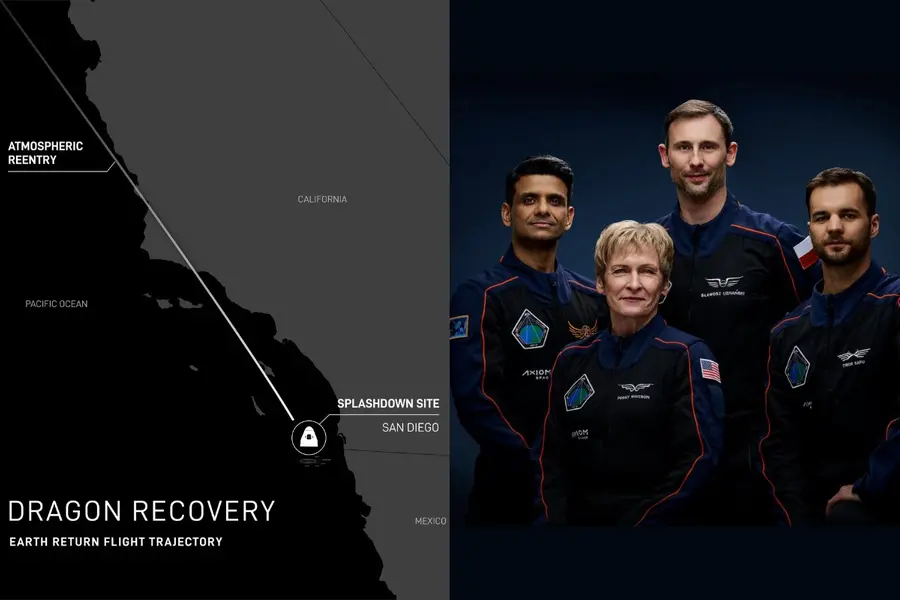
Houston: After nearly 20 days in space, including 19 days aboard the International Space Station (ISS), the Axiom Mission 4 (Ax-4) crew, led by Group Captain Shubhanshu Shukla, is on course to return to Earth today. The team is expected to splashdown off the coast of San Diego, California, at around 3 pm IST.
According to a post on X (formerly known as Twitter) by SpaceX, the crew, aboard its Dragon spacecraft are on track to re-enter the Earth's atmosphere, with their arrival to be announced with a "brief sonic boom" ahead of their splashdown in the Pacific Ocean.
"Dragon and the Axiom Space Ax-4 crew are on track to re-enter Earth's atmosphere and splash down off the coast of San Diego at ~2:31 a.m. PT tomorrow. Dragon will also announce its arrival with a brief sonic boom prior to splashing down in the Pacific Ocean," SpaceX stated.
The Dragon spacecraft, Grace, is carrying the four-member crew on a 22.5-hour return journey from the ISS.
The spacecraft undocked from the space-facing port of the ISS Harmony module at 4:45 pm IST on Monday. Both Axiom Space and NASA confirmed that the separation was successful, marking the beginning of the crew's journey back home.
In a mission update shared on its blog, NASA stated that the Dragon spacecraft is now gradually moving away from the station into an orbital path that will bring both the crew and cargo safely back to Earth.
Axiom Space, in its live session on X, noted that the Axiom-4 mission saw over 60 scientific studies and more than 20 outreach events.
The Ax-4 crew, comprising Commander Peggy Whitson, Pilot Shubhanshu Shukla of the Indian Space Research Organisation (ISRO), European Space Agency (ESA) project astronaut Slawosz "Suave" Uznanski-Wisniewski of Poland, and Hungarian to Orbit (HUNOR) astronaut Tibor Kapu, had been actively engaged in research and outreach activities aboard the ISS as part of the mission during the past 18-days.
As per NASA, the Dragon spacecraft will return to Earth with more than 580 pounds of cargo, including NASA hardware and data from over 60 experiments conducted during the mission.
ANI
Published: 15 Jul 2025, 11:16 am IST
Related Topics
Disclaimer: Kindly avoid objectionable, derogatory, unlawful and lewd comments, while responding to reports. Such comments are punishable under cyber laws. Please keep away from personal attacks. The opinions expressed here are the personal opinions of readers and not that of Mathrubhumi.
