
A humanoid robot named Flash stunned the world by completing the Beijing half marathon in 50 minutes, faster than the human record
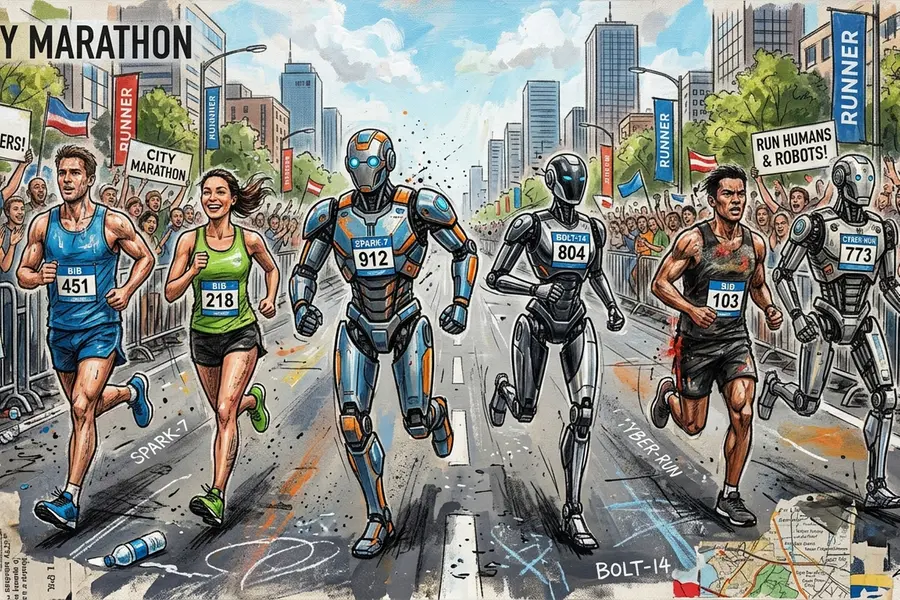
In a striking mix of technology and sport, a humanoid robot developed by a Chinese company made headlines on Sunday after completing a half marathon in a record-breaking time. The event, held in Beijing, saw robots and human runners sharing the spotlight in a unique race format.
The standout performer was ‘Flash’, a humanoid robot created by Shenzhen Honor Smart Technology Development Co Ltd. Competing in the 2026 Beijing E-Town half marathon, the robot finished the 21-kilometre course in just 50 minutes and 26 seconds.
This timing surpassed the existing human world record of 57 minutes and 20 seconds, as reported by official media. According to state broadcaster CCTV, Flash maintained an average speed of around 25 kilometres per hour while navigating the course autonomously.
For comparison, the current men’s half marathon world record was set by Ugandan long-distance runner Jacob Kiplimo at the Lisbon Half Marathon in Portugal last month.
The event brought together more than 100 teams from countries including China, Germany, France and Brazil. Robots raced alongside amateur human participants, highlighting rapid advancements in robotics and artificial intelligence.
Some of the robots demonstrated impressive agility, with movements resembling elite athletes such as Usain Bolt. Others displayed more basic levels of performance, reflecting varying stages of technological development.
Race format and rules
Although robots and human runners followed the same 21-kilometre route, they competed in separate lanes to maintain safety. For robotic participants, the maximum allowed completion time was set at three hours and 40 minutes, according to state-run Xinhua news agency.
This year’s event introduced two participation modes for robots. Teams could either operate their machines through remote control or rely on autonomous navigation systems.
Focus on autonomous technology
For teams using remote control, finishing times were adjusted by applying a multiplier of 1.2. Around 40 percent of participants chose autonomous navigation to improve their final results.
Liang Liang, deputy secretary-general of the Chinese Institute of Electronics, explained that this system encourages innovation. He noted that promoting autonomous navigation is key, as it forms the technological base for integrating humanoid robots into everyday life in the future.
Human winners of the race
On the human side of the E-Town half marathon, China’s Zhao Haijie secured the men’s title with a finishing time of one hour, seven minutes and 47 seconds. In the women’s category, Wang Qiaoxia claimed victory with a time of one hour, 18 minutes and six seconds.
The event offered a glimpse into how robotics is steadily moving from labs into real-world environments, blending competition with innovation in an entirely new way.
Published: 19 Apr 2026, 08:08 pm IST
Related Topics
Disclaimer: Kindly avoid objectionable, derogatory, unlawful and lewd comments, while responding to reports. Such comments are punishable under cyber laws. Please keep away from personal attacks. The opinions expressed here are the personal opinions of readers and not that of Mathrubhumi.
