
Indian researchers have developed a dental implant that combines titanium and zirconia in one integrated structure. The technology could simplify implant procedures, but further clinical testing is still needed.
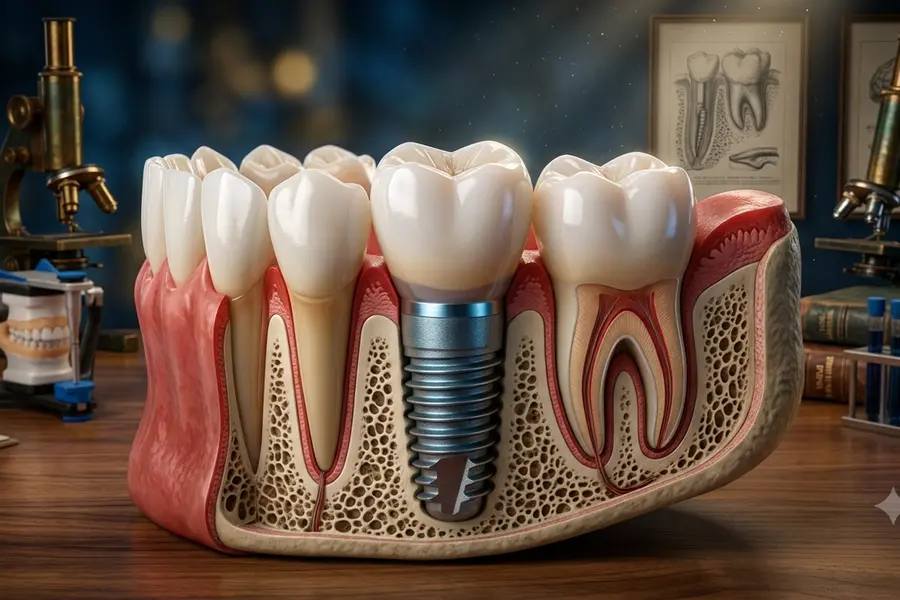
Indian researchers have developed a new type of dental implant that combines strong titanium and tooth-coloured zirconia into one integrated structure.
The design could reduce the number of surgical steps needed for some dental implant procedures, although it still requires further development and clinical testing.
Researchers at the International Advanced Research Centre for Powder Metallurgy and New Materials (ARCI) have developed a new bi-layered dental implant.
In simple terms, the implant combines two different materials in one structure:
- Titanium alloy (Ti6Al4V): used for the part designed to support and integrate with the jawbone.
- Yttria-stabilised zirconia (YSZ): used for the upper part, because it is strong, wear-resistant and has a tooth-like appearance.
The idea is to combine the strengths of both materials instead of using separate components.
ARCI is an autonomous institute under India's Department of Science and Technology (DST).
How are normal dental implants different?
A conventional dental implant generally has three main parts.
First is the fixture. This is placed into the jawbone and acts like an artificial tooth root.
Second is the abutment. It connects the implant fixture to the artificial tooth.
Third is the crown. This is the visible part that looks and functions like a tooth.
Because these parts are connected separately, there can be tiny movements at the junction between them.
These movements, known as micromovements, can potentially affect the process through which the implant becomes firmly integrated with the surrounding bone.
Traditional implants may also require more than one surgical procedure, depending on the treatment and clinical approach.
What is different about the new design?
The ARCI researchers have tried to reduce the number of separate components by creating a single integrated bi-layered structure.
Think of it as one implant made from two carefully joined materials.
The titanium section provides the strength needed around the jawbone, while the zirconia section is intended for the visible tooth region.
The researchers believe this design could reduce the complexity associated with connecting multiple implant components.
However, this does not mean that every dental implant procedure will automatically require only one surgery. The actual number of procedures depends on the patient's condition, treatment plan and clinical requirements.
Why use both titanium and zirconia?
Both materials are already important in dentistry, but they have different strengths.
Titanium alloy is strong and widely used in dental implants. It is suitable for applications where the material has to withstand substantial forces.
Zirconia is known for its tooth-like appearance and resistance to corrosion and wear, making it attractive for visible dental applications.
The researchers wanted to bring these properties together.
The challenge was finding a reliable way to join the two materials without creating cracks, gaps or weaknesses at the point where they meet.
How was the implant made?
The researchers used a manufacturing technique called Spark Plasma Sintering (SPS).
In simple terms, SPS uses controlled heat and pressure to turn powdered materials into a dense solid structure.
The researchers designed a special tapered graphite mould to help control the temperature during the process.
This was important because titanium alloy and zirconia require different conditions for sintering.
Using this approach, the researchers were able to manufacture the two materials together in a single processing step.
The resulting structure had a reported 99.5% density.
Did the two materials join properly?
According to the research findings reported by the Department of Science and Technology, testing showed a well-bonded boundary between the titanium and zirconia.
Researchers reported that they did not find:
- Cracks
- Separation between the layers
- Large pores
- Unwanted secondary phases
They also found no noticeable movement of elements from one material into the other across the interface.
This is important because a weak connection between titanium and zirconia could compromise the performance of the implant.
How strong is the new material?
Laboratory tests showed several promising mechanical properties.
The researchers reported:
- Hardness: up to 1,350 HV
- Compressive strength: about 1,550 MPa
- Flexural strength: about 310 MPa
According to PIB, these results were comparable to or better than those of some commercial implant materials.
These numbers describe how the material performed in laboratory testing. They do not by themselves prove how the implant will perform inside a human mouth over many years.
Was it tested for safety?
The researchers also carried out laboratory biological tests.
One test used L929 mouse fibroblast cells, which are commonly used in laboratory studies to assess whether a material has harmful effects on cells.
The researchers reported metabolic activity above 90% at all tested concentrations in the MTT test.
They also conducted a haemolysis test, which checks whether a material causes significant damage to red blood cells.
The reported results showed negligible red blood cell damage.
These findings support the material's biocompatibility in the laboratory tests performed.
Does this mean the implant is ready for patients?
Not yet. This is an important distinction.
The reported work demonstrates the development and laboratory testing of the bi-layered material and implant structure. It does not establish that the implant is already approved for routine treatment or ready for widespread use in dental clinics.
Further development and appropriate clinical testing in humans would be needed to establish its long-term safety and effectiveness.
Researchers are also still working on manufacturing-related challenges.
What manufacturing problem remains?
After producing the material, researchers used a five-axis CNC machine to shape it into the threaded form required for an implant.
They encountered some difficulties with moving the cutting tool along curved surfaces.
The researchers are working on optimising this process.
The fabrication method itself was reported to be highly reproducible, which the researchers say could make it suitable for future industrial-scale production.
Could this mean fewer surgeries?
Potentially, yes. The main idea behind the design is to reduce the complexity created by several separate implant components.
By integrating the materials into one structure, the approach could potentially reduce the need for some surgical interventions associated with conventional implant systems.
But the research does not establish that every patient receiving this implant would need fewer operations.
That would depend on future clinical evidence and the specific dental treatment involved.
Why is the research important?
Dental implants need to perform under demanding conditions.
They have to withstand chewing forces, remain stable in the jaw, interact safely with surrounding tissues and function in the moist environment of the mouth.
The new design attempts to address several of these requirements at the same time.
It combines:
- The strength of titanium
- The appearance of zirconia
- A stable connection between the two materials
- Laboratory-tested biocompatibility
- A potentially simpler implant structure
What could it mean for India?
The research is also significant from the perspective of India's domestic medical-device development.
The researchers have developed the material and manufacturing approach within an Indian government research institution.
If the technology passes further testing and eventually meets the necessary clinical and regulatory requirements, it could contribute to the development of domestically manufactured dental implants.
The researchers have also said that the manufacturing process has potential for scaling up.
The biggest difference is not simply the use of titanium or zirconia. Both materials are already used in dentistry.
The innovation lies in combining the two into a single bi-layered structure and developing a manufacturing process that produces a strong connection between them.
A successful implant needs more than high strength. It also needs a stable material interface and safe interaction with the body.
The ARCI research produced encouraging results in laboratory mechanical and biological tests. However, laboratory results are only an early stage of evaluating a medical device.
Long-term human studies would be needed to determine whether the implant remains stable in the jaw, withstands years of chewing forces and performs safely in actual patients.
The research has been published in the journal Materials Letters.
Published: 09 Sept 2026, 05:47 pm IST
ABOUT THE AUTHOR

Related Topics
Disclaimer: Kindly avoid objectionable, derogatory, unlawful and lewd comments, while responding to reports. Such comments are punishable under cyber laws. Please keep away from personal attacks. The opinions expressed here are the personal opinions of readers and not that of Mathrubhumi.