
Union Minister Ashwini Vaishnaw refutes IMF’s ‘second-tier AI power’ tag, citing India’s strong performance in AI penetration, talent, and across five key layers of AI architecture.
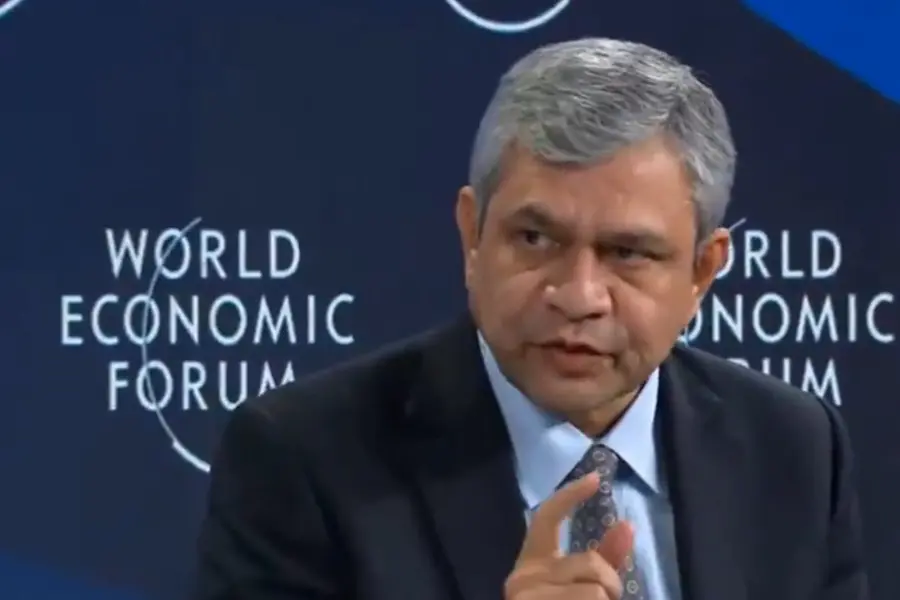
Union Minister for Electronics and Information Technology Ashwini Vaishnaw on Wednesday firmly pushed back against the International Monetary Fund’s (IMF) description of India as a “second-tier AI power”, questioning the framework used for such an assessment and maintaining that the country belongs among the leading nations in artificial intelligence.
His remarks came in response to comments made by IMF Managing Director Kristalina Georgieva during a World Economic Forum (WEF) panel in Davos, where India was placed in a secondary group of AI-capable countries. Vaishnaw said the categorisation did not reflect India’s actual position in the global AI ecosystem.
“I don't know what the IMF criteria has been, but Stanford places India as third in terms of AI penetration, in terms of AI preparedness, and in terms of AI talent,” the minister said, pointing to independent global benchmarks. He added that India’s approach prioritises broad adoption of artificial intelligence rather than limiting growth to scale alone.
“So our focus is very much on making sure that AI diffusion happens in a very big way,” he said, while underlining India’s progress across multiple areas. Referring to talent rankings, Vaishnaw added, “all the three, actually on AI talent it is number two, so I don't think your classification in the second bouquet is right. It's actually in the first.”
The minister explained that a country’s AI strength should not be measured through a single lens. Instead, he said capability must be assessed across five interconnected layers — architecture, applications, models, chips, infrastructure and energy.
Also Read | AI affects 40% jobs globally and 60% in advanced nations, IMF chief warns
“Actually, clearly in the first group, and the reason for that is there are five layers in the AI architecture. The application layer, the model layer, the chip layer, the infra layer, and the energy layer. We are working on all the five layers, making very good progress in all the five layers,” Vaishnaw said.
According to the minister, India’s strongest advantage lies in the application layer, where artificial intelligence can be deployed to solve real-world business problems and create measurable economic value.
“On the application layer, we will probably be the biggest supplier of services to the world,” he said, adding that enterprise operations can be better understood and tailored AI-driven solutions can be delivered through this approach. “That’s going to be the biggest factor of success or successful deployment of AI, because that’s where ROI (return on investment) comes from.”
Also Read | IBM CEO Arvind Krishna highlights need for India-led AI models and semiconductors at Davos
Vaishnaw also cautioned against equating AI leadership solely with the development of massive foundational models. He argued that real economic impact does not depend on building extremely large systems.
“ROI doesn’t come from creating a very large model. Ninety-five percent of the work can happen with models which are 20 billion or 50 billion parameters,” he said. India, he added, has already developed a range of such models that are now being rolled out across sectors to improve productivity, efficiency and technology usage.
Earlier at the Davos gathering, the IT minister also said that India continues to engage closely with major global economies across multiple areas, reinforcing its role in shaping the international technology landscape.
Published: 21 Jan 2026, 02:20 pm IST
Related Topics
Subscribe to our Newsletter
Disclaimer: Kindly avoid objectionable, derogatory, unlawful and lewd comments, while responding to reports. Such comments are punishable under cyber laws. Please keep away from personal attacks. The opinions expressed here are the personal opinions of readers and not that of Mathrubhumi.
