
Javier Tebas expressed the view that Gianni Infantino should leave as FIFA president, but doubted he would do so.
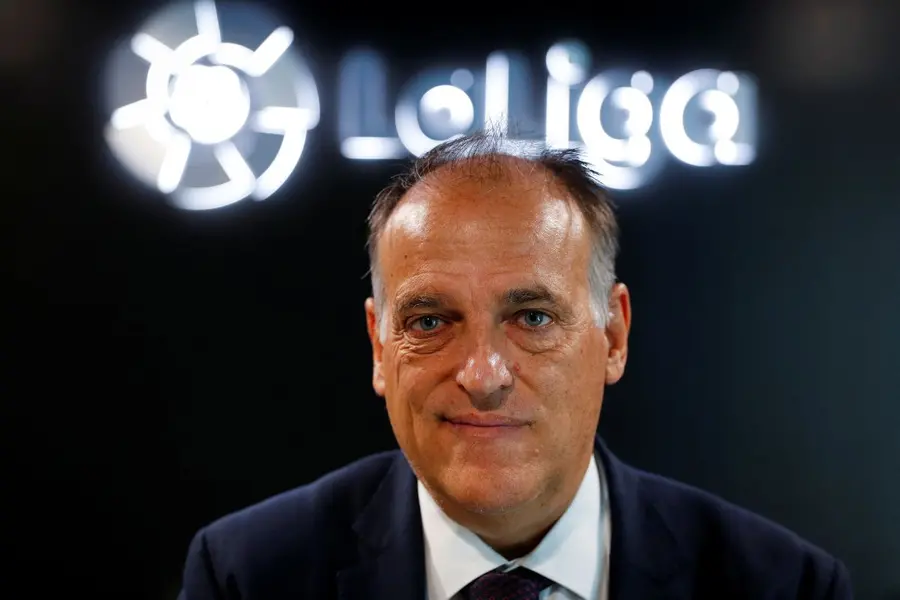
Lausanne: La Liga president Javier Tebas has renewed his criticism of FIFA president Gianni Infantino, saying the world football chief should step down for "destroying the football industry" by expanding international competitions.
Speaking to La Gazzetta dello Sport on Tuesday, Tebas reiterated his long-standing opposition to fixture congestion and criticised FIFA's consideration of a proposal to expand the 2030 FIFA World Cup from 48 to 64 teams.
"Increasing the number of national teams makes no sense. The football industry isn't just the World Cup, which is the most important event. But not everything can revolve around the World Cup," Tebas told La Gazzetta dello Sport.
He also questioned Infantino's continued leadership of FIFA.
"In my opinion, yes, I think his time is up," he said of Infantino. "However, he has the support of the system and the federations, so there's not much more to add, is there? There's no opposition candidate, nobody wants to stand just to lose. This is the system and it's rotten at its core.
Also read: FIFA World Cup: What Indian football must learn from Cape Verde's remarkable rise
"He shouldn't stay, but he won't leave. I've heard many people who are against Infantino. They say it, but then they do nothing. I don't know what's worse, the silence or the complicity, because those who stay silent are perfectly aware of the damage football is suffering."
Tebas' remarks come after South American football governing body CONMEBOL formally proposed increasing the number of teams in the 2030 World Cup to 64. The tournament is already set to be the largest in history, with six host nations across three continents.
"It's national competition that sustains this sport," Tebas added. "They are destroying the football industry, which generates tens of thousands of jobs, for an event that lasts 40 days and involves a minority of players."
The La Liga chief also criticised FIFA's handling of the recently concluded FIFA World Cup, particularly the introduction of hydration breaks and the decision to extend the half-time interval in the final from the usual 15 minutes to 27 minutes. Spain defeated Argentina 1-0 in the title clash.
FIFA introduced mandatory hydration breaks midway through each half to help players cope with summer temperatures in the United States, Canada and Mexico. However, critics argued that the stoppages disrupted the rhythm of matches and provided coaches with additional tactical opportunities.
"FIFA arranges things as it pleases, for what it wants, for its own interests - certainly not for football," Tebas said. "Hydration breaks are a lie. We have them in La Liga, but only when it's genuinely hot. Here, the pitches in Dallas, Los Angeles, and Atlanta had air conditioning. It was a lie - and just a break for advertising."
Also read: ‘The pain is immense’: Lionel Messi shares emotional message after World Cup final defeat
Infantino announced in April that he would seek a fourth term as FIFA president. The election for the 2027-2031 cycle is scheduled to take place on March 18 in Morocco.
Meanwhile, Football Supporters Europe (FSE), the fan organisation recognised by UEFA, also criticised FIFA's governance following the World Cup.
In a statement titled "A World Cup that failed supporters", the group called for "structural governance reforms to hand decision-making power back to the FIFA Council and Congress and ensure full consultation with clubs, leagues, players and supporters."
The organisation added: "The 2026 World Cup should have been a celebration of the game and the supporters who give it life. Instead, it has too often become a case study in what is so deeply wrong with football today.
"From the outset, supporters were asked to place their trust in FIFA and "chill", but it prioritised spectacle and commercialisation over the match-going experience with key elements of football's identity being messed with. Over the last month, we've seen football contorted to the whim of Gianni Infantino and the Trump administration."
The supporters' body further criticised what it described as "historically high ticket prices", "skyrocketing transportation costs, bending of rules and procedures, exclusion of swathes of the global population and a lack of transparent communication."
It concluded: "All this created an environment of confusion and distrust that has severely damaged the reputation of FIFA, the World Cup, and the integrity of football itself.
"The lessons from this World Cup are clear: FIFA is unfit to govern global football. The future of the game cannot rest in the hands of a man who has proven yet again that he puts financial and political interests ahead of the future of our game." (AP)
Published: 22 Jul 2026, 12:11 pm IST
Related Topics
Disclaimer: Kindly avoid objectionable, derogatory, unlawful and lewd comments, while responding to reports. Such comments are punishable under cyber laws. Please keep away from personal attacks. The opinions expressed here are the personal opinions of readers and not that of Mathrubhumi.
