
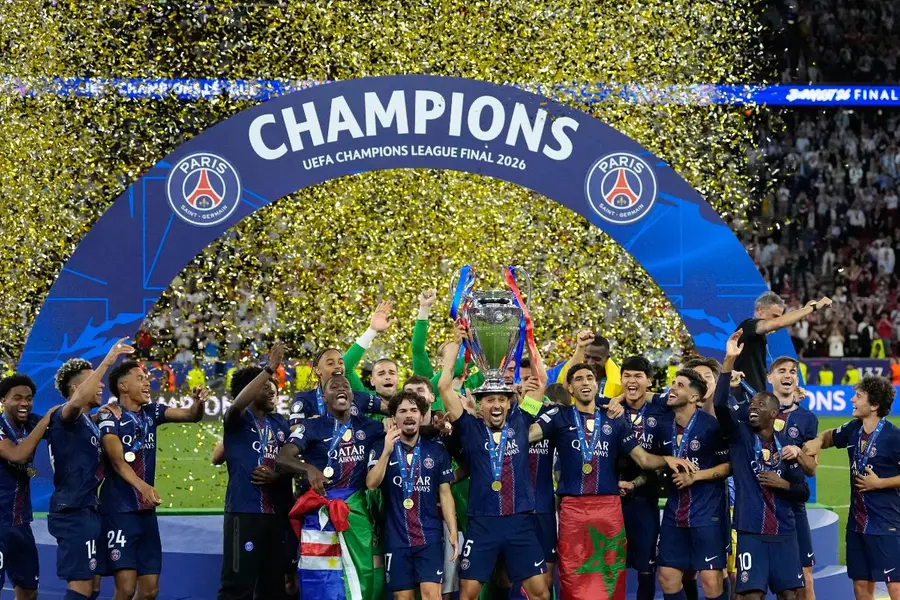
Paris Saint-Germain overcame an early setback and dominated large stretches of the UEFA Champions League final before edging Arsenal 4-3 on penalties in Budapest. Luis Enrique's side retained the European crown and cemented their status as the continent's new powerhouse.
A Champions League final can often be decided by a single moment, a controversial call or a missed penalty.
However, while Paris Saint-Germain ultimately needed a shootout to overcome Arsenal in Budapest, the broader story of the night was one of sustained dominance rather than narrow fortune.
PSG successfully defended their European crown with a dramatic 4-3 penalty shootout victory after a 1-1 draw at the Puskas Arena, becoming only the second club in the modern Champions League era after Real Madrid to retain the trophy.
Arsenal had threatened to script history of their own, but over 120 minutes the French champions consistently looked the more complete side.
Despite falling behind early to Kai Havertz’s sixth-minute strike, Luis Enrique’s team never appeared rattled.
They gradually took control of the contest, found an equaliser through Ousmane Dembele’s second-half penalty and eventually held their nerve when the final was settled from 12 yards.
PSG controlled the game long before penalties
The final scoreline may suggest an evenly matched contest, but the statistical picture told a different story.
PSG dominated possession with 74 per cent of the ball, registered 21 shots compared to Arsenal’s seven and generated significantly more attacking threat throughout the evening.
Arsenal’s game plan revolved around protecting their early advantage and restricting space, but PSG gradually found solutions to every defensive challenge placed before them.
The turning point came through tactical adjustments. As Arsenal clogged central areas and sat deeper, PSG altered their attacking structure.
Desire Doue drifted into more central positions while Dembele operated wider, creating new passing angles and stretching Arsenal’s defensive block. Joao Neves frequently dropped alongside Vitinha during build-up play, helping PSG bypass Arsenal’s pressing traps and maintain territorial control.
Fresh legs also made a difference. The introduction of Bradley Barcola added pace and directness against an increasingly fatigued Arsenal back line, creating several dangerous transition opportunities as extra time approached.
Perhaps most importantly, PSG looked like a team comfortable with the occasion. Having already won the competition a year earlier, they carried themselves with the confidence of champions.
Arsenal remained organised and disciplined, but PSG consistently appeared more assured in possession and more capable of dictating the tempo.
Vitinha and Neves ran the final
While PSG’s attacking stars grabbed headlines, the final was arguably won in midfield.
Vitinha delivered a masterclass in control and orchestration. The Portuguese midfielder seemed omnipresent, constantly demanding possession and ensuring PSG maintained pressure.
He finished with the highest totals for touches, completed passes, carries and progressive runs, becoming the central figure in PSG’s territorial dominance.
His ability to recycle possession and prevent Arsenal from launching dangerous counter-attacks proved invaluable.
Every time Arsenal appeared ready to break, Vitinha was there to slow the transition or restart another PSG attack.
Alongside him, Joao Neves produced another outstanding display. The 21-year-old covered enormous ground, disrupted Arsenal’s rhythm and contributed at both ends of the pitch.
His all-action performance included over 100 touches, impressive duel success rates and a constant presence in advanced areas despite operating primarily from midfield.
Together, Vitinha and Neves ensured PSG controlled the centre of the pitch for long stretches, forcing Arsenal to spend much of the evening defending rather than building sustained attacks.
Arsenal’s fine margins finally caught up with them
For much of the season, Arsenal have thrived on defensive resilience and meticulous game management. In Budapest, those strengths almost carried them to European glory.
Arteta’s side executed their plan effectively for long periods after Havertz’s early goal. They slowed the tempo, limited clear-cut opportunities and relied on David Raya’s excellent goalkeeping to keep PSG at bay.
Their disciplined defensive structure pushed the game into extra time and ultimately penalties.
However, the fine margins that often worked in Arsenal’s favour deserted them when it mattered most.
By the time the shootout arrived, several of Arsenal’s regular penalty takers had already been substituted. While Declan Rice, Gabriel Martinelli and Viktor Gyokeres converted confidently, Eberechi Eze dragged his effort wide before Gabriel Magalhaes blasted over the crossbar. PSG, by contrast, approached their penalties with greater composure and confidence.
The defeat will hurt Arsenal, particularly given how close they came to securing a first Champions League title.
Yet the final also highlighted the gap they still need to bridge. PSG were more dominant in possession, more influential in midfield and more composed under pressure.
On a night when history was within touching distance for both clubs, PSG ultimately showed why they remain Europe’s benchmark.
Their second consecutive Champions League triumph was not simply the result of a shootout victory: It was the reward for being the better team across the full 120 minutes.
Published: 31 May 2026, 10:06 am IST
Related Topics
Disclaimer: Kindly avoid objectionable, derogatory, unlawful and lewd comments, while responding to reports. Such comments are punishable under cyber laws. Please keep away from personal attacks. The opinions expressed here are the personal opinions of readers and not that of Mathrubhumi.
