
Notably, Suryakumar Yadav had left the decision to other players as a matter of personal choice, emphasising that individual discretion should guide interactions in the charged atmosphere.
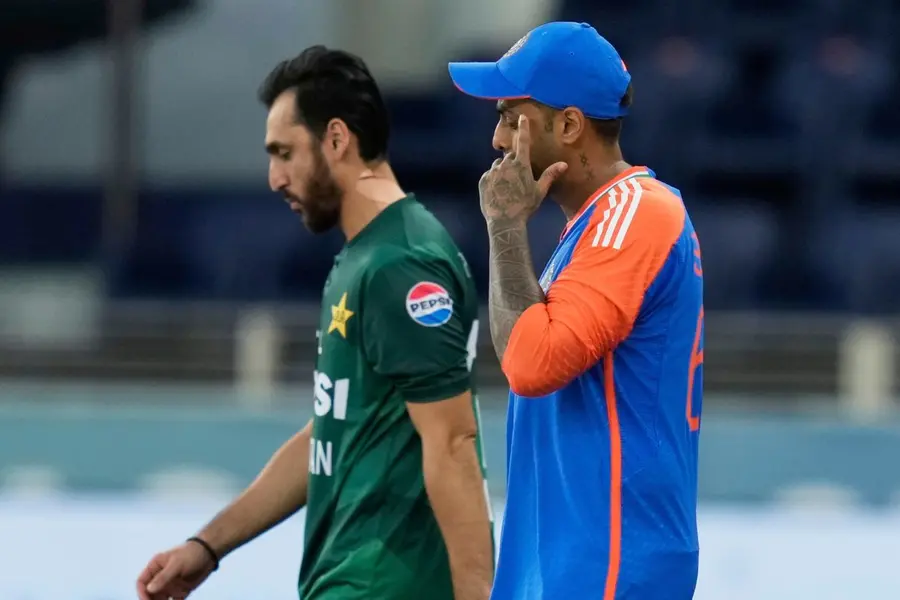
Dubai: The highly anticipated Asia Cup Group A match between India and Pakistan at the Dubai International Stadium unfolded under unusual circumstances, with tensions palpable both on and off the field.
As expected, both captains — India’s Suryakumar Yadav and Pakistan’s Salman Ali Agha — received enthusiastic roars from the half-filled stadium as they made their way onto the pitch. However, the customary handshake at the toss, a standard display of sportsmanship in cricket, did not take place. Instead, both skippers handed their team sheets to the umpires, paused briefly for the obligatory discussion with commentator Ravi Shastri, and returned to their respective dressing rooms without any formal gesture of camaraderie.
According to reports, Suryakumar Yadav had made a firm decision earlier that morning. Hours before the game, he informed the team that he would personally abstain from shaking hands with the Pakistani side. Importantly, he left the decision to other players as a matter of personal choice, emphasising that individual discretion should guide interactions in the charged atmosphere.
The backdrop to this unusual behaviour stems from heightened tensions following the recent Pahalgam terror attack, which claimed 26 lives. The Indian public’s outrage, coupled with retaliatory strikes by India, created a difficult scenario for players representing the nation. While the Board of Control for Cricket in India (BCCI) and the government had approved the game in Dubai, players were acutely aware that their actions would be scrutinised by millions at home.
Concerns within the Indian squad were addressed during a team meeting held a day prior to the match, according to assistant coach Ryan Ten Doeschate. Speaking at a pre-match press conference, he said: “It is actually something we addressed in the morning. We obviously are aware of the sentiments and the strong feelings. And Gauti’s (coach Gautam Gambhir) message has just been very professional, about not worrying about things that are not in our control.”
Ten Doeschate, a Dutch national and former international cricketer, further elaborated on the delicate balance the team had to maintain. “I have no doubt the players share the compassion and feeling of the vast majority of the Indian public. The Asia Cup was in limbo for a long period of time, and we were just waiting. We didn’t think we were going to be coming at one stage. But obviously, you know what the government stance is. Now the team, particularly the players, have to put their sentiments and emotions aside. Hopefully, the way we play can represent how we feel about the country,” he said.
The unusual atmosphere extended beyond the toss. Observers noted that the players from both teams conducted their warm-ups almost side by side but with minimal acknowledgement of one another. India carried out drills on one half of the pitch while Pakistan’s bowlers operated full tilt on the other side, creating an impression of mutual avoidance rather than pre-match engagement.
This subtle yet noticeable frostiness underscores the broader tensions enveloping this fixture, a game that always carries significant sporting and political weight. The Asia Cup encounter is more than just a cricket match; it has historically been a symbolic battleground, reflecting the delicate balance of rivalry and diplomacy between the two nations.
Inside the Indian dressing room, there was a clear message from leadership: focus on cricket, let emotions be secondary, and honour the country through performance. For the players, this meant compartmentalising personal and national sentiments while facing a formidable opponent in Pakistan.
Meanwhile, officials at the Dubai International Stadium maintained strict security measures throughout the day. Authorities emphasised crowd control, reflecting the sensitive nature of the fixture. Fans were reminded of strict protocols, with potential fines and other consequences for non-compliance, underlining the seriousness with which organisers approached the match.
While cricketing excellence remained the foremost priority, it was impossible to ignore the socio-political undercurrents shaping the encounter. Every run scored and wicket taken was inevitably viewed through the lens of recent events, adding a layer of intensity rarely seen in standard Group A fixtures.
For cricket purists, the focus remained on the game itself: the strategies, the performances, and the tactical acumen on display. Yet, for players and coaching staff alike, navigating the dual pressures of sport and national sentiment proved an intricate challenge.
As the toss concluded and play got underway, the match promised to be a test not just of skill, but of composure, patience, and professionalism. Both sides entered the contest with unchanged squads, reflecting confidence in their respective line-ups and an emphasis on continuity.
The India-Pakistan rivalry, already intense due to cricketing history, took on an additional dimension this time around — one coloured by recent geopolitical events and the weight of national expectation. Players on both sides had to strike a careful balance between representing their nations proudly and respecting the complex emotional climate surrounding the fixture.
With the game underway in Dubai, spectators and analysts alike watched closely, aware that this clash was about far more than cricket. It was an encounter that demanded tactical brilliance on the field while simultaneously navigating the storm of emotions off it — a vivid reminder of how deeply sport can intersect with society and politics.
Published: 14 Sept 2025, 08:39 pm IST
Disclaimer: Kindly avoid objectionable, derogatory, unlawful and lewd comments, while responding to reports. Such comments are punishable under cyber laws. Please keep away from personal attacks. The opinions expressed here are the personal opinions of readers and not that of Mathrubhumi.
