
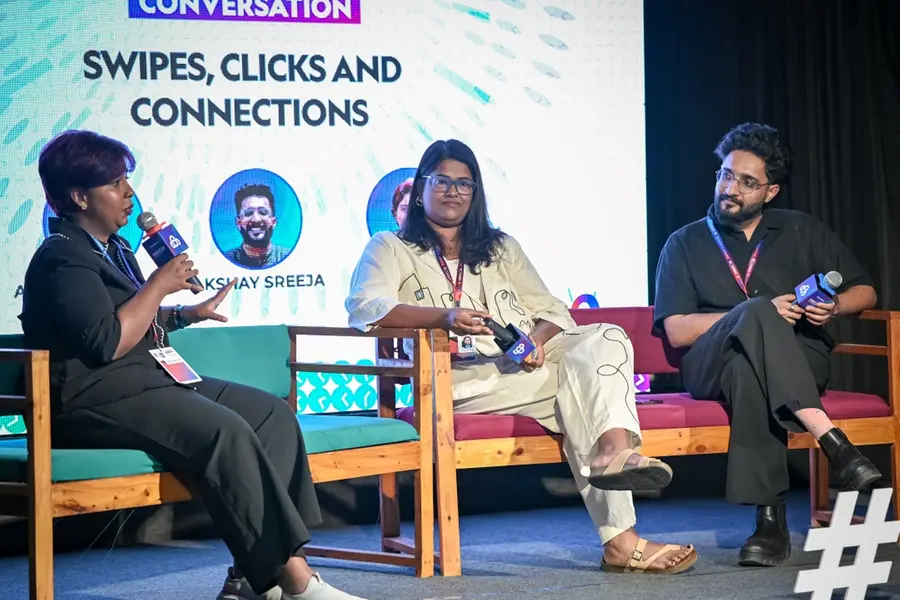
The sixth edition of the Mathrubhumi International Festival of Letters witnessed a fruitful session between Aiswarya S Nair, a PhD scholar specialising in cultural narratives and sociopolitical ideologies and poet, writer, and spoken word artist Akshay Sreeja. The session titled 'Swipes, Clicks and Connections' was moderated by Anaswara Varghese.
Defining love is deeply personal and often one of the most subjective aspects of human thought. The session began by exploring the panelists' perceptions of love.
"The idea of love is unique for everyone, and if I dare to define it, it would be an injustice," said Aiswarya. Love depends on who you are -- if you are a romantic poet, you may seek something deep and intense, whether in nature, childhood memories, or even certain smells and sounds. For Akshay, love was a far more complex concept.
The discussion delved into the traditional structures of relationships, the established norms of companionship, and the patriarchal setup of "finding the one." The conversation then shifted to Gen Z's modern perspective on relationships.
The evolution of romantic interactions -- from love letters and landline conversations to swiping right on a stranger in a dating app -- reflects a significant cultural shift. Aiswarya, identifying as a millennial, noted that her generation was the first to actively push against traditional relationship norms. Akshay, on the other hand, argued that this "revolution" is happening primarily in the East, where arranged marriages have long been the norm. In the West, choosing one's own partner has been normalised for ages.
Aiswarya shared a personal anecdote. During her college days, she experienced a silent, mutual attraction with a stranger she frequently saw on the bus. At that time, acknowledging such a connection would have been taboo. Fast forward to today, she runs a YouTube channel where she openly discusses her dating experiences. This shift highlights how Gen Z has embraced dating platforms as a legitimate means of forming connections.
The panelists explored emerging dating concepts such as situationships, love bombing, breadcrumbing, ghosting, and vibing from different perspectives.
Consent was emphasised as the foundation of all relationships. Having an open discussion about where one stands in a relationship is crucial. Akshay pointed out that situationships are often viewed negatively on social media, but as long as they remain non-toxic, they can provide a space for mental peace and companionship.
A key point raised was the concept of "ethical dating" -- standing firm in one's individuality and being transparent about one's intentions.
Traditional matrimonial sites prioritise criteria such as religion, caste, and financial status -- factors usually determined by parents. In contrast, dating apps offer a more personalised experience, allowing users to connect based on shared interests and personalities. The swiping culture has made the process of finding compatible partners easier and more efficient.

However, Indian dating apps often frame dating as a stepping stone to marriage, reinforcing societal expectations. In India, dating is still largely associated with hookup culture, which prevents it from gaining broader social acceptance. Until about 10-15 years ago, even questioning marriage was controversial. The lingering mindset -- "Why date someone if you don’t intend to marry?" -- reflects these entrenched societal norms.
Dating apps have also provided safe spaces for marginalised communities to find meaningful relationships that may not be possible in traditional settings. However, the Indian dating market still largely promotes monogamy-as seen in a popular dating app’s slogan: "Find the perfect partner and delete the app."
Another major discussion point was the rise of gamophobia (fear of marriage) and philophobia (fear of emotional attachment) among Gen Z. Aiswarya and Akshay both shared personal experiences, explaining why they, too, fall into this category. Aiswarya argued that marriage, as a patriarchal institution, places the burden primarily on women. She called for a shift in perspective -- towards equal partnerships rather than traditional marital roles.
Akshay, raised by a single mother, viewed marriage as a construct designed primarily for family formation. He believes gamophobia is a valid reaction to societal pressures. Many people fear marriage because they are moving away from rigid traditions and questioning its necessity.
The conversation also touched upon how women face disproportionate scrutiny in relationships, especially after divorce. The fidelity and chastity of marriage are often tied to women, making them the target of blame in case of separation.
The panelists unanimously agreed that the traditional system of marriage, with its restrictive structures, often leads to infidelity. Dating apps, by contrast, offer new ways of understanding relationships, allowing individuals to explore connections that align with their personal definitions of love and commitment.
Education and financial independence have enabled individuals, especially women, to choose solitude over forced companionship. Relationships should be a matter of personal choice, free from societal intervention.
Dating apps provide a degree of anonymity, allowing users to explore different kinds of relationships
One of the concluding points of discussion was the future of dating apps. The taboo surrounding dating apps -- especially among older generations -- will likely diminish as Gen Z ages into adulthood and eventually into seniority. As dating apps become more inclusive, they will serve as platforms that celebrate diversity and individuality.
The session was an open forum for discussing individuality, relationships, and online dating. In a digital era where technology shapes social interactions, conversations like these help in understanding both the necessity and potential pitfalls of dating apps. The engaging discussion between the panelists made the session insightful and thought-provoking.
Published: 07 Feb 2025, 08:56 pm IST
Related Topics
Disclaimer: Kindly avoid objectionable, derogatory, unlawful and lewd comments, while responding to reports. Such comments are punishable under cyber laws. Please keep away from personal attacks. The opinions expressed here are the personal opinions of readers and not that of Mathrubhumi.