

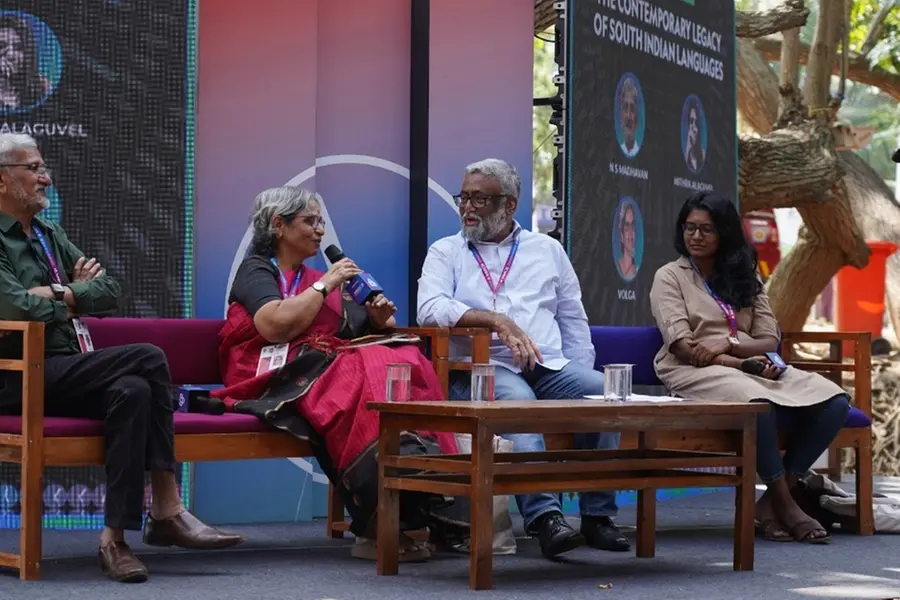
The third day of the Mathrubhumi International Festival of Letters (MBIFL) 2025 saw a thought-provoking discussion on 'The Contemporary Legacy of South Indian Languages'. The session featured esteemed writers N S Madhavan, B Jayamohan, and Volga, moderated by Satheesh Chapparike. The discussion navigated through the historical evolution, literary contributions, and challenges faced by South Indian languages in a rapidly globalizing world.
The literary depth of South Indian languages
Opening the session, moderator Satheesh underscored the rich literary heritage of South Indian languages -- Malayalam, Tamil, Kannada, and Telugu -- and their unique contributions to global literature. He noted that despite their deep cultural and historical roots, these languages still strive for greater global recognition.
- Malayalam: A young yet dynamic literary tradition
N S Madhavan reflected on Malayalam literature’s journey, describing it as relatively young compared to other Indian languages. "Modern Malayalam literature, as we read today, is only five to six centuries old. The first novel, Indulekha, was published in the 19th century, and Chemmeen by Thakazhi Sivasankara Pillai made waves in world literature when it appeared on The New York Times bestseller list for 40 weeks."
Madhavan highlighted the literary boom of the 1950s and 60s, which produced legendary writers like M T Vasudevan Nair, O V Vijayan, and Uroob. However, he lamented the slow recognition of Malayalam literature on the global stage due to late translations.
"O V Vijayan’s Khasakkinte Itihasam was published the same year as One Hundred Years of Solitude, yet it took decades for Vijayan’s work to gain international recognition."
He also emphasized the strong bond between Malayalam literature and cinema, noting that the two industries have significantly influenced each other.
- Telugu: A literature of resistance and progressivism
Volga provided an in-depth analysis of Telugu literature, tracing its roots in dissent and progressive thought. She cited poets like Mananu, Pothana, and Molla, who defied royal patronage and wrote for the people. She also highlighted the 17th-century poet Veeramun, who challenged caste oppression and religious orthodoxy through thousands of verses.
"Few outside Telugu literary circles know about Veeramun, despite his immense contribution as a social critic."
Volga also detailed the rise of feminist and Dalit voices in Telugu literature, particularly from the 1980s onwards.
"When women began writing about their own bodies and experiences, male critics dismissed their work as ‘blue poetry.’ In response, women poets banded together and published Neela Meghalu, the first feminist poetry anthology in Telugu literature."
She noted that contemporary Telugu literature is witnessing an influx of Dalit and transgender voices, making it a powerful medium of social change.

- Tamil: One of the world’s oldest literary traditions
B Jayamohan spoke about the richness of Tamil literature, one of the oldest literary traditions in the world.
"Tamil boasts Tolkappiyam, an ancient grammar text that dates back over 2,000 years. Sangam literature offers timeless reflections on war, love, and daily life."
He acknowledged the contributions of contemporary Tamil writers like Jeyamohan, Charu Nivedita, and Perumal Murugan, who continue to push boundaries in fiction and poetry.
"Jeyamohan has written the world’s longest novel, spanning 26 volumes and 23,000 pages. Yet, his name is still not as globally recognized as it should be."
Jayamohan also noted that while Tamil literature is thriving, its influence on mainstream Tamil cinema is still growing, unlike the deeply intertwined relationship between Malayalam literature and cinema.
- Kannada: A flourishing literary boom
While there was no dedicated Kannada representative, moderator Satheesh Chapparike highlighted Kannada literature’s golden era between the 1960s and 1990s, which saw the rise of figures like U R Ananthamurthy, Girish Karnad, and Shivaram Karanth.
"Unlike Malayalam, where literature influences both parallel and mainstream cinema, Kannada’s literary impact has been limited primarily to art-house films."
The road ahead
A crucial discussion point was why South Indian literature has not achieved the same global reach as South Indian cinema. Volga pointed to a key reason:
"Cinema has financial backing. A hit Malayalam film gets its remake rights sold to Telugu or Tamil producers. Literature lacks that level of commercial investment, so translations happen slowly."
Satheesh offered a hopeful perspective. He said, "There is growing international demand for South Indian literature. Institutions like the University of Chicago are setting up translation departments dedicated to South Asian languages. The future looks promising."
Another audience question touched on the role of AI in literature. N S Madhavan expressed cautious optimism:
"AI-driven language models will alter the way we write and translate literature. While it offers new opportunities, it also risks eroding linguistic and historical nuances."
The discussion concluded with all panelists agreeing that South Indian literature is experiencing a renaissance, driven by fresh voices, increased translation efforts, and growing global recognition.
Published: 09 Feb 2025, 02:07 pm IST
ABOUT THE AUTHOR
Disclaimer: Kindly avoid objectionable, derogatory, unlawful and lewd comments, while responding to reports. Such comments are punishable under cyber laws. Please keep away from personal attacks. The opinions expressed here are the personal opinions of readers and not that of Mathrubhumi.