
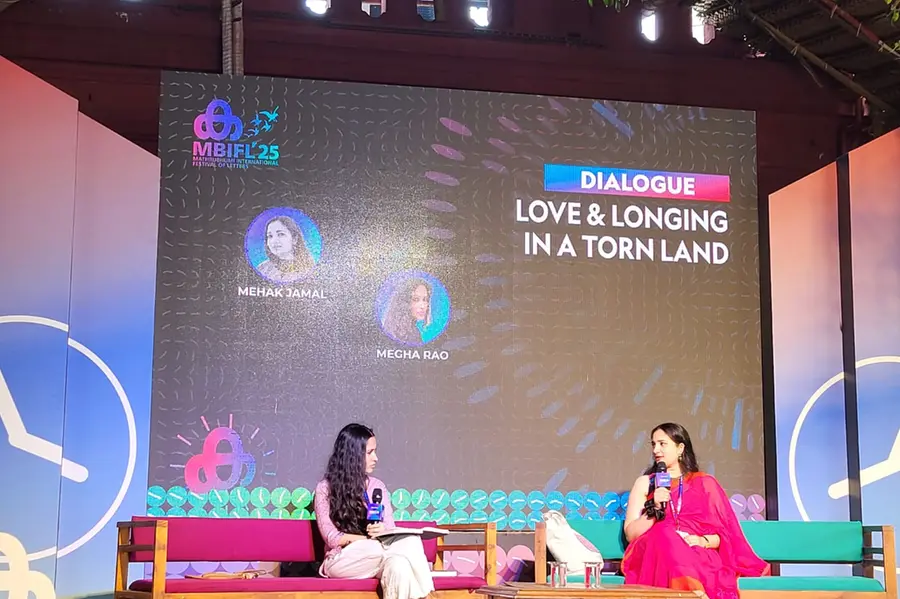
Kashmir, a land of breathtaking mountains, valleys, and springs, remains a lingering issue between nations. While it is often defined by land of conflict in public narratives, Mehak Jamal, a Kashmiri writer and filmmaker, seeks to explore a different side of her homeland in her debut book, 'Loal Kashmir: Love and Longing in a Torn Land'. The book delves into the untold stories of love and yearning in Kashmir, beyond the political turmoil. The session discussing her work was moderated by Megha Rao, a poet and surrealist artist.
Born and raised in Srinagar, Mehak has always been passionate about telling stories from her homeland. Reflecting on her experiences, she shared, "I was born and brought up there, and while I got the opportunity to study outside Kashmir, the questions I faced were extreme. Either people would ask about the beautiful landscapes, or they would ask things like, 'Are there schools over there?’ People only associate Kashmir with conflict, but I wanted to portray the love and longing in that land. That’s why I wrote the book."
She emphasized that the book is based on real-life stories, stating that she was not trying to shift focus away from the conflict but rather to narrate the many other lived experiences of Kashmiris.
Kashmir has a rich history of romantic poetry, yet literature from Kashmiri natives remains scarce, especially in the realm of fiction. Despite Urdu being one of the region’s prominent languages, translations of Kashmiri literary works into English are rare.
Mehak also discussed the long-lasting impacts of the abrogation of Article 370, noting that many people across India remain unaware of its significance. She went to state that freedom of speech was severely curtailed, with journalists being imprisoned. She highlighted the importance of using the term 'India-administered Kashmir', emphasizing that she is now in a position to advocate for its broader adoption. She spoke about how months of schooling were lost, multiple academic years were disrupted, and dissenting voices were silenced. She expressed concerns about the loss of forest lands due to private land occupations post-Article 370 abrogation. She remarked, "They wanted Kashmir, not Kashmiris." While tourism has flourished, people admire the region’s handicrafts and culture without truly understanding how Kashmiris live and love.
She also shared a bittersweet truth about the Pheran, a traditional Kashmiri garment. She explained that the Pheran has become a symbol of resistance because its loose fit makes security forces suspicious that something might be hidden underneath. Kashmiri people are often discouraged from wearing it, making it not just a cultural attire but an act of defiance.
She also criticized right-wing politics, recalling a particularly offensive remark made after the abrogation: “Now we can marry fair Kashmiri girls.” She condemned such statements as deeply problematic. Furthermore, she lamented about the Prime Minister’s "forced promotion of yoga" near Dal Lake, where people were allegedly compelled to participate under the threat of job termination.
Mehak also spoke about the challenges she faced while writing the book. "I got an agent and a publisher, but they told me I needed releases from the people whose stories I included. I hadn’t thought of that," she admitted. She added that she lost many stories because people later changed their minds out of fear.
When asked why she chose to write a book instead of making a film, given her background as a filmmaker, she responded, "I found writing a book was better. I felt I couldn’t do total justice to the subject through a film, but eventually, one could be made." She also pointed out that Kashmir is often misrepresented in Bollywood, where Kashmiris are portrayed as either "good" or "bad," with no middle ground.
Films set in Kashmir often use its landscapes as a picturesque backdrop while focusing primarily on war and conflict, particularly in movies from the 1990s to the 2000s. Even recent films like 'The Kashmir Files' have been polarizing in nature. Though she enjoyed 'Pathaan', she admitted that its premise threw her off.
Mehak also spoke about stepping outside her comfort zone by experimenting with dark genres, mentioning 'Bad Egg' -- a work completely different from her character and personality. She clarified, "After all, they are just fictions; they do no harm."
One of her favorite stories from the book, 'Love Letter', follows a character named Javed. She shared several interesting narratives from her book, each shedding light on the deep emotions and lived realities of Kashmiris beyond the lens of conflict.
Published: 09 Feb 2025, 10:28 pm IST
Related Topics
Disclaimer: Kindly avoid objectionable, derogatory, unlawful and lewd comments, while responding to reports. Such comments are punishable under cyber laws. Please keep away from personal attacks. The opinions expressed here are the personal opinions of readers and not that of Mathrubhumi.
