

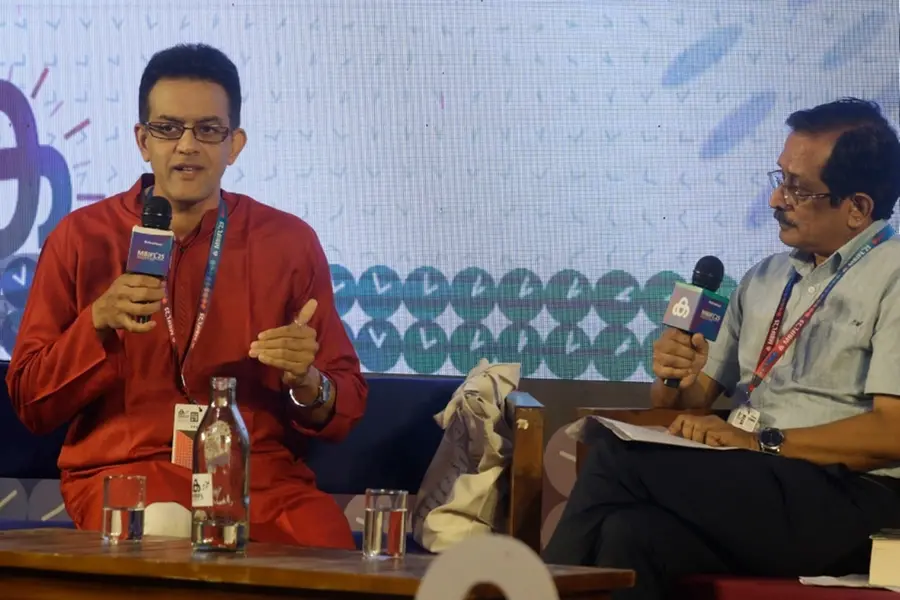
Historian Vikram Sampath and Professor S Nagesh took the stage at the Mathrubhumi International Festival of Letters (MBIFL) 2025 for a thought-provoking discussion on Tipu Sultan, one of the most polarising figures in Indian history. The session, titled 'The Curious Case of Tipu Sultan', delved into his military strategies, political ambitions, and the controversies surrounding his rule.
Sampath, known for his rigorous archival research, challenged mainstream historical narratives, shedding light on aspects often overlooked. His work, based on original documents, avoids mass interpretation and instead presents primary sources for readers to draw their own conclusions. The discussion also touched upon Sampath’s book, Tipu Sultan: The Saga of Mysore's Interregnum (1760–1799), which provides an in-depth exploration of Tipu’s rule based on archival sources.
A leader or a tyrant?
Tipu Sultan, the 18th-century ruler of Mysore, has been viewed in vastly different shades -- some hail him as a visionary military strategist, while others see him as a ruthless oppressor. His battles against the British, his diplomatic manoeuvres with the French and the Ottoman Empire, and his military innovations, particularly the use of Mysorean rockets, make him a complex historical figure.
However, Sampath emphasised that his ambition went beyond the resistance against colonial rule. His aspirations were not merely nationalistic but deeply intertwined with personal power struggles and religious motivations.
"He constantly sought legitimacy, sending appeals to the Mughal emperor and even the Ottoman Caliph, portraying himself as the true Muslim ruler of Hindustan."
Tipu's governance also sparked debates about religious persecution and forced conversions. His own letters, meticulously studied by Sampath, reveal troubling instances of violence.
“In his own words, he describes sending his commanders to Malabar, boasting about converting thousands and destroying churches and temples.”

A legacy written in blood?
One of the most harrowing episodes discussed was the massacre of the Mandayam Iyengar community. According to historical records, Tipu lured 700 men, women, and children to a temple under false pretences, only to have them trampled to death by elephants. The trauma of this event remains, as Sampath pointed out:
"Even today, 250 years later, the Mandya Iyengar community does not celebrate Diwali on the same day as the rest of India. They observe it as a day of mourning."
Similarly, thousands of Christians in Mangalore and Kodavas in Coorg faced forced conversions and exile under Tipu’s rule. Captured communities were marched for hundreds of kilometres, many perishing along the way.
"Not only the living prisoners, but even the dead were to be converted," Sampath quoted from Tipu’s orders, underscoring the brutality of his campaigns.
The British view of Tipu Sultan
Interestingly, despite being one of the fiercest challengers to British expansion in India, Tipu was not demonised in British records to the extent one might expect. In fact, British accounts praised his military acumen.
Even after his death in 1799, Tipu fascinated the British public. His personal artefacts, including a mechanical tiger mauling a British soldier, were taken to England, displayed as curiosities rather than symbols of an enemy’s downfall.
Rewriting history?
The discussion took an introspective turn when audience members asked about the politicisation of historical figures. Sampath acknowledged that history is often used as a tool for contemporary agendas, but emphasised the importance of archival research over ideological bias.
"My role as a historian is to illuminate the archives and present the truth as it is, based on documented evidence. Everything in history needs to be backed by references -- anything beyond that is political noise," he said.
He also addressed the distortion of temple destruction narratives, stating that while some temples received grants under Tipu’s rule, others were demolished for strategic or ideological reasons.
"The deeper one delves, the more layers emerge. Sometimes grants were given for appeasement, sometimes for superstition. But that does not negate the extensive destruction that took place," Sampath said.
Tipu Sultan remains a deeply divisive historical figure, one whose legacy continues to spark debate and controversy. Sampath’s discussion at MBIFL 2025 brought forward a nuanced, evidence-based approach, highlighting both his strategic brilliance and his undeniable brutality. Whether seen as a freedom fighter, an ambitious usurper, or a ruler with a violent vision, one thing is certain -- Tipu Sultan's legacy is far from settled.
MBIFL 2025 continues to foster debates that challenge historical perspectives and encourage deeper engagement with India's past. The event is taking place at Kanakakunnu, Thiruvananthapuram, from 6th to 9th February 2025.
Published: 07 Feb 2025, 01:47 pm IST
ABOUT THE AUTHOR
Disclaimer: Kindly avoid objectionable, derogatory, unlawful and lewd comments, while responding to reports. Such comments are punishable under cyber laws. Please keep away from personal attacks. The opinions expressed here are the personal opinions of readers and not that of Mathrubhumi.