

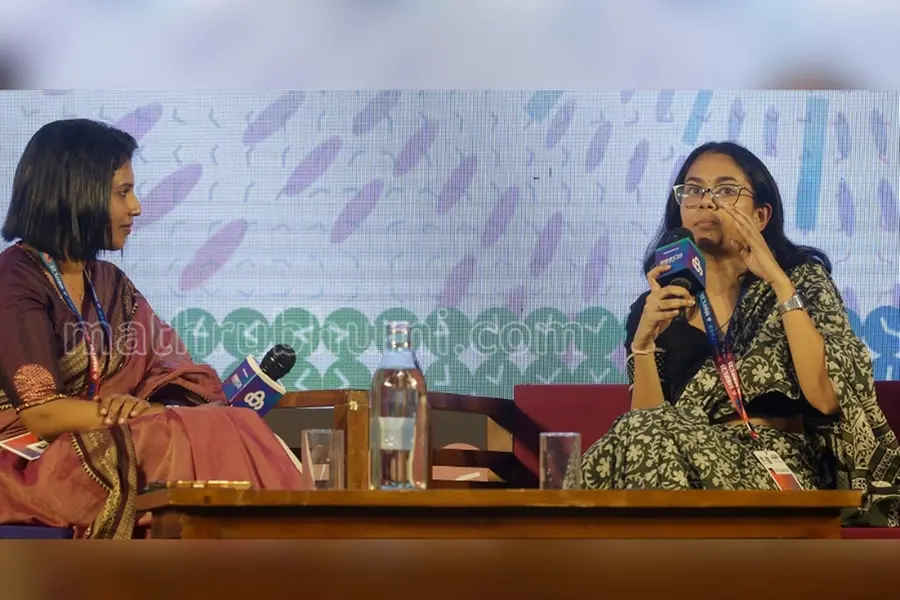
The Mathrubhumi International Festival of Letters (MBIFL) 2025 has consistently provided a platform for critical discussions that shape the socio-political landscape of our time. At MBIFL 2025, a compelling session titled 'Can Campus Politics Change the Nation?' featured Aishe Ghosh, former JNU Students’ Union President, and media personality and former student activist Amrutha Satheesan. The discussion delved into the role of student activism in shaping democracy, resisting political suppression, and fostering critical thinking among the youth.
Role of student movements in the society
Historically, student activism has been at the forefront of societal change. From the Indian freedom struggle to contemporary movements against authoritarian policies, student leaders have played a crucial role in shaping public discourse. Highlighting the power of student movements, Aishe Ghosh said, "Why is student politics or campus politics not discussed often? Not just politics, but why is the role of the student community as a whole -- as a contributing force in society -- not given enough attention? Historically, student movements have shaped not just campuses but the world around them. They have helped young minds understand, process, and react to the realities of their time."
Amrutha Satheesan echoed this sentiment, emphasising that universities must be spaces for debate, dissent, and critical engagement. "The role of students is not just to acquire degrees. If our education does not help us analyse society, question laws, and engage with democracy, then what is its purpose," she asked.

The targeting of educational institutions
A key issue discussed was the increasing suppression of student activism in India and across the world. Educational institutions are being targeted through administrative controls, fee hikes, and ideological influences. According to Ghosh, this is a deliberate attempt to depoliticise students and weaken democratic discourse:
"A growing sentiment of indifference is being cultivated inside campuses. The student movement has always been the binding glue that connects us to society, ensuring we do not remain indifferent. If students stop engaging in political discourse, who will," Ghosh asked.
She also spoke about the structural inequalities in education, where only certain sections of society have access to resources, opportunities, and representation. She explained, "We saw that education belonged to a particular class, a particular dominant caste. And when that realisation set in, student movements mobilised to demand justice, inclusion, and fairness within our institutions."
Ghosh also highlighted how student activism is not just a national issue but a global concern, citing the recent bombings of Palestinian universities. She asked, "Why should we, as students, care about what happens in another country? Because movements are about solidarity. The attack on students anywhere in the world is an attack on education and democracy itself."
The importance of political awareness among students
The discussion stressed the importance of students being aware of socio-political issues and their legal rights. Using the Citizenship Amendment Act (CAA) protests as an example, Ghosh said: "Why should students care about the Citizenship Amendment Act? Why should we understand what CAA or NRC means? Because when we start discussing these issues, we realise what is happening inside society. We question whether these laws align with the principles of democracy and the Constitution."
Amrutha Satheesan further agreed that politically aware students create a stronger democracy. She said, "A campus without political engagement is a campus without life. The student movement has always been about creating spaces where we can debate, challenge ideas, and shape our understanding of the world. If these spaces disappear, we are left with institutions that train students to obey rather than think."

The road ahead: Reclaiming campus spaces
The session concluded with a call for students to reclaim their campuses as spaces for free thought, dialogue, and activism. Addressing those who claim to be “apolitical,” Ghosh stated: "Being apolitical is also a political stance. It means accepting the status quo. If you do not question injustice, you are complicit in it."
In response to a question from the audience about how the descendants of prominent leaders often get more exposure in political careers while many student leaders drop out of active politics, Amrutha Satheesan said, "I was not born into a political family. As the first person in my family to step into active politics as a student, it was entirely my choice. And I have two children who have the freedom to choose their own paths. They can decide their politics, their religion, their views, and their lives. Even at just 10 and 5 years old, they are among the most politically aware people I have seen."
Published: 07 Feb 2025, 07:27 pm IST
ABOUT THE AUTHOR
Disclaimer: Kindly avoid objectionable, derogatory, unlawful and lewd comments, while responding to reports. Such comments are punishable under cyber laws. Please keep away from personal attacks. The opinions expressed here are the personal opinions of readers and not that of Mathrubhumi.