
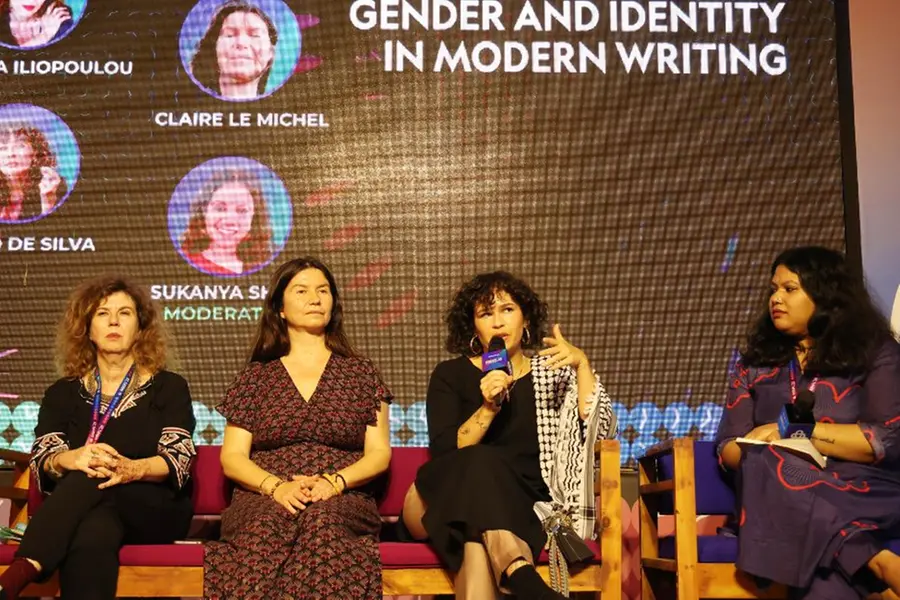
The sixth edition of the Mathrubhumi International Festival of Letters (MBIFL) buzzed with intellectual energy as a panel of acclaimed writers explored the intricate intersection of gender and identity in modern literature. The session on 'The Intersection of Gender and Identity in Modern Writing', moderated by Sukanya Shaji, featured Katerina Iliopoulou, Claire le Michel and Saraid de Silva, each bringing unique perspectives to the discussion.
Katerina, a distinguished poet and translator, opened the conversation by emphasising the intimate connection between language and identity.

"Translation is an act of love," she declared, reflecting on her work with the complex and often intertwined legacies of Sylvia Plath and Ted Hughes. She argued that art is deeply rooted in social, political, and economic realities, shaping the stories we tell and how we tell them.
Katerina emphasised the power of storytelling to illuminate the unique experiences of individuals, carrying their emotions and histories across cultures and time.
Claire, a writer and academic, explored the healing potential of poetry and its connection to the living world. "I am a healer," she shared, explaining how poetry allows her to explore beyond conventional boundaries, connecting with herself and other beings.
She spoke of the heart's capacity for multifaceted thinking, embracing diverse perspectives, whether human, animal, or other. Referencing Marina Tsvetaeva, Claire highlighted the duality of the heart. She also posed a crucial question about the relationship between art and politics: "Art is connected with politics, but the question is, with what politics?"
Claire stressed the importance of artistic integrity, urging writers to remain true to themselves, much like looking in a mirror or immersing oneself in a book.
Saraid brought a vital perspective on the reader's experience, asserting that 'reading fiction is like an experience'. She raised the question of whether art should be exempt from political analysis, sparking a lively debate.
Saraid also shared insights into her own work, including her novel 'Amma', discussing the interwoven themes and ideas that drive her storytelling. She noted the statistical trend of women consuming more fiction than men, suggesting that women possess a particular curiosity and insight into human nature. "Women have a curiosity about people, especially people," she observed.
The discussion further delved into the power of fiction to cultivate empathy. Katerina emphasized the role of storytelling in disseminating art and addressing intergenerational trauma, particularly as it relates to gender. Claire underscored the emotional resonance of fiction, stating that it “touches your feelings”.
The panel explored the nuances of gender dynamics in both the creation and consumption of literature. Saraid pointed to the statistically validated observation that women tend to read more fiction, while men often gravitate towards non-fiction. This led to a broader conversation about the different ways men and women engage with stories and the insights they seek from them.
The MBIFL session provided a platform for a thought-provoking exploration of gender, identity, and the enduring power of storytelling. The panelists’ diverse perspectives enriched the conversation, offering valuable insights into the complex relationship between literature and the human experience. The event was a reminder of the crucial role that writers play in shaping our understanding of ourselves and the world around us.
Published: 06 Feb 2025, 08:03 pm IST
Related Topics
Disclaimer: Kindly avoid objectionable, derogatory, unlawful and lewd comments, while responding to reports. Such comments are punishable under cyber laws. Please keep away from personal attacks. The opinions expressed here are the personal opinions of readers and not that of Mathrubhumi.