
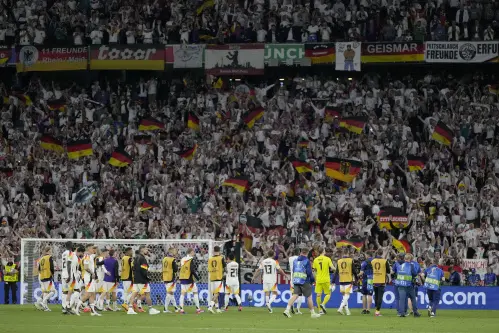
Euro 2024 has so far been a spectacle filled with surprises, stellar performances, and significant narratives, which has captivated imaginations of football fans across Europe.
The resurgence of seasoned players have been a pure sight of delight.
All of them have made triumphant returns to international football.
Toni Kroos, coaxed out of retirement, orchestrated Germany's emphatic 5-1 victory over Scotland, showcasing his enduring class before retiring for good after the tournament. Meanwhile, N'Golo Kanté, absent from the France squad since 2022 due to injury and a move to Saudi Arabia, made a stellar comeback in a 1-0 win, reminding everyone of his unmatched energy and tactical acumen at the age of 33.
However, the spotlight also shone on youth, as 16-year-old Lamine Yamal became the youngest player ever to feature in a European Championship match, contributing an assist in Spain's 3-0 triumph over Croatia. Contrastingly, veterans like Pepe, anchoring Portugal's defense at the age of 41, and Cristiano Ronaldo, leading their attack at 39 in a record sixth Euros appearance, continued to defy age with their enduring prowess.
The tournament hasn't been without its dramatic moments, notably Kylian Mbappé's injury sidelining him with a broken nose, casting doubt over his availability for upcoming matches despite a heroic return in a protective mask.
Goal-scoring trends have seen a resurgence of own goals, with three already recorded in the tournament's early stages. This adds to the drama of the 34 goals scored by 34 different players, featuring spectacular strikes from outside the penalty area by players like Romania's Nicolae Stanciu and Switzerland's Michel Aebischer.
In terms of surprises, Slovakia's unexpected 1-0 victory over Belgium, despite a significant ranking difference, highlighted the unpredictability and competitive balance at Euro 2024. Belgium, once hailed for its "golden generation," now faces questions about its current squad's ability to replicate past successes.
Off the field, the tournament reflects broader European socio-political dynamics. The distribution of host stadiums, predominantly in the former West Germany, underscores enduring geographical divisions, despite efforts to integrate more venues from the East. On a societal level, players and fans alike have used the platform to address pressing issues, from Ukraine's players highlighting the impact of Russian military actions to French players advocating against far-right political movements.
The tournament's cultural significance is also evident, akin to the Eurovision Song Contest, uniting diverse nations under a shared passion for football. Beyond the sporting spectacle, UEFA has had to address disciplinary issues, including offensive fan displays, reflecting tensions and provocations amidst the celebrations.
Looking ahead, with 39 games remaining over the next 26 days, Euro 2024 promises further drama and excitement. As teams navigate through group stages and knockout rounds, the tournament continues to serve as a stage for both established stars and rising talents to leave their mark on European football history.
In essence, Euro 2024 has begun with a blend of nostalgia, unpredictability, and social commentary, captivating millions and reinforcing football's role as a unifying force amidst Europe's diverse tapestry. AP
Published: 19 Jun 2024, 02:23 pm IST
Related Topics
Subscribe to our Newsletter
Disclaimer: Kindly avoid objectionable, derogatory, unlawful and lewd comments, while responding to reports. Such comments are punishable under cyber laws. Please keep away from personal attacks. The opinions expressed here are the personal opinions of readers and not that of Mathrubhumi.
