
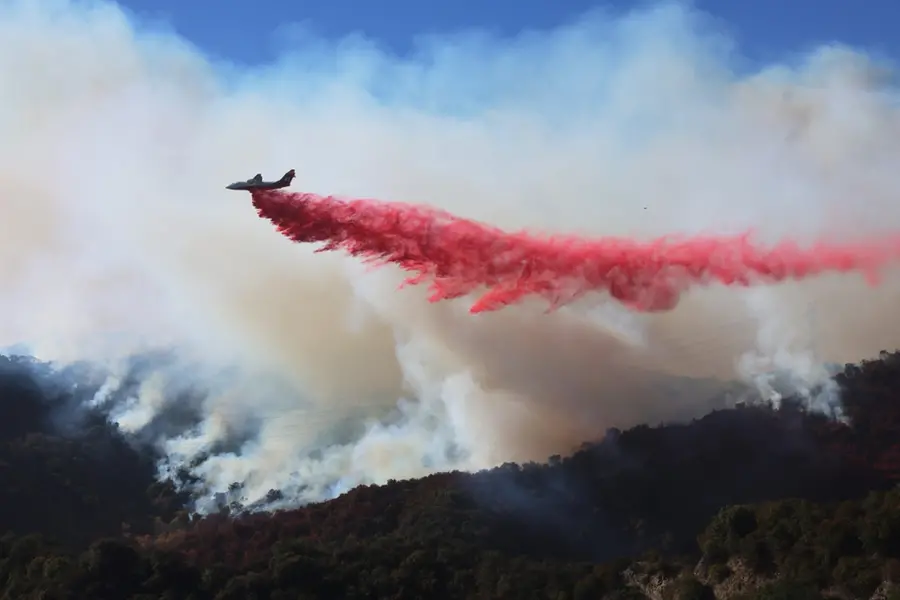
As wildfires continue to devastate parts of Los Angeles, fire crews are using more than just water to fight the flames. In a desperate attempt to control the rapidly spreading fires, aircraft have been dumping large amounts of bright pink fire retardant ahead of the flames. But what exactly is this fire suppressant, and is it safe?
The fire retardant in question is Phos-Chek, a product manufactured by Perimeter. This substance has been employed in combating wildfires across the United States since 1963. It is the primary long-term fire retardant utilised by the California Department of Forestry and Fire Protection and is also recognised as the most widely used fire retardant globally, according to a 2022 report by the Associated Press.
Why are they using fire retardants?
The flames are burning quickly through difficult-to-reach areas such as canyons. Firefighters can’t always get in on the ground, so aerial fire suppressants are a vital tool to slow down the spread.
However, these drops are not always a guarantee of success. High winds can make it too risky for planes to fly low enough to drop the retardant, and sometimes the wind can blow it away before it hits the ground. Despite this, fire agencies like Cal Fire, the US Forest Service, and local fire departments continue to use the suppressant as an important part of their firefighting efforts.
How does it work?
Aerial fire retardants are usually a mix of water, ammonium phosphate (basically fertiliser), and iron oxide, which gives the suppressant its bright pink colour. According to Daniel McCurry, a professor at the University of Southern California (USC), the suppressant works by cutting off the fire’s oxygen supply and slowing its burn. It cools and coats plants, trees, and other surfaces to stop flames from spreading.
The company Perimeter, which supplies the fire retardants, says the ammonium phosphate changes the way plant matter breaks down, making it non-flammable.
The company also explained that the bright colour serves as a helpful guide for both pilots and firefighters. Over time, the hue naturally fades to more neutral earth tones after being exposed to sunlight for a few days.
Are they safe for the environment?
While fire retardants are considered safe for humans, there are concerns about their effects on wildlife and the environment. For instance, the Forest Service restricts the use of these chemicals over waterways or in habitats of endangered species, as the chemicals may harm fish and other creatures.
McCurry and other researchers have found heavy metals like chromium and cadmium in some fire suppressants, and while they haven't yet fully confirmed whether these metals are from fire retardants, they say it’s possible that they could end up in water supplies downstream from the fires.
However, Perimeter, the company behind the fire retardant used in California, maintains that their products are extensively tested and meet all safety standards. They also say that the metals found in fertilisers are naturally occurring and not intentionally added to the products.
The company has previously recommended cleaning off the powder as soon as it is safe to do so. They have warned that the longer the retardant remains, the harder it becomes to remove entirely. For smaller surfaces, they suggest using warm water and a mild detergent. For larger areas, pressure washers are an effective method for removal.
Health and safety concerns
While the potential environmental impact of fire retardants is a concern, their use in wildfires is often seen as essential to protect human lives. Wildfires release dangerous smoke, which has been linked to breathing and heart problems. Studies have shown that in the western US, wildfire smoke can make up half of all air pollution, causing serious health risks.
Furthermore, recent research from the Alzheimer’s Association suggests that wildfire smoke might even pose a greater threat to brain health than other forms of air pollution, potentially increasing the risk of dementia.
In light of this, fire retardants are seen as a necessary tool to stop fires from becoming even more dangerous. Edward Goldberg from Perimeter, the company that supplies fire retardant, put it simply: “The use of wildland fire retardant is the best way to save lives, protect communities, and keep fires small.”
Despite their vital role in combating wildfires, McCurry believes more research is needed to fully understand the environmental impact of fire retardants. He acknowledges their importance but says, “If there was a brush fire coming for my house, I’d still rather they paint a lot of fire retardant in front of it.”
(Agency inputs)
Published: 14 Jan 2025, 01:29 pm IST
Related Topics
Disclaimer: Kindly avoid objectionable, derogatory, unlawful and lewd comments, while responding to reports. Such comments are punishable under cyber laws. Please keep away from personal attacks. The opinions expressed here are the personal opinions of readers and not that of Mathrubhumi.
