
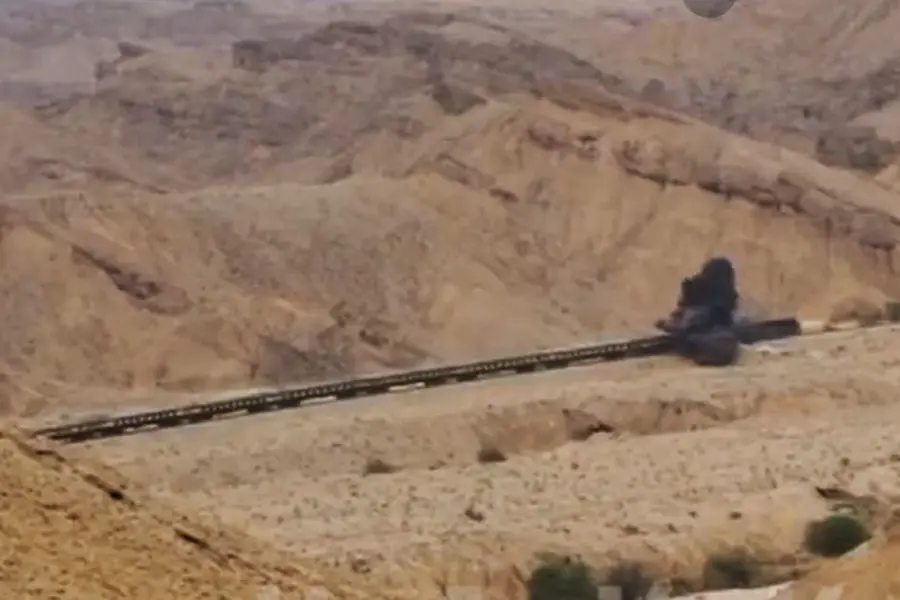
Shocking visuals have surfaced showing the attack and seizure of the Jaffar Express by the Baloch Liberation Army (BLA), in Pakistan's restive Balochistan province. Hours since then, Pakistani security forces engaged in a tense gun battle with the militants even as efforts continued to rescue nearly 300 hostages still held aboard the train.
The Baloch Liberation Army (BLA), which claimed responsibility for the attack, has indicated it is open to negotiations for a prisoner exchange, though the government has yet to respond.
According to officials, at least 27 militants have been killed, and security forces have managed to rescue more than 150 passengers out of the 450 originally on board when the train was hijacked on Tuesday. The attack occurred as the train entered a tunnel in the Bolan district, marking an unprecedented escalation by separatist militants in the region.
Security forces, supported by helicopters, are proceeding cautiously as many of the militants are wearing explosive-laden vests, officials said. Government spokesperson Shahid Rind condemned the attack as “an act of terrorism.”
How the train attack was hijacked
The attackers reportedly blew up the railway tracks, disabling the train’s engine and coaches while opening fire on security personnel aboard. The train’s driver was critically wounded in the assault, and an unspecified number of security forces have been killed, according to officials speaking on condition of anonymity.
The hostages include women and children, with those rescued being transported to hospitals in Mach district and Quetta, about 100 kilometers (62 miles) away.
BLA demands prisoner swap
The BLA has warned that the lives of the remaining hostages and captured security personnel are at risk unless the government agrees to release jailed BLA members. BLA spokesman Jeeyand Baloch stated that the group was willing to release passengers in exchange for the militants’ freedom. The government has not yet issued an official response, but similar demands have been rejected in the past.
The BLA, which has waged a years-long insurgency in Balochistan, frequently targets Pakistani security forces and Chinese nationals working on China-Pakistan Economic Corridor (CPEC) projects. In response to the train hijacking, China’s Foreign Ministry spokesperson Mao Ning condemned the attack, reaffirming Beijing’s support for Pakistan’s counterterrorism efforts.
Growing regional instability
Balochistan, a resource-rich province bordering Iran and Afghanistan, has long been a hotspot for separatist movements demanding greater autonomy. The region’s volatile security situation has also fueled tensions with neighboring Iran, which has dealt with insurgent attacks by groups such as Jaish al-Adl.
In January 2024, Pakistan and Iran engaged in tit-for-tat airstrikes targeting militants along their shared border, killing at least 11 people before de-escalating through diplomatic talks. Both nations continue to accuse each other of harbouring separatist fighters.
While the BLA has primarily targeted military and government infrastructure, its decision to hijack a civilian train may erode local support for its insurgency. Security analyst Syed Muhammad Ali noted that by shifting tactics from attacking military targets to harming unarmed civilians, the BLA risks losing public sympathy.
“This may give them instant public and media attention, but it will weaken their support base within the civilian population, which is their ultimate objective,” Ali said.
The attack is the first train hijacking of its kind in Pakistan, raising concerns about escalating militancy in the already restive province. Security forces remain engaged in a high-risk operation, with hundreds of lives still hanging in the balance.
Published: 12 Mar 2025, 02:39 pm IST
Related Topics
Disclaimer: Kindly avoid objectionable, derogatory, unlawful and lewd comments, while responding to reports. Such comments are punishable under cyber laws. Please keep away from personal attacks. The opinions expressed here are the personal opinions of readers and not that of Mathrubhumi.
