
Reaffirming solidarity with Kyiv, the G7 pledged continued financial aid, advanced air defense systems, and winter energy assistance.
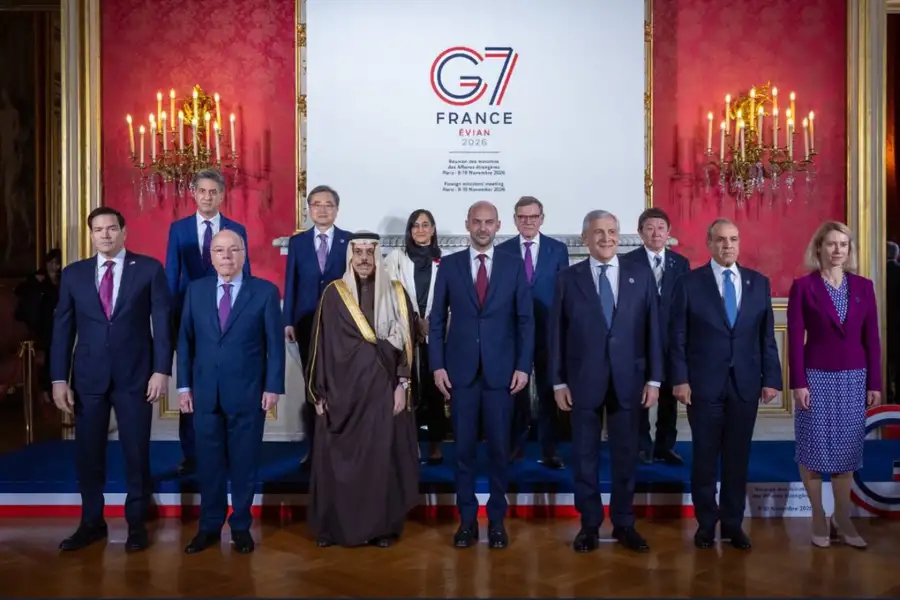
Washington: The United States Embassy in Saudi Arabia has spotlighted key security commitments emerging from last week’s G7 Foreign Ministers' Meeting in Paris, emphasising the bloc's robust condemnation of Iranian aggression in the Strait of Hormuz alongside ongoing Houthi strikes targeting Saudi Arabia and Yemen.
In a social media update reviewing outcomes from the diplomatic summit, the embassy underscored the G7 ministers' firm censure of Tehran and its regional proxies over mounting threats to Gulf stability and international trade routes.
"We strongly condemned Iran’s attacks against its neighbours and the disruption of international trade, energy security, and the global economy caused by the obstruction of transit passage through the Strait of Hormuz," the highlighted statement read.
The embassy further drew attention to the coalition's solidarity with Riyadh and Sana'a in the wake of cross-border hostilities.
"We condemned in the strongest terms the unacceptable continued strikes carried out by the Houthis in Yemen and against the Kingdom of Saudi Arabia, including those on civilians and civilian infrastructure," the ministers declared, urging the group to immediately cease military operations to enable an inclusive political settlement.
Reaffirming the sovereign right of Saudi Arabia and the Yemeni government to defend their territories under international law, the G7 demanded that external actors—specifically naming Tehran—halt the supply of arms and backing to the Houthis in breach of United Nations Security Council resolutions.
The points amplified by the US mission form part of a comprehensive joint declaration published by the foreign ministers of Canada, France, Germany, Italy, Japan, the United Kingdom, the United States, and the High Representative of the European Union following their November 9–10 talks in Paris, which outlined concerted security, diplomatic, and economic measures across the Middle East.
Within the wider communique, ministers demanded that Iran halt attacks against merchant shipping in the Strait of Hormuz and dismiss all unlawful transit fees or restrictions. The bloc commended defensive mine-clearing and escort missions undertaken by U.S. Central Command alongside a joint European initiative led by France and the UK.
Addressing Tehran's atomic programme, the G7 insisted Iran must never develop nuclear weapons, demanded full co-operation with the International Atomic Energy Agency (IAEA), and committed to enforcing UN sanctions reinstated via the snapback mechanism in September 2025. The ministers also backed the UK's attribution of Iranian involvement in a September 27 incident at RAF Fairford, warning that the alliance remains united against hostile Iranian operations targeting allied territory and citizens.
Regarding Yemen and the Red Sea, the bloc demanded the swift opening of a humanitarian corridor in Taiz, the unconditional release of 70 arbitrarily detained UN staff, and lauded EU naval operations EUNAVFOR ASPIDES and ATALANTA for protecting navigation in the Bab al-Mandeb Strait and Gulf of Aden.
In Lebanon, the ministers urged the complete implementation of UN Security Council Resolution 1701—including Hezbollah's disarmament—alongside progress on Israeli-Lebanese pilot zones as the Lebanese Armed Forces deploy, and economic reforms tied to an International Monetary Fund programme.
On Gaza and the West Bank, the G7 pressed for rapid adherence to UN Security Council Resolution 2803, the dismantling of Hamas's military capabilities with no governing role for the faction, progressive Israeli withdrawal from Gaza, scaled-up aid access, and an end to violence in the West Bank.
For Syria, the alliance reaffirmed support for a peaceful political transition, the integration of north-eastern regions, civilian protection in the south, and national reconstruction.
Shifting to Eastern Europe, the G7 Foreign Ministers reiterated their "unwavering support to Ukraine and its courageous people as they defend their territorial integrity, sovereignty, freedom, and independence" in the face of relentless Russian strikes on residential areas and infrastructure.
The bloc expressed backing for ongoing U.S.-led diplomatic efforts toward a comprehensive, reciprocal ceasefire—beginning with a mutual halt to attacks on energy grids and Black Sea commercial shipping—while insisting that European states must participate in shaping future European security architecture.
Building on commitments made at the Évian Summit, the ministers reviewed ongoing deliveries of air defence systems, interceptors, and long-range capabilities to Kyiv, pledged coordinated financial backing for Ukraine through 2027 and beyond, and announced enhanced winter energy assistance, including repairs to the Chornobyl New Safe Confinement and cyber resilience initiatives under Italy's Tallinn Mechanism.
Finally, the G7 pledged to tighten punitive economic measures against Russia's war economy—specifically targeting shadow-fleet vessels, false-flag ships, marine insurers, and oil traders—while condemning military assistance supplied to Moscow by North Korea, Iran, and China, including weaponry, military training, and dual-use components.
ANI
Published: 15 Nov 2026, 11:22 pm IST


ABOUT THE AUTHOR

Related Topics
Disclaimer: Kindly avoid objectionable, derogatory, unlawful and lewd comments, while responding to reports. Such comments are punishable under cyber laws. Please keep away from personal attacks. The opinions expressed here are the personal opinions of readers and not that of Mathrubhumi.