
The United States has committed $1.3 billion to Pakistan’s Reko Diq mine under President Donald Trump’s Project Vault initiative
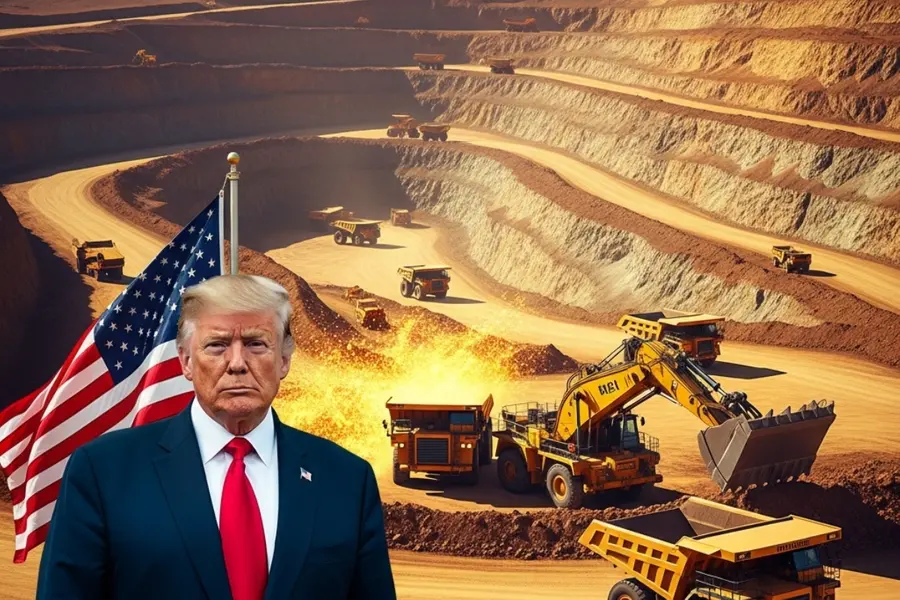
The United States has approved a $1.3 billion investment in Pakistan’s Reko Diq mine in Balochistan under President Donald Trump’s Project Vault initiative. The move brings one of the world’s largest undeveloped copper and gold deposits into Washington’s critical minerals strategy, reflecting growing efforts to secure key resources amid intensifying global competition and geopolitical tensions.
Why the US is targeting Reko Diq now
The Reko Diq mine in Pakistan’s Balochistan province is considered one of the world’s largest undeveloped copper and gold deposits. Estimates suggest the site contains around 5.9 billion tonnes of ore with a copper grade of 0.41 per cent and gold reserves of approximately 41.5 million ounces.
The US Export-Import Bank (EXIM) has approved $1.3 billion in financing for the project. The investment falls under Project Vault, a public-private partnership unveiled by President Donald Trump on February 2, 2026. The initiative aims to build a US strategic reserve of critical minerals and strengthen supply-chain security.
According to US officials, Project Vault will support minerals classified as “critical” by the US Geological Survey, which lists more than 50 such minerals, including copper, lithium, uranium and rare earth elements. Copper is considered essential for defence systems, renewable energy infrastructure, electric vehicles and telecommunications.
Reko Diq is currently being developed by Canadian mining company Barrick Gold. It is the only non-US investment included under Project Vault so far, highlighting Washington’s growing interest in overseas mineral assets.
Strategic and geopolitical factors
The move reflects broader geopolitical competition over critical minerals. As global demand rises for resources needed in clean energy and advanced technologies, countries are seeking to secure stable and diversified supply chains.
Balochistan is resource-rich but politically sensitive. The province has faced a long-running insurgency led by the Baloch Liberation Army (BLA), which has targeted infrastructure and projects linked to natural resources. The region is also strategically significant due to China’s involvement in the China–Pakistan Economic Corridor (CPEC), part of Beijing’s Belt and Road Initiative.
By investing in Reko Diq, the US is positioning itself in a region where mineral access intersects with security concerns and great-power competition.
What Project Vault involves
Project Vault is designed as a large-scale financing mechanism. EXIM has approved up to $10 billion in loans for critical mineral projects, with an additional $2 billion expected from private capital. In addition to the Pakistan allocation, several US-based mining and processing projects have received funding commitments.
Officials have described the programme as an effort to “reshape the global market for critical minerals and rare earths” and reduce reliance on rival supply chains.
Why this matters
The $1.3 billion commitment represents more than a mining investment. It marks a strategic shift in US policy towards securing overseas mineral resources deemed essential for national security and economic resilience.
With rising global competition for copper and gold reserves, and increasing geopolitical tensions in mineral-rich regions, Reko Diq has emerged as a key focal point in Washington’s critical minerals strategy.
Published: 06 Feb 2026, 12:40 pm IST
Related Topics
Disclaimer: Kindly avoid objectionable, derogatory, unlawful and lewd comments, while responding to reports. Such comments are punishable under cyber laws. Please keep away from personal attacks. The opinions expressed here are the personal opinions of readers and not that of Mathrubhumi.
