
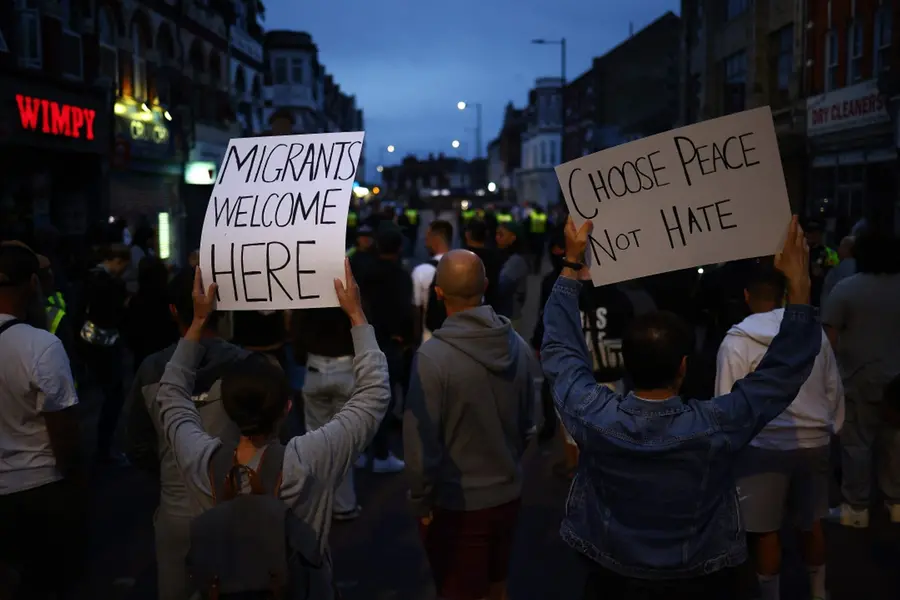
London: On Wednesday, thousands of people took to the streets in various English cities to protest against recent far-right violence that has put UK police on high alert.
In cities such as London, Birmingham, Bristol, Liverpool, and Newcastle, anti-racism and anti-fascist rallies were held in response to several days of riots. These riots, which have involved attacks on mosques and migrant-related facilities, were fueled by false information about the murder of three children on July 29.
Also Read
"Whose streets? Our streets!" chanted protesters at a few-thousand-strong gathering in Walthamstow, northeast London, where some held banners saying "Stop the far right".
"I live in the borough and we don't want these people on our streets... they don't represent us," Sara Tresilian, 58, told AFP, referring to the far-right.
"You have to turn out (and) give that message... I think it's important that you show up for your friends and neighbours."
Andy Valentine, the Met Police's deputy assistant commissioner, thanked "communities for coming together across the capital and for showing community spirit this evening".
In Sheffield, protesters chanted "Say it loud, say it clear, refugees are welcome here," while police watched. In Birmingham, hundreds gathered outside a migrant support centre. Brighton saw around 2,000 people join a peaceful demonstration.

However, tensions were high in Aldershot, where police had to separate anti-racism activists from a group shouting "Stop the boats," referring to migrants arriving via the English Channel.
To manage the situation, the government put 6,000 specialist officers on standby for the roughly 100 planned protests by far-right and counter-protest groups. In a social media post, Home Secretary Yvette Cooper thanked "all the police officers working tonight to protect & support local communities".
Authorities have begun sentencing those involved in the unrest, with nearly 430 arrests and at least 120 charges so far. The violence has been described as the worst since the 2011 London riots and has led some countries to issue travel warnings for the UK.
The unrest began after three young girls, ages 6, 7, and 9, were killed and five other children were critically injured in a knife attack at a dance class in Southport. Initially, false rumours circulated that the attacker was a Muslim asylum seeker, but the suspect was later identified as 17-year-old Axel Rudakubana, born in Wales, with Rwandan parents.
The riots have seen demonstrators hurl bricks and flares at police, burn cars, and attack mosques and hotels housing asylum seekers. Prime Minister Keir Starmer has warned that those involved will face severe legal consequences, including those inciting violence online. He has warned significant sentences for rioters and has made extra prison places available.
On Wednesday, a man was sentenced to three years in prison for violent disorder and assaulting a police officer in Southport. Two others received 20 and 30-month sentences for violence in Liverpool.
"The three men sentenced today are the tip of the iceberg, and just the start of what will be a very painful process for many who foolishly chose to involve themselves in violent unrest," said prosecutor Jonathan Egan.
The disorder has been linked to figures from the now-defunct English Defence League (EDL), a far-right group known for Islamophobia and football hooliganism. EDL founder Tommy Robinson has been accused of inflaming tensions. Authorities in Cyprus, where Robinson was reportedly on holiday, said they are ready to assist UK police if needed. However, Robinson later wrote on the X social media platform: "Lucky I'm not in Cyprus then".
The far-right rallies were promoted on social media under the slogan "Enough is enough." UK lawmakers have criticised social media platforms for their role in spreading violence, with tech billionaire Elon Musk facing particular criticism for provocative statements, including claims of an impending British "civil war."
Agencies
Published: 08 Aug 2024, 08:35 am IST
Related Topics
Disclaimer: Kindly avoid objectionable, derogatory, unlawful and lewd comments, while responding to reports. Such comments are punishable under cyber laws. Please keep away from personal attacks. The opinions expressed here are the personal opinions of readers and not that of Mathrubhumi.