
Critics labeled the action unconstitutional, predicting that federal courts would ultimately overturn the order.
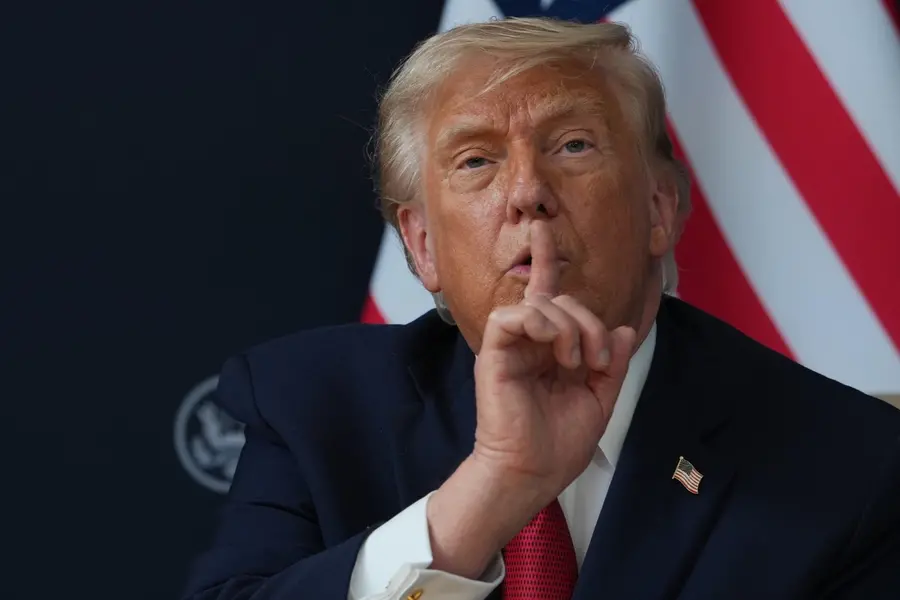
US President Donald Trump announced an immediate ban barring journalists from CNN, MS NOW, and Politico from entering the White House premises.
Taking to his Truth Social network, the 80-year-old Republican leader accused the three prominent news organisations of spreading false reports regarding his administration.
"I am proud to announce that, effective immediately, I am banning Fake News CNN, MSNOW...and Politico...from the White House as a result of their constant 'reporting' FAKE NEWS!" Trump posted on his social media platform.
He further argued that media organisations ought not to be permitted to publish falsehoods while covering the presidency.
"media Outlets shouldn't be able to constantly write or report FICTION and LIES when they're covering the President of the United States," he stated in his online message.
Later, speaking to journalists inside the Oval Office, Trump defended his decision and suggested that the executive branch holds the authority to exclude news outlets that consistently produce untruthful stories. He added that the decision was not triggered by a single news report.
"It's really just cumulative stories over the last two years," Trump explained to reporters. "You get sick of it. They purposely write negative news, and they do that because they want to try and diminish the Republicans and a Republican administration".
The US President also cautioned that additional news outlets could face similar restrictions in the future, though he refrained from naming specific targets.
US Secretary of Defense Pete Hegseth, a former television host on Fox News who has implemented strict media restrictions at the Pentagon, publicly endorsed the President’s ban. Hegseth claimed that the targeted news outlets had previously "endangered troops" through unspecified published reports.
News outlets and political leaders push back against White House media ban
The sudden exclusion of journalists from major television networks and news websites drew immediate backlash from media organisations and political opponents. Critics labeled the action unconstitutional, predicting that federal courts would ultimately overturn the order.
CNN issued a sharp response on the social media platform X, standing firmly behind its reporting staff. "We have a right under the U.S. Constitution to do that reporting without hindrance or interference from the government," the network stated. "Should the ban which President Trump threatened go ahead, it would be an illegal assault on that fundamental and constitutionally-protected right".
Congressional opposition leaders also condemned the move. Senate Democratic Leader Chuck Schumer posted a direct warning to the administration on X. "This is a democracy," Schumer wrote. "You will not be able to manipulate the news or hide the truth".
Media experts noted that blocking CNN threatens the traditional five-network television pool system that travels with the American President to ensure independent coverage for the public. In his social media declaration, Trump did not clarify how his administration intends to enforce the ban in practice.
This action represents the latest escalation in Trump's ongoing friction with news organisations. In February 2025, the administration banned journalists from The Associated Press from accessing small presidential venues after the agency refused to adopt Trump’s order to rename the Gulf of Mexico as the "Gulf of America". That decision triggered an ongoing federal lawsuit filed by the news agency.
Furthermore, since returning to the White House, Trump has initiated legal proceedings against several major news institutions, including The New York Times, The Wall Street Journal, and the BBC.
Internal party disagreements and legal developments unfold in Washington
Alongside his media restrictions, President Trump faces public disagreements within his own party over immigration policy.
Representative Maria Elvira Salazar, a Republican congresswoman representing a majority-Hispanic district in South Florida, released a campaign video breaking ranks with the White House. In her advertisement, Salazar asserted that some of the administration's border enforcement tactics have "gone too far".
When asked about her remarks, Trump acknowledged his continued endorsement of her re-election bid while explicitly rejecting her position. "I disagree with her," Trump said. "I'm very strong on the borders, and she isn't".
Meanwhile, public attention has turned toward financial questions surrounding Donald Trump Jr.'s recent wedding in the Bahamas to socialite Bettina Anderson. Reports revealed that Russian businessman Umar Kremlev, who maintains close ties to Russian President Vladimir Putin, helped bankroll the event.
Addressing reporters, President Trump dismissed concerns about the funding arrangement, stating that "a lot of people have parties" and "it's totally allowed". He added that he had questioned his son about Kremlev's financial backing. According to Trump, his son responded, "I'm paying him back, Dad". Trump did not attend the wedding, citing ongoing foreign policy crises involving Iran.
In other government actions, defense contractor Lockheed Martin's subsidiary, Sikorsky Aircraft, has agreed to fund a new helipad at the White House. Trump explained that the upgrade was necessary because newer presidential helicopters damage the lawn. The administration has not disclosed the total financial cost.
Concurrently, a senior official at the US Postal Service confirmed that work has been halted on a controversial computer system intended to limit mail-in voting. The project was abandoned following a recent US Supreme Court ruling rejecting Trump’s executive order on the matter.
Additionally, the Department of Justice’s Office of Legal Counsel issued an official legal opinion declaring that federal laws prohibiting licensed gun dealers from selling handguns to individuals aged 18 to 20 are unconstitutional under the Second Amendment and cannot be enforced. On the southern border, construction work is advancing on the US-Mexico wall despite significant local opposition.
Politically, Trump is also relying on historic campaign advertisements featuring controversial crime themes to attack Democratic candidates. Meanwhile, the US Chamber of Commerce launched a multi-state bus tour promoting private enterprise against candidates affiliated with the Democratic Socialists of America. Suzanne Clark, chief executive of the group, told reporters, "Free enterprise isn't perfect... But it is the best at getting better. ... It's our job to get out there and promote it and protect it".
Major diplomatic meetings and international security treaties take shape
On the international stage, Washington is preparing for a high-profile visit from Chinese President Xi Jinping and his wife, Madame Peng.
The Chinese delegation will arrive on Wednesday at Joint Base Andrews, followed by an official welcome ceremony on the State Floor of the White House on Thursday. The schedule includes a military review in the Rose Garden, closed-door bilateral talks, and a formal state dinner. On Friday, the leaders will share tea before touring the National Archives. Senior administration officials indicated that discussions may include targeted tariff reductions in non-strategic commercial sectors, though export restrictions on rare earth minerals will remain firm.
On security matters, the US Senate and House of Representatives passed a comprehensive sanctions package targeting the Russian economy, its shadow fleet of oil tankers, and key state officials. The legislation, championed by the late Senator Lindsey Graham prior to his death in July, requires Trump to impose tariffs of up to 100 per cent on the top five global importers of Russian natural gas and crude oil.
In the Arctic region, Secretary of State Marco Rubio announced a permanent defense agreement with Denmark regarding Greenland. "Greenland will forever be part of the strategic defense area of North America and exclude any adversary from it and the surrounding area," Rubio stated. "This deal permanently and completely addresses our national security concerns in Greenland".
Danish Prime Minister Mette Frederiksen affirmed that the treaty respects the territorial sovereignty and self-determination of both Greenland and Denmark. The deal allows Washington to construct additional military installations across Greenland. Observers noted that earlier threats by Trump to acquire Greenland had strained relations with European NATO allies.
In the Horn of Africa, the US administration lifted long-standing economic sanctions against Eritrea’s government, military forces, and ruling political party. The decision allows penalties imposed in 2021 to lapse as the nation becomes strategically important for Red Sea shipping during the U.S.-Iran war.
Concurrently, the President of Somaliland, Abdirahman Mohamed Abdullahi, visited Washington to offer the US military and commercial access along the Gulf of Aden coast. Somaliland is seeking official US diplomatic recognition and an embassy presence in Hargeisa or Berbera. While the US has provided $6.2 million in counter-terrorism aid, Washington continues to recognise Somalia's unified territorial boundaries.
In global forums, US officials are scheduled to participate in a G20 conference addressing the Ebola health crisis in Africa, alongside discussions on protecting undersea data cables and harvesting seabed minerals.
Disputes over public buildings and national healthcare pricing models
Domestically, the administration remains entangled in legal battles over national landmarks in the capital.
At the John F. Kennedy Center for the Performing Arts, board members aligned with Trump voted to close the facility indefinitely for structural repairs after placing his name on the building's facade, prompting several artists to cancel scheduled performances. A federal judge subsequently blocked plans to modify the structure, ordering 30 days' advance notice before major alterations.
Trump criticized the judge as "hostile," asserting that he deserves credit for saving the facility and claiming he can secure $257 million in congressional funding alongside an ongoing operational subsidy.
Simultaneously, opponents of the administration's takeover of the US Institute of Peace filed an emergency legal appeal to prevent contractors from permanently carving Trump’s name into the building's exterior.
Finally, the administration announced a national prescription drug initiative titled the Medicaid "GENEROUS" model. The programme introduces Most Favored Nation pricing, tying the cost of selected medicines within Medicaid to rates paid in other developed countries. While the administration claims the plan will deliver billions in savings ahead of upcoming midterm elections, health policy experts note that the exact financial details remain undisclosed.
Published: 19 Sept 2026, 06:34 am IST
Related Topics
Disclaimer: Kindly avoid objectionable, derogatory, unlawful and lewd comments, while responding to reports. Such comments are punishable under cyber laws. Please keep away from personal attacks. The opinions expressed here are the personal opinions of readers and not that of Mathrubhumi.
