
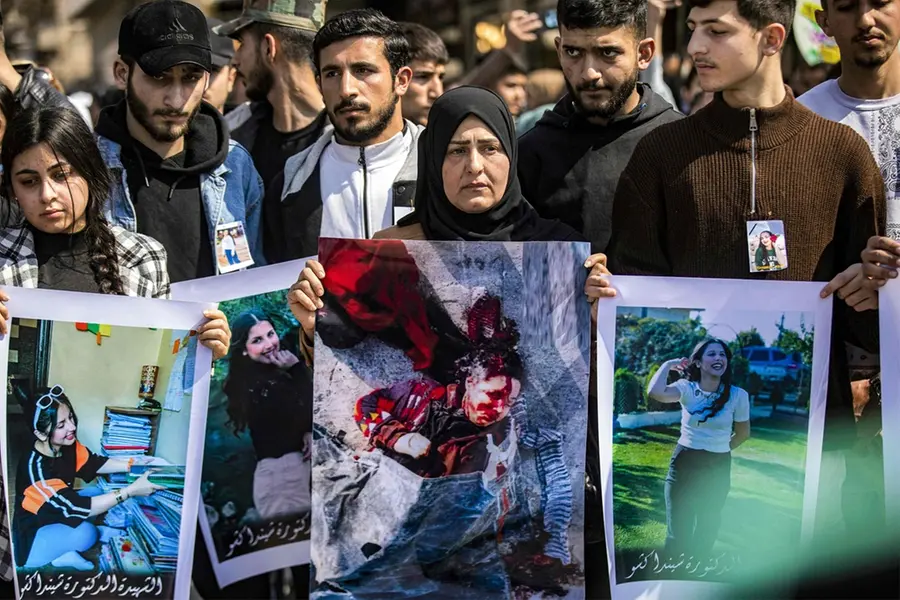
Beirut, Lebanon: Syria’s Mediterranean coast has witnessed extreme violence in recent days, with mass killings primarily targeting the Alawite minority. While official figures have not been released, the Syrian Observatory for Human Rights has reported 1,225 civilian deaths, mostly Alawites, while Human Rights Watch (HRW) stated that "hundreds" had been killed.
The violence follows the December ousting of former president Bashar al-Assad. Many Alawites, belonging to Assad’s sect, fear reprisals for his repressive rule.
Interim President Ahmad al-Sharaa, formerly the leader of Hayat Tahrir al-Sham (HTS), has pledged to prosecute those responsible for the bloodshed and has set up a fact-finding committee.
Survivors and rights groups have described widespread attacks since last Thursday in Alawite-majority coastal areas.
"In extremely disturbing cases, entire families—including women, children, and non-combatants—were killed, with predominantly Alawite towns targeted," UN human rights office spokesman Thameen Al-Kheetan said on Tuesday.
Eyewitnesses reported armed groups raiding homes, asking residents about their sect before either killing or sparing them. One survivor recounted seeing a family of four executed against a wall in an Alawite village in Latakia province. In Jableh, another resident said, “More than 50 of my family and friends have been killed. Bodies were gathered with bulldozers and buried in mass graves.”
The Observatory and social media users shared videos of bodies piled outside homes and executions at close range, but AFP has not independently verified the footage.
Armed groups behind the violence
No single group has claimed responsibility for the killings. HRW reported that unidentified armed groups from various regions, including Tartus and Latakia, were involved in the attacks following a general mobilisation order.
Fighters arrived from Idlib, HTS’s former stronghold, as well as from eastern areas controlled by Turkey-backed groups. HTS, an offshoot of the former Syrian branch of Al-Qaeda, has since been disbanded and integrated into the new security forces.
Syria researcher Cedric Labrousse said at least three factions were involved: Syrian groups opposed to the new government, warlords backing the newly formed Syrian army—including pro-Turkey factions—and foreign jihadists. He noted that foreign fighters, including Kyrgyz, Uzbeks, and Chechens, were expelled from the region in January by the new authorities.
HRW stressed that "accountability for atrocities must include all parties," including HTS, which now forms part of Syria’s security forces.
Government forces under attack
Following Assad’s removal, tensions remained high on the coast, with repeated attacks against the new government and reports of atrocities against Alawites.
Last Thursday, authorities reported coordinated assaults on government forces, buildings, and hospitals. According to the official toll, at least 231 security personnel were killed, while the Observatory put the number at 250 pro-Assad fighters.
The attacks came after Assad-era general Ghiath Dalla announced on social media the creation of a "military council for the liberation of Syria." Dalla, a former officer in the notorious Fourth Brigade led by Assad’s brother Maher al-Assad, has been linked to efforts to resist the new government.
Alawite fears amid shifting power
The Alawite community, numbering around 1.7 million or about nine percent of Syria’s population, follows an offshoot of Shiite Islam. Sunni jihadist groups consider them heretics.
During Syria’s 13-year civil war, Alawites were overrepresented in the army and paramilitary forces and were accused of mass atrocities against dissidents. Now, they face fears of retribution amid the country’s shifting political landscape.
With AFP inputs
Published: 12 Mar 2025, 04:00 pm IST
Related Topics
Disclaimer: Kindly avoid objectionable, derogatory, unlawful and lewd comments, while responding to reports. Such comments are punishable under cyber laws. Please keep away from personal attacks. The opinions expressed here are the personal opinions of readers and not that of Mathrubhumi.
