
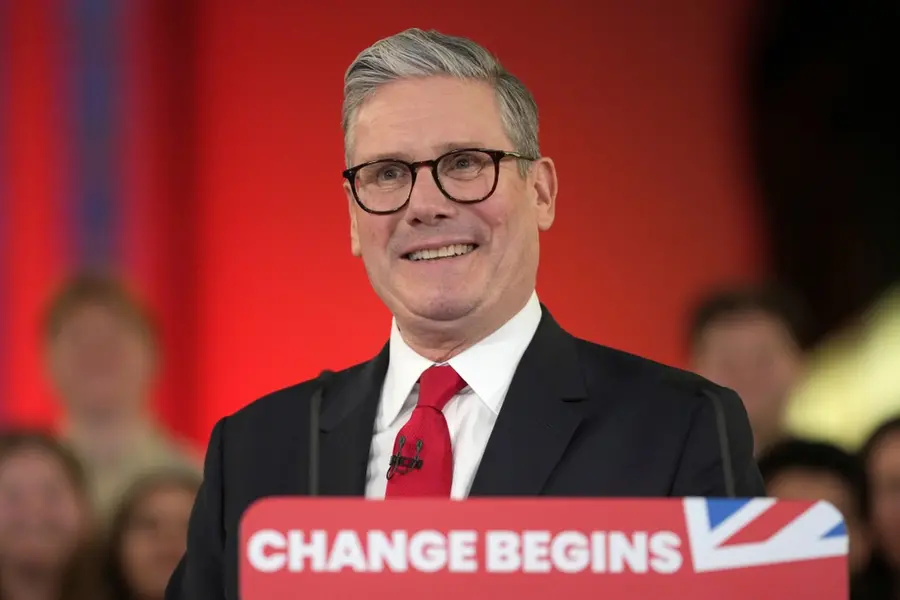
London: Keir Starmer, the newly elected Labour prime minister, is set to kickstart his ambitious plan to "rebuild Britain" following a decisive victory that ended 14 years of Conservative rule. Starmer wasted no time, swiftly appointing his ministerial team on Friday and preparing for his first full day in office on Saturday.
In a stunning electoral triumph, Labour secured a commanding 174-seat majority in the UK parliament, marking a significant return to power for the centre-left party.
On Saturday, Starmer is scheduled to convene his inaugural cabinet meeting, joined by Rachel Reeves as Britain's first woman finance minister and David Lammy, the new Foreign Secretary.
"The work of change begins immediately," Starmer said Friday shortly after being confirmed as prime minister by King Charles III and flag-waving crowds of cheering Labour activists welcomed him to Downing Street.
"But have no doubt, we will rebuild Britain", he added.
Reiterating his five key "missions" for government in his maiden speech, the 61-year-old vowed to get the state-run National Health Service "back on its feet", ensure "secure borders" and safer streets.
But daunting challenges await his government, including a stagnating economy, creaking public services and households suffering from a years-long cost-of-living crisis.
"Changing a country is not like flicking a switch. The world is now a more volatile place. This will take a while," Starmer said, as he sought to temper expectations.
Global leaders extended congratulations to Starmer on his resounding victory. He spoke with US President Joe Biden, emphasising their commitment to the UK-US special relationship and shared economic goals.
Meanwhile, former US president Donald Trump focused on the success of his ally Nigel Farage's far-right Reform UK party, which captured five seats and garnered significant voter support, including Farage's own election to parliament after multiple attempts.
Its capture of five seats and around 14 percent of the vote, alongside Farage becoming an MP on his eighth attempt, was one of the stories of the election.
But it paled in comparison to Labour's triumphs, after the party neared its record of 418 seats under ex-leader Tony Blair in 1997 by winning 412.
The Conservatives suffered their worst-ever defeat, capturing just 121 constituencies, prompting Rishi Sunak to apologise to the nation and confirm that he will resign as Tory leader once a successor is selected.
Former leader William Hague, a Sunak mentor who represented the same northern English constituency until 2015, conceded it was "a catastrophic result in historic terms".
A record 12 senior ex-government ministers lost their seats, alongside former prime minister Liz Truss, whose economically calamitous short-lived tenure in 2022 wounded the party irreparably ahead of the election.
It is now poised for another period of infighting between a moderate wing eager for a centrist leader and those who may be willing to court Farage as a new leader.
The election also saw the centrist Liberal Democrats make their biggest gains in around a century, claiming more than 70 seats to become the third largest party in parliament.
But it was a dismal contest for the pro-independence Scottish National Party, which was virtually obliterated in Scotland. It dropped from 48 seats to just nine, with one still to declare early Saturday.
The Green Party had its best general election, quadrupling its MPs count to four.
Meanwhile an unprecedented six independent lawmakers were elected -- four of them defeating Labour candidates in districts with large Muslim populations and campaigns centred around the Israel-Hamas conflict.
Delight within Labour at its seats landslide will be restrained by recognition that it only secured around 34 percent of the vote -- a drop on 2019 and the lowest ever to secure a majority.
Meanwhile turnout, at just below 60 percent, was the lowest since 2001, suggesting widespread apathy and that the party could struggle to maintain slender majorities in many seats.
"While this shouldn't overshadow Labour's victory today, it may point to some challenges Labour may face," Chris Hopkins, political research director at the pollster Savanta, said of those factors.
"Simply put, they likely won't be able to return 400-plus MPs next election with less than 40 percent of the vote." AFP
Published: 06 Jul 2024, 09:27 am IST
Related Topics
Disclaimer: Kindly avoid objectionable, derogatory, unlawful and lewd comments, while responding to reports. Such comments are punishable under cyber laws. Please keep away from personal attacks. The opinions expressed here are the personal opinions of readers and not that of Mathrubhumi.
