
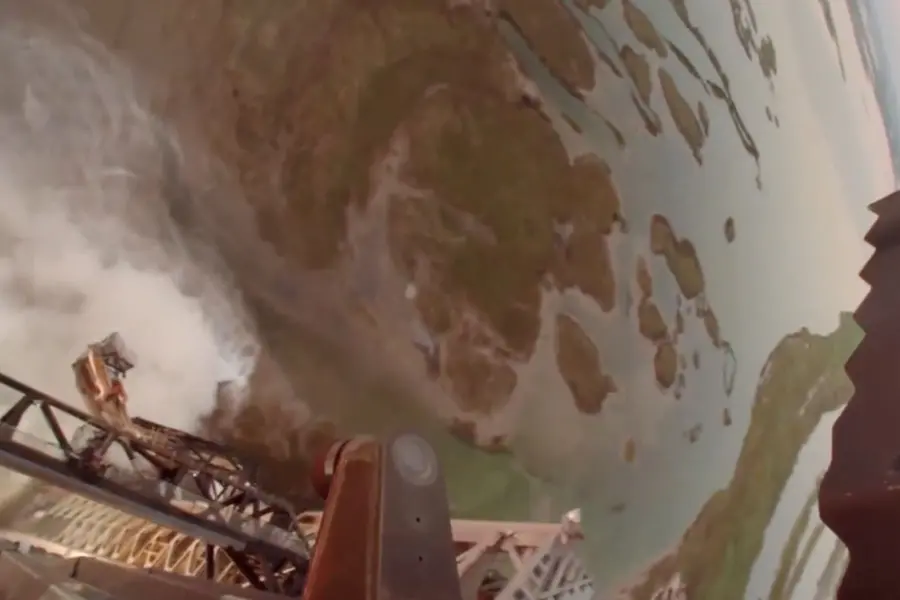
Boca Chica: SpaceX achieved a remarkable feat in spaceflight history on Sunday, successfully catching the first-stage booster of its Starship rocket as it returned to the launch pad after a test flight. The groundbreaking moment was captured in a breathtaking camera view from the "super heavy booster" itself, which SpaceX founder Elon Musk shared on social media, thrilling space enthusiasts around the world.
In the video, posted on Musk’s X (formerly Twitter) handle, viewers can see the controlled descent of the booster as it slowly approaches the landing pad at SpaceX’s Texas launch site. The footage shows the massive mechanical arms—nicknamed "Mechazilla"—extending from the launch tower to precisely catch the descending booster, marking the first-ever successful attempt of this kind.
"An extraordinary day for engineering," Musk captioned the post, as cheers from SpaceX staff erupted in the background of the company’s live stream.
The flight, which lifted off at 7:25 am local time (1225 GMT), saw the booster return to Earth just minutes after launching attached to the Starship rocket. While the booster was captured on the launch pad, the upper stage of the Starship was scheduled to splash down in the Indian Ocean.
This successful "catch" has been hailed as a key milestone in SpaceX’s journey toward making space travel more efficient through rapid reusability. Musk’s video post immediately drew excitement online, as space fans marveled at the unique perspective offered by the onboard camera.
SpaceX's engineers had spent months preparing for this booster recovery attempt, with Musk and his team emphasizing that countless hours had gone into ensuring the infrastructure and safety criteria were met. The video of the smooth capture is now making waves across social media, with fans praising SpaceX's ongoing innovations.
This achievement also brings SpaceX one step closer to its future missions, including NASA's Artemis program, which aims to land astronauts on the Moon, as well as Musk’s larger goal of using Starship to one day transport humans to Mars.
(With inputs from AFP)
Published: 15 Oct 2024, 05:38 pm IST
Related Topics
Disclaimer: Kindly avoid objectionable, derogatory, unlawful and lewd comments, while responding to reports. Such comments are punishable under cyber laws. Please keep away from personal attacks. The opinions expressed here are the personal opinions of readers and not that of Mathrubhumi.
