
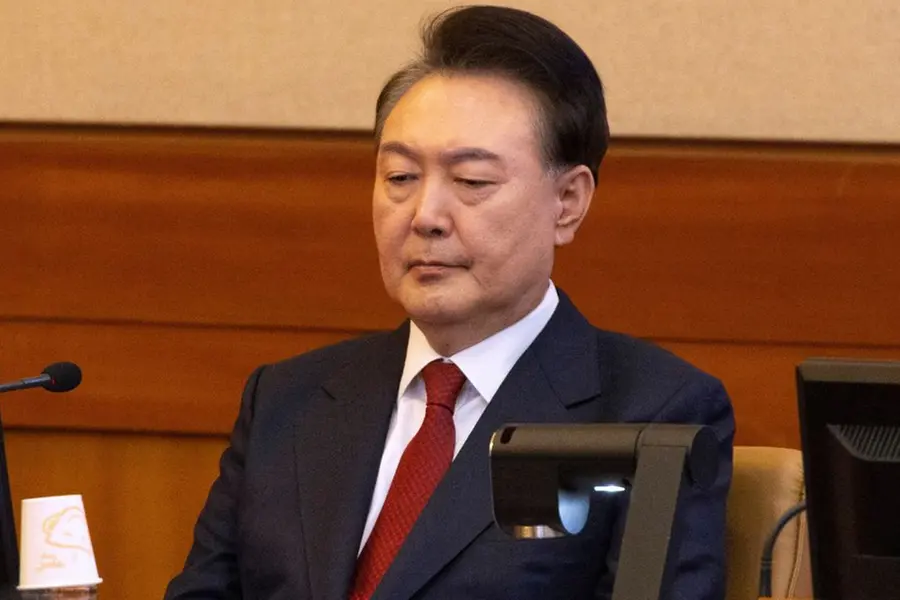
Seoul: South Korean President Yoon Suk Yeol made history on Thursday by becoming the first sitting head of state to stand trial in the country. Yoon, 64, faces serious charges of insurrection, which carry a potential sentence of life imprisonment or even the death penalty.
Court appearance and security
Yoon appeared in court for a preliminary hearing at the Seoul Central District Court, with heightened security around the venue. His motorcade arrived to a significant police presence, and dozens of his supporters gathered nearby. The hearing focused on the presentation of witnesses and other trial preparations. Additionally, Yoon’s lawyers requested the cancellation of his arrest and his release from custody, although such requests are rarely granted.
Charges of rebellion and martial law
Yoon was indicted on January 26 on charges of rebellion after declaring martial law in December. The prosecution alleges that this was an illegal attempt to dissolve the National Assembly and arrest opposition politicians and election officials. Yoon, however, maintains that his actions were a temporary warning to the liberal opposition and that he had always planned to respect the National Assembly’s decision if it voted to lift the martial law. The imposition of martial law lasted just six hours but caused significant political turmoil.
Impeachment and constitutional court proceedings
In December, the South Korean parliament impeached Yoon, temporarily suspending his presidential powers. The Constitutional Court is now deliberating whether to formally remove him from office or dismiss the impeachment, with a decision expected soon. If Yoon is removed, a new presidential election must be held within 60 days. Yoon’s tenth hearing in this impeachment case is also scheduled for later Thursday, where former acting president Han Duck-soo and former intelligence official Hong Jang-won are expected to testify.
Political turmoil
The imposition of martial law has deeply divided the nation, leading to riots by Yoon's conservative supporters outside the Seoul Western District Court when his arrest was authorised last month. Yoon’s defence team and members of the ruling party have publicly questioned the credibility of the courts and law enforcement institutions involved in the case. In addition to Yoon, several other high-ranking officials, including the defence minister, police chief Cho Ji-ho, and military commanders, have been arrested and indicted on charges related to the martial law declaration.
Yoon’s case has sparked intense debate over whether his martial law declaration violated the constitution. In South Korea, presidents have immunity from most criminal prosecutions, but not for charges of rebellion or treason.
(With input from AP, AFP)
Published: 20 Feb 2025, 08:05 am IST
Related Topics
Disclaimer: Kindly avoid objectionable, derogatory, unlawful and lewd comments, while responding to reports. Such comments are punishable under cyber laws. Please keep away from personal attacks. The opinions expressed here are the personal opinions of readers and not that of Mathrubhumi.
