
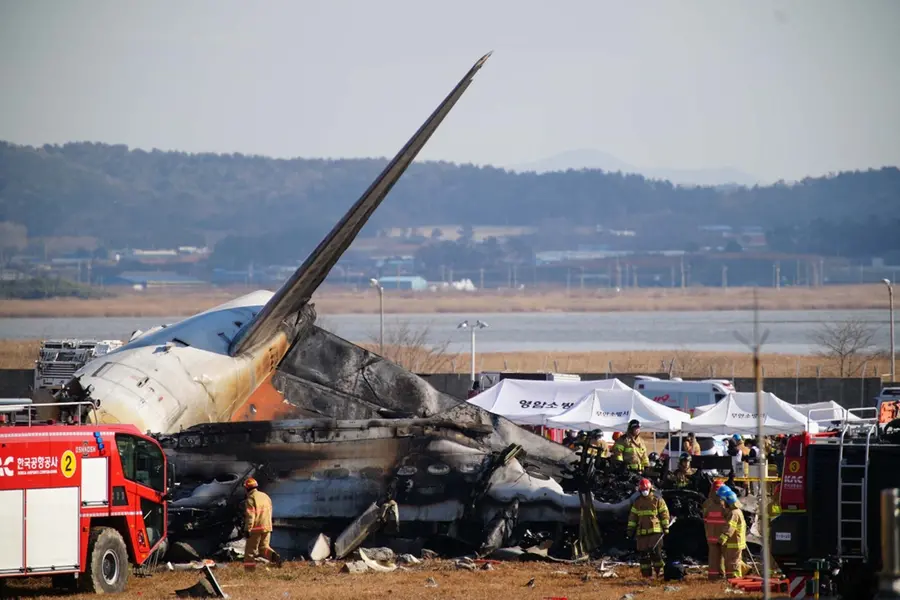
Seoul: The South Korean transport ministry on Saturday has revealed that the ill-fated Jeju Air flight, involved in last month’s deadly crash, received a warning from air traffic control about potential bird activity just one minute before its black box recording stopped.
The crash, which occurred on December 29, 2024, in the city of Muan, killed 179 people on board and left only two survivors.
The ministry briefed the preliminary findings of its investigation to the bereaved families on Saturday, shedding light on crucial events leading up to the tragic accident. According to the ministry, air traffic control communicated with the plane at 8:57:50 am, warning the crew about a potential bird strike as the aircraft approached Muan International Airport for landing.
At 8:58:11 am, the captain and first officer reported seeing a flock of birds flying below the aircraft, just moments before the black box recording ended at 8:58:50 am. The ministry speculates that the plane likely lost power after both engines were shut down due to the bird strikes, leading to the abrupt halt in the black box’s recording.
Bird strike and go-around attempt
Surveillance footage from the time of the accident confirmed that the plane made an attempt to go around after hitting a flock of birds. The aircraft had first communicated with the air traffic control tower at 8:54:43 am, during its final approach for landing. The control tower had cleared the aircraft for landing on Runway 01, which was in the opposite direction of where the accident would later occur.
Feathers and blood found on engines
The investigation also revealed the presence of feathers and blood, likely from winter migratory ducks, found on both engines of the plane. This evidence supports the theory that the bird strike caused the catastrophic engine failure that led to the crash.
Distress call
At 8:58:56 am, the pilot is believed to have declared a “mayday” distress call, though this timing is based on an estimate synchronised with control tower records. The ministry noted that there was no recording of the mayday call in the black box. After the plane was struck by the birds, it continued flying for around four minutes before attempting to land without the landing gear deployed. It crashed into a concrete localizer mound at 9:02:57 am and exploded in flames.
Ongoing investigation
The South Korean transport ministry stated that it would take several months to analyse the flight data and cockpit voice recordings to verify the details of the crash further. The government is expected to release the preliminary report by Monday, which will be shared with the International Civil Aviation Organisation (ICAO) as well as aviation authorities in the United States, France, and Thailand.
Meanwhile, the group representing the victims’ families announced that it had decided to end the search for additional remains at the crash site. Authorities have already sent the remains recovered from the site to the national forensics institute for identification.
IANS
Published: 25 Jan 2025, 08:04 pm IST
Related Topics
Disclaimer: Kindly avoid objectionable, derogatory, unlawful and lewd comments, while responding to reports. Such comments are punishable under cyber laws. Please keep away from personal attacks. The opinions expressed here are the personal opinions of readers and not that of Mathrubhumi.
