
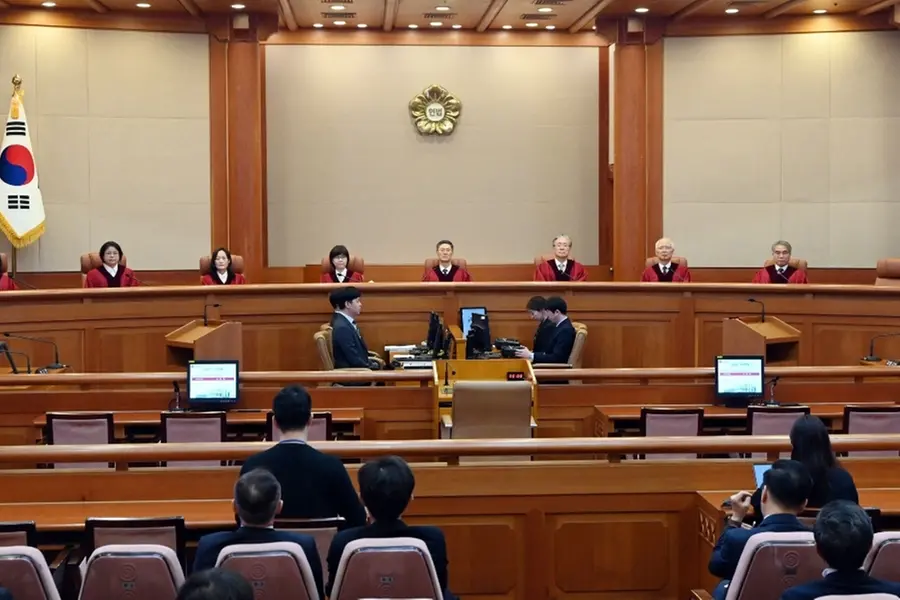
Seoul: South Korea’s Constitutional Court ruled on Monday to overturn the impeachment of Prime Minister Han Duck-soo, reinstating him as the country’s acting president amid an ongoing power struggle.
The decision prolongs uncertainty in the nation’s political crisis, which has triggered nationwide protests and raised concerns over governance and diplomatic stability. However, the court has yet to decide on the fate of President Yoon Suk Yeol, who remains suspended following his impeachment over a controversial martial law decree.
Political turmoil: From martial law to impeachments
The crisis erupted when President Yoon Suk Yeol declared martial law on December 3, deploying hundreds of troops and police officers to the National Assembly, allegedly to maintain order during escalating political tensions. Critics, however, accused him of attempting a power grab, leading to his impeachment by the National Assembly.
With Yoon suspended, PM Han Duck-soo assumed the role of acting president. But within weeks, Han himself faced impeachment in late December, further destabilising the government. The role of acting president was then transferred to Deputy Prime Minister and Finance Minister Choi Sang-mok.
Monday’s ruling reinstates Han, restoring his position as South Korea’s second-highest official. However, the country’s leadership remains in limbo as the Constitutional Court has yet to rule on Yoon’s impeachment case.

Yoon’s future hangs in the balance
The court’s impending decision on Yoon’s impeachment carries significant consequences:
- If the court upholds Yoon’s impeachment, South Korea must hold a presidential election.
- If the court rules in Yoon’s favour, he will regain presidential powers and return to office.
Analysts had expected a ruling on Yoon’s case by mid-March, but delays suggest that the court is carefully considering its decision.
Criminal charges and potential death sentence
Beyond impeachment, Yoon is facing criminal charges for rebellion, linked to his martial law order. Prosecutors allege he deployed troops to physically remove lawmakers to prevent them from overturning his decree.
Yoon’s Legal Situation:
- Arrested and charged with rebellion after martial law decree
- Released on March 8 to stand trial without detention
- Faces potential life sentence or death penalty if convicted
Public reaction and deepening divisions
The crisis has polarised South Korea, leading to massive rival protests in Seoul and other major cities. While initial polls showed strong public disapproval of Yoon’s martial law enactment, his supporters have since mobilised, arguing that he acted in national interest.
At the core of the debate is why Yoon deployed military forces to the National Assembly. Yoon maintains it was to preserve order, but senior military officials claim he ordered lawmakers forcibly removed to block an impeachment vote.
What’s next for South Korea?
With Han reinstated as acting president and Yoon’s fate still undecided, South Korea faces an extended period of political uncertainty. The Constitutional Court’s final ruling on Yoon will determine:
- Whether South Korea holds a presidential election
- If Yoon regains power
- The country’s stability amid ongoing protests and legal battles
As tensions rise, South Korea remains at a critical crossroads, with its democracy under scrutiny and its leadership in question.
Published: 24 Mar 2025, 08:34 am IST
Related Topics
Disclaimer: Kindly avoid objectionable, derogatory, unlawful and lewd comments, while responding to reports. Such comments are punishable under cyber laws. Please keep away from personal attacks. The opinions expressed here are the personal opinions of readers and not that of Mathrubhumi.