
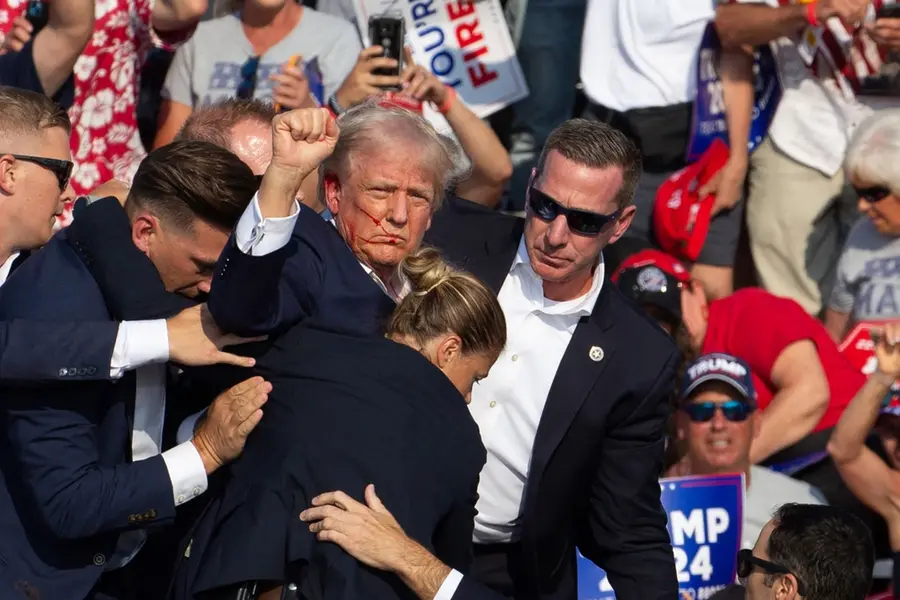
The Secret Service's response to a shooting at a July rally for former President Donald Trump was significantly hampered by communication breakdowns with local law enforcement, according to a report released on Friday. The five-page document summarises a litany of missed opportunities to prevent the shooting that left Trump wounded and a gunman firing from an unsecured rooftop.
Missed security opportunities at Butler rally
On July 13, Trump was injured by a gunshot during a campaign rally in Butler, Pennsylvania. The report highlights several issues, including a lack of clear communication between the Secret Service and local law enforcement, which left Trump vulnerable to sniper fire. Ronald Rowe Jr., acting director of the Secret Service, acknowledged the failures in handling line-of-sight vulnerabilities at the rally grounds and criticised "complacency" among agents.
“This was a failure on the part of the United States Secret Service,” said Rowe, addressing a news conference on Friday. “It’s important that we hold ourselves to account for the failures of July 13th and that we use the lessons learned to make sure that we do not have another failure like this again.”
Breakdowns in communication and tactical oversight
The report identifies a series of communication deficiencies leading up to the shooting by 20-year-old Thomas Matthew Crooks, who fired eight rounds at Trump from a rooftop 150 yards from where the former president was speaking. Despite identifying the building as a possible security threat before the rally, the Secret Service failed to implement necessary precautions.
“Line-of-sight issues were acknowledged but not properly mitigated,” said Rowe. “While some members of the advanced team were diligent, there was complacency on the part of others that led to a breach of security protocols.”
Another key issue was the failure to utilise Secret Service radio frequencies for critical communications. Local law enforcement relied on mobile phones to transmit details about Crooks, leading to fragmented information sharing. The report also revealed that some local officers were unaware of the existence of two Secret Service communication centres on-site, further hindering coordination.
“The failure of personnel to broadcast via radio the description of the assailant or vital information from local law enforcement... inhibited the collective awareness of all Secret Service personnel,” the report noted.
Concerns about roof access and local police coordination
The report raises concerns about why no law enforcement personnel were stationed on the roof from which Crooks launched his attack. A tactical team was positioned on the second floor of the building, but there was no discussion with the Secret Service about deploying officers to the roof, despite its known vulnerabilities.
In a further communication breakdown, the tactical team operating on the second floor had no contact with the Secret Service before the rally. The team had been brought in by a local police department without the knowledge of the federal agents in charge.
Lack of accountability
The executive summary of the report does not identify specific individuals responsible for the security lapses, nor does it mention any disciplinary actions taken. However, it is reported that five Secret Service agents were placed on modified duty, and Kimberly Cheatle, the director at the time, resigned shortly after the incident.
The Secret Service has faced increased scrutiny following the Butler shooting and a separate incident in which a man, Ryan Wesley Routh, was arrested at a Florida golf course where Trump was playing, with a rifle found hidden in nearby shrubbery.
Rowe concluded that these events highlight the need for a "paradigm shift" in how the agency protects public officials. He emphasised that Trump is now receiving the "highest levels" of protection, citing the Florida incident as an example of the agency's procedures functioning as intended.
Published: 21 Sept 2024, 07:11 am IST
Related Topics
Disclaimer: Kindly avoid objectionable, derogatory, unlawful and lewd comments, while responding to reports. Such comments are punishable under cyber laws. Please keep away from personal attacks. The opinions expressed here are the personal opinions of readers and not that of Mathrubhumi.
