
Ukrainian military intelligence reports indicate that Russia is prioritising the production of the Geran-4 and Geran-5 to build up stocks ahead of an autumn and winter campaign.
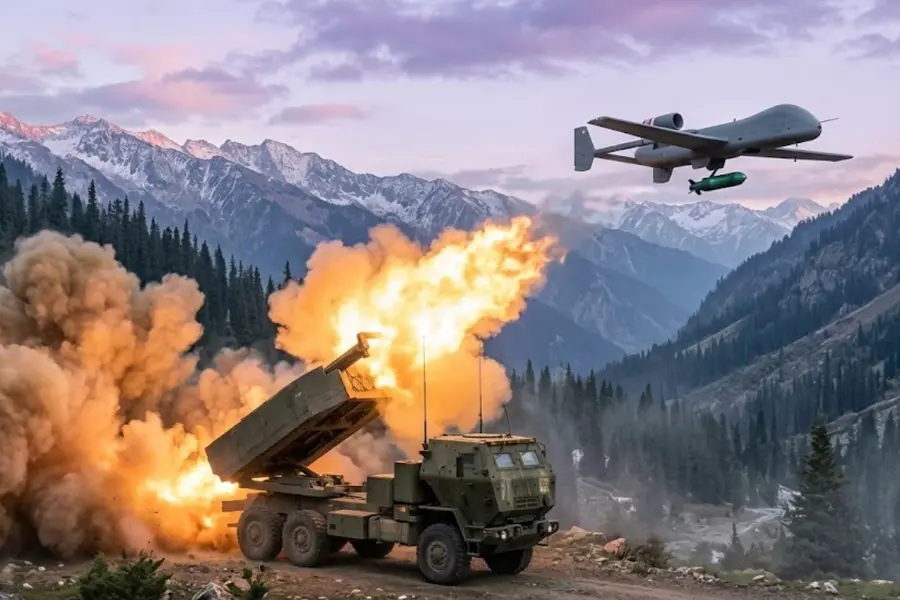
Russia's latest generation of jet-powered attack drones is posing a growing challenge to Ukraine's air defences, with the newly deployed Geran-5 proving significantly harder to intercept than earlier models.
The drone, which Russian forces began using operationally in August 2026, combines higher speed, longer range and anti-jamming capabilities, giving it an advantage over earlier propeller-driven variants.
Ukraine's Air Force spokesperson, Colonel Yuriy Ihnat, told the Financial Times in an interview on September 14 that Ukrainian forces were intercepting only about 60 per cent of attacks involving the Geran-5. The interception rate for other drone variants stands at around 95 per cent.
The figures underline how Russia's evolving drone technology is complicating Ukraine's efforts to protect its cities and critical infrastructure from aerial attacks.
What makes the Geran-5 different?
The Geran-5's design sets it apart from earlier Russian long-range attack drones. Its cylindrical fuselage and straight wings give it a profile closer to that of a cruise missile than a conventional drone.
According to Russian sources, the aircraft has a range of up to 1,000 km and can operate at altitudes of around 6,000 metres, higher than earlier models.
It is also considerably faster, with an estimated maximum speed of approximately 600 kilometres per hour. Its anti-jamming capabilities further complicate efforts to disrupt its navigation and communications.
These characteristics make the Geran-5 a more challenging target for Ukraine's ground-based air defence systems.
Ihnat said Ukraine has been compelled to increase its reliance on fighter aircraft to counter the new threat.
Since Russia began deploying the Geran-5 in August, Ukraine has resorted to the "very intensive use" of its fighter jets, with pilots directly shooting down the drones.
The drone's capabilities may extend beyond speed and range. Russian military expert Yuri Knutov has said the system incorporates machine vision linked to a digital terrain map, allowing it to identify and select targets autonomously.
From fighter jets to long-range drone warfare
The air war over Ukraine has undergone a significant transformation since Russia launched its full-scale invasion in 2022.
In the early stages of the conflict, both sides relied heavily on combat aircraft for two main purposes: engaging enemy aircraft and carrying out strikes in support of ground forces.
However, the growing effectiveness of air defence systems made such operations increasingly risky. Both sides gradually shifted towards stand-off attacks, using weapons that could strike targets from a distance while keeping aircraft outside the reach of many defensive systems.
By 2023, Russia had begun making extensive use of glide bombs.
Equipped with stabilising wings and navigation systems, these bombs could be released from distances of around 70 km from their targets, allowing aircraft to remain beyond the range of many air defence systems.
Drones subsequently emerged as a major instrument of air power. Their relatively low production costs, ability to be manufactured in large numbers and lack of onboard crews made them attractive for sustained attacks.
Smaller drones have been deployed near the front lines, while long-range variants have been used to strike targets deep inside Ukraine and Russia.
Russia's earlier long-range attack drones were largely based on propeller-driven designs.
The Geran-1 and Geran-2, upgraded Russian versions of Iran's Shahed-136, became the principal long-range drones in Russia's arsenal.
Although capable of travelling considerable distances, their relatively slow speeds made them easier to intercept.
Russia's shift towards jet-powered models has progressively increased their speed and operating altitude.
The Geran-3, the first jet-powered variant, was deployed in 2025. It could reach speeds of around 330 km/h, compared with approximately 185 km/h for the Geran-2.
However, the Geran-3 had a shorter range of around 600 km, compared with the Geran-2's reported potential range of up to 2,500 km. Its ability to fly at higher altitudes helped reduce its vulnerability to air defences.
The Geran-4 appeared later in 2025, with a reported maximum speed of 500 km/h and a range of around 850 km.
The Geran-5, introduced operationally in August 2026, represents the latest step in this progression, combining a higher top speed with a longer range.
Foreign components
Ukraine's military intelligence service has published details of components identified in the Geran-5, highlighting the role of foreign technologies in its production.
The components reportedly include a Chinese-supplied jet engine, digital processors manufactured in the United States and transistors made in Germany.
The findings suggest that Russia continues to obtain commercially available technologies from multiple countries despite Western sanctions.
According to the analysis, the country has developed supply chains that allow it to source components from abroad before assembling and manufacturing the finished systems domestically.
The reliance on foreign components highlights the international dimensions of the technology used in Russia's expanding drone programme.
Why the Geran-5 could pose a growing challenge for Ukraine
Russia's ability to manufacture the new jet-powered drones in large numbers could further complicate Ukraine's air defence efforts.
Ukrainian military intelligence reports indicate that Russia is prioritising the production of the Geran-4 and Geran-5 to build up stocks ahead of an autumn and winter campaign.
The timing is significant for Ukraine, which is reportedly running low on Western-supplied Patriot missiles used to intercept aerial threats.
These missiles are described in the report as the only truly effective means of shooting down the Geran-5.
Ukraine's deputy head of military intelligence, Major General Vadym Skibitskyi, highlighted the challenge in August, saying the country needed new interceptor missiles capable of matching the speed of the latest drones.
He said Ukraine now needed new interceptor missiles "with the appropriate speed" to intercept the latest jet-powered Gerans.
The development of faster drones, combined with Russia's efforts to expand production, could place additional pressure on Ukraine's air defence systems as the conflict continues.
Published: 28 Sept 2026, 11:48 am IST
ABOUT THE AUTHOR

Related Topics
Disclaimer: Kindly avoid objectionable, derogatory, unlawful and lewd comments, while responding to reports. Such comments are punishable under cyber laws. Please keep away from personal attacks. The opinions expressed here are the personal opinions of readers and not that of Mathrubhumi.