
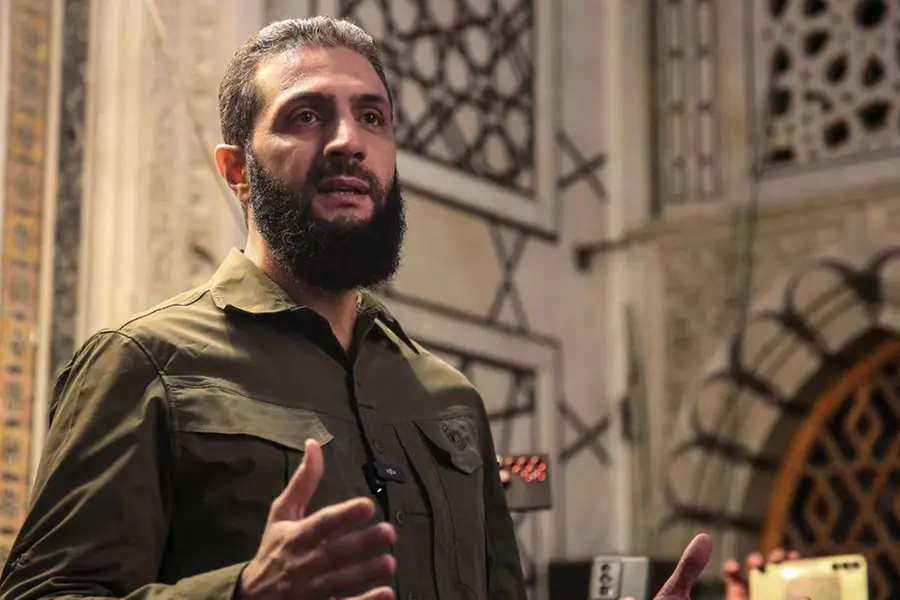
Damascus: Syria's rebel leader, who helped overthrow President Bashar Assad last month, has been appointed as the country’s interim president. The announcement came on Wednesday after a meeting of former insurgent factions in the Syrian capital, Damascus. The interim president, Ahmad al-Sharaa, is also set to oversee the drafting of a new constitution, with the existing one, adopted under Assad in 2012, being cancelled.
Al-Sharaa, previously known as Abu Mohammed al-Golani, is the head of Hayat Tahrir al-Sham (HTS), an Islamist group that played a crucial role in the swift offensive that toppled Assad. Once linked to al-Qaida, HTS has distanced itself from the terrorist group in recent years. Al-Sharaa has positioned himself as a proponent of pluralism, tolerance, and the protection of women’s and minority rights.
Also Read

Although a televised speech was expected from Al-Sharaa following the announcement, he did not appear immediately, leaving the details of his appointment unclear. The exact process behind his selection as interim president also remains undisclosed.
Reactions to appointment
The United States had previously offered a USD 10 million reward for al-Sharaa's capture but withdrew it after a recent meeting with him in Damascus. Top US diplomat for the Middle East, Barbara Leaf, described al-Sharaa as 'pragmatic' following their talks.
There has been no immediate reaction from the Arab world or international bodies, although Al-Sharaa's appointment was widely anticipated. While Western nations are cautiously restoring relations with Syria after Assad’s downfall, they remain wary of the country's new Islamist leadership.
Cancellation of Assad’s constitution
On the same day, Col. Hassan Abdul Ghani, spokesperson for Syria's new military government, announced that the country's constitution, introduced under Assad in 2012, was nullified. Al-Sharaa is now authorised to form a temporary legislative council to draft a new constitution for the country.
Abdul Ghani also revealed plans to disband all armed factions in Syria, with their members being integrated into state institutions. This marks a significant step towards centralising power under the new leadership.
Formation of new government
Since the fall of Assad, HTS has assumed control as Syria's de facto ruling power, establishing an interim government composed mostly of officials from its previous administration in rebel-held Idlib province. The new authorities have pledged to set up an inclusive government and hold a national dialogue, though no specific date has been set for this process.
Al-Sharaa has called for the creation of a unified national army and security forces, but concerns remain about how the diverse rebel factions, each with their own leadership and ideology, will unite under a central government.
Tensions with Kurdish forces
The situation is further complicated by the presence of Kurdish forces in Syria, who have established an autonomous enclave in the country’s north. These forces have long maintained a neutral stance, neither fully supporting the Assad government nor the rebels.
Tensions have risen in recent weeks between Kurdish forces and Turkish-backed groups allied with HTS. Notably, the Kurdish-led Syrian Democratic Forces (SDF) were not present at the meeting of Syria’s armed factions and have not yet commented on the developments.
Agency
Published: 30 Jan 2025, 06:24 am IST
Related Topics
Disclaimer: Kindly avoid objectionable, derogatory, unlawful and lewd comments, while responding to reports. Such comments are punishable under cyber laws. Please keep away from personal attacks. The opinions expressed here are the personal opinions of readers and not that of Mathrubhumi.