
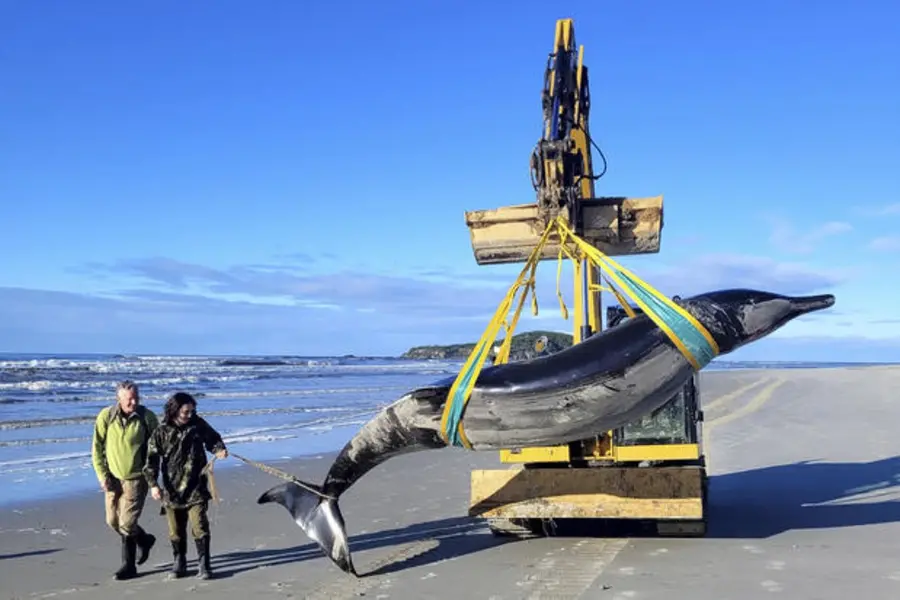
Wellington: The spade-toothed whale, considered the world’s rarest, has never been sighted alive. Their population size, diet, and precise habitat within the vast southern Pacific Ocean remain unknown. However, scientists in New Zealand might now have a significant breakthrough.
The country's conservation agency on Monday reported that a creature washed up on a South Island beach is believed to be a spade-toothed whale. The five-metre-long beaked whale was identified on Otago Beach by its distinctive colour patterns and the shape of its skull, beak, and teeth.
Also Read

“We know very little, practically nothing” about the creatures, Hannah Hendriks, marine technical adviser for the Department of Conservation, said. “This is going to lead to some amazing science and world-first information.”
If confirmed to be a spade-toothed whale, this specimen will be the first in a condition suitable for scientific dissection. This would enable researchers to map its relationship to the few other known specimens, understand its diet, and potentially discover more about its habitat.
To date, only six other spade-toothed whales have been identified, all found on New Zealand’s North Island beaches. Unfortunately, those specimens were buried before DNA testing could confirm their species, preventing any detailed study, Hendriks explained.
This time, the beached whale was quickly transported to cold storage and researchers will work with local Maori iwi (tribes) to plan how it will be examined, the conservation agency said.
New Zealand’s Indigenous people consider whales a taonga — a sacred treasure — of cultural significance. In April, Pacific Indigenous leaders signed a treaty recognizing whales as “legal persons,” although such a declaration is not reflected in the laws of participating nations.
Nothing is currently known about the whales’ habitat. The creatures deep-dive for food and likely surface so rarely that it has been impossible to narrow their location further than the southern Pacific Ocean, home to some of the world’s deepest ocean trenches, Hendriks said.
“It’s very hard to do research on marine mammals if you don’t see them at sea,” she said. “It’s a bit of a needle in a haystack. You don’t know where to look.”
The conservation agency said the genetic testing to confirm the whale's identification could take months.
It took “many years and a mammoth amount of effort by researchers and local people” to identify the “incredibly cryptic” mammals, Kirsten Young, a senior lecturer at the University of Exeter who has studied spade-toothed whales, said in emailed remarks.
The fresh discovery “makes me wonder — how many are out in the deep ocean and how do they live?” Young said.
The first spade-toothed whale bones were found in 1872 on New Zealand’s Pitt Island. Another discovery was made at an offshore island in the 1950s, and the bones of a third were found on Chile’s Robinson Crusoe Island in 1986. DNA sequencing in 2002 proved that all three specimens were of the same species — and that it was one distinct from other beaked whales.
Researchers studying the mammal couldn’t confirm if the species went extinct. Then in 2010, two whole spade-toothed whales, both dead, washed up on a New Zealand beach. Firstly mistaken for one of New Zealand’s 13 other more common types of beaked whale, tissue samples — taken before they were buried — later revealed them as the enigmatic species.
New Zealand is a whale-stranding hotspot, with more than 5,000 episodes recorded since 1840, according to the Department of Conservation.
(with inputs from agency)
Published: 16 Jul 2024, 02:28 pm IST
Related Topics
Disclaimer: Kindly avoid objectionable, derogatory, unlawful and lewd comments, while responding to reports. Such comments are punishable under cyber laws. Please keep away from personal attacks. The opinions expressed here are the personal opinions of readers and not that of Mathrubhumi.