
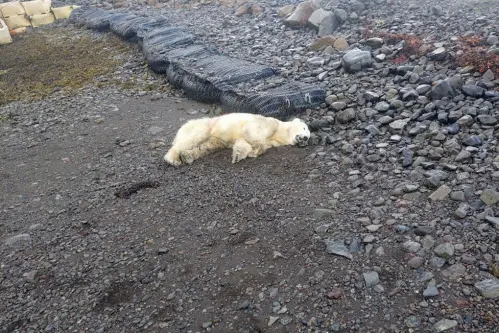
London: Authorities reported on Friday that a rare polar bear spotted near a cottage in a remote Icelandic village was shot by police after being deemed a threat. The incident occurred Thursday afternoon in northwest Iceland, following consultations with the Environment Agency, which opted against relocating the animal, according to Westfjords Police Chief Helgi Jensson.
“It’s not something we like to do,” Jensson stated. “In this case, as shown in the picture, the bear was very close to a summer house. There was an elderly woman inside.”
The bear rummaged through garbage while the cottage's owner, who was alone, became frightened and locked herself upstairs. She reached out for help via satellite link to her daughter in Reykjavik, the capital. “She stayed there,” Jensson noted, adding that other summer residents had left the area. “She knew the danger.”
While polar bears are not native to Iceland, they occasionally arrive on ice floes from Greenland, explained Anna Sveinsdóttir, director of scientific collections at the Icelandic Institute of Natural History. Numerous icebergs have been observed off the northern coast in recent weeks.
Although polar bear attacks on humans are rare, a study published in the *Wildlife Society Bulletin* in 2017 indicated that the loss of sea ice due to global warming has led to more hungry bears coming ashore, increasing the likelihood of conflicts with humans. Between 1870 and 2014, there were 73 documented polar bear attacks across Canada, Greenland, Norway, Russia, and the United States, resulting in 20 fatalities and 63 injuries. Notably, 15 of these attacks occurred in the last five years of that timeframe.
The bear shot on Thursday marked the first sighting in Iceland since 2016. Sightings are uncommon, with only 600 recorded since the ninth century. Although polar bears are a protected species in Iceland, making it illegal to kill them at sea, they can be shot if they pose a threat to humans or livestock.
In 2008, the arrival of two polar bears sparked a debate over how to handle such situations, leading the environment minister to form a task force. The group concluded that killing wandering bears was the most appropriate response, citing the potential danger they pose to people and animals, as well as the high cost of returning them to Greenland, about 300 kilometers (180 miles) away. The task force noted a healthy bear population exists in eastern Greenland, where these bears likely originate.
The young bear, weighing between 150 and 200 kilograms (300 to 400 pounds), will be taken to the institute for study. Scientists collected samples from the bear on Friday to check for parasites and infections and to assess its overall health, including organ condition and body fat percentage. The pelt and skull may also be preserved for the institute’s collection.
A Coast Guard helicopter surveyed the area where the bear was found but did not locate any additional bears. After the bear was removed, the woman who reported the sighting chose to extend her stay in the village, according to Jensson.(AP)
Published: 22 Sept 2024, 10:16 am IST
Related Topics
Disclaimer: Kindly avoid objectionable, derogatory, unlawful and lewd comments, while responding to reports. Such comments are punishable under cyber laws. Please keep away from personal attacks. The opinions expressed here are the personal opinions of readers and not that of Mathrubhumi.
