
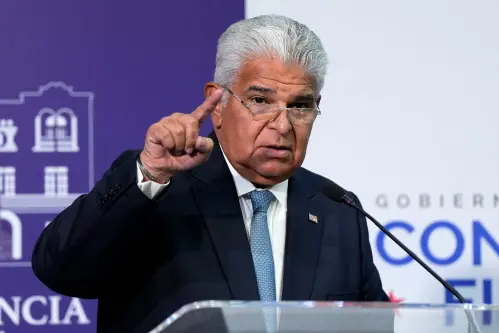
Panama City: On Thursday, José Raúl Mulino, President of Panama, denied the U.S. State Department’s assertion that Panama had reached an agreement permitting U.S. warships to pass through the Panama Canal without charges.
Mulino stated that he had informed U.S. Secretary of Defense Pete Hegseth on Wednesday that he had no authority to set or exempt transit fees. He expressed surprise at the U.S. State Department’s statement made late Wednesday suggesting otherwise.
“I completely reject that statement yesterday,” Mulino said during his weekly press conference. He added that he had instructed Panama’s ambassador in Washington to formally dispute the State Department’s claim. Late Wednesday evening, the U.S. State Department posted on X, saying, “U.S. government vessels can now transit the Panama Canal without charge fees, saving the U.S. government millions of dollars a year.” The department did not respond to Mulino’s remarks on Thursday.
The Panama Canal Authority issued a brief statement that same night, saying it had "not made any adjustments” to the fees.Mulino expressed his astonishment, saying, “The U.S. statement really surprises me because they’re making an important, institutional statement from the entity that governs United States foreign policy under the president of the United States based on a falsity. And that’s intolerable.”
The conflicting statements came just days after U.S. Secretary of State Marco Rubio met with Mulino and canal administrators and visited the key trade route. Rubio delivered a message from U.S. President Donald Trump that China’s influence in the region was unacceptable.Rubio had conveyed Trump’s concerns that China's presence near the canal could violate a treaty that led the U.S. to hand over control of the waterway to Panama in 1999. The treaty calls for the permanent neutrality of the American-built canal.
Canal administrators mentioned they were open to discussions about giving U.S. warships priority when crossing the canal, but did not suggest any consideration of waiving fees.Mulino emphasised that both Panama’s constitution and the laws governing the Canal Authority make it clear that neither the government nor the authority has the power to waive fees. “It’s a constitutional limitation,” he said. | AP
Published: 06 Feb 2025, 08:44 pm IST
Related Topics
Disclaimer: Kindly avoid objectionable, derogatory, unlawful and lewd comments, while responding to reports. Such comments are punishable under cyber laws. Please keep away from personal attacks. The opinions expressed here are the personal opinions of readers and not that of Mathrubhumi.
