
More than 800 people, including those injured and stranded by the floods, have so far been rescued from the affected areas, Kafle said
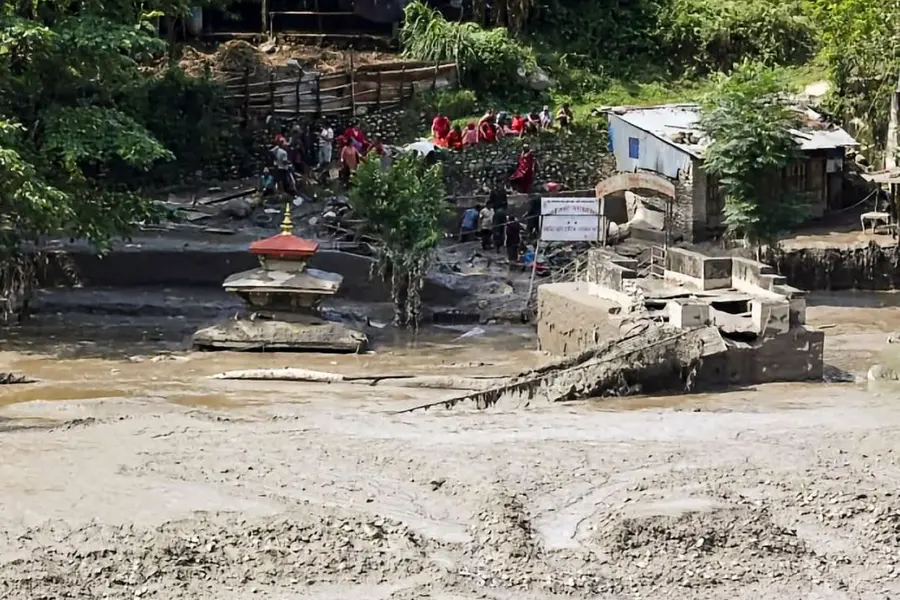
Kathmandu: Rescue teams battled through thick mud on Thursday as they searched for more than 1,400 people reported missing after devastating flash floods and landslides struck the Nepal-Tibet border.
The death toll has risen to 392, with entire villages swept away by a massive surge of freezing water, mud and debris that destroyed homes, bridges and other infrastructure.
Many of those missing are foreign tourists, including trekkers and Hindu pilgrims travelling to Tibet’s sacred Mount Kailash.
Nepali police said they had recovered 389 bodies, while authorities reported that another 910 people in Nepal remained out of contact. Of those, 517 were foreign tourists.
India accounts for the largest number of missing foreign nationals, while the United States said 90 of its citizens were unaccounted for.
China separately said 100 Chinese citizens who were not included in Nepal’s figures were missing.
‘It is a giant graveyard’
The scale of destruction became clearer as rescue teams entered the worst-hit areas.
Nepali soldiers used sniffer dogs to search for people and bodies buried beneath layers of mud and debris.
Omkar Joshi, a 35-year-old Nepali customs agent rescued from a hilltop in the border town of Timure, described the devastation as overwhelming.
“It is a giant graveyard,” he told AFP, saying that little remained except sand and pebbles stained with blood.
The sudden wall of mud and water swept through settlements, carrying away vehicles and destroying vital transport links.
Environmental historian Ruth Gamble of Australia's La Trobe University described the phenomenon as resembling an “inland tsunami”, with the debris travelling nearly 170 kilometres south into Nepal.
Glacial collapse triggered disaster
The US Geological Survey (USGS) said the disaster was caused by a glacial collapse that triggered a huge debris flow.
The event was initially reported as a magnitude 4.4 earthquake after seismic activity was detected. However, further analysis showed that the seismic signals were caused by the glacial collapse and the resulting debris flow.
The disaster highlights the growing risks posed by melting glaciers. Scientists have warned that climate change is increasing the likelihood of glacial lake floods and other glacier-related disasters.
Fears of another flood
Authorities are also concerned that another major flood could occur.
Large amounts of debris have blocked part of the river along the Nepal-China border, potentially trapping water upstream.
Qianggong Zhang, head of climate and environmental risks at the Kathmandu-based International Centre for Integrated Mountain Development, warned that the blockage could trigger a second flood.
Nepal's Flood Forecasting Division issued a special notice on Thursday, warning of a growing lake behind debris left by the landslide and urging people to exercise extreme caution.
Foreign tourists among those missing
Nepal's tourism authorities said citizens of Australia, Britain, Malaysia, the Netherlands, Portugal, South Africa and South Korea were among those who remained out of contact.
In Tibet, Chinese state media reported three deaths following the mudslide at Gyirong Port, while 558 people, including 260 foreigners, were reported missing.
Chinese Premier Li Qiang visited the affected area on Thursday to oversee relief operations.
Nearly 800 emergency workers, along with sniffer dogs and speed boats, have been mobilised in Tibet to assist with rescue efforts, China's Xinhua news agency reported.
China's Tibet Autonomous Region remains largely inaccessible to foreign journalists.
Balendra Shah visits affected areas
Nepal Prime Minister Balendra Shah visited some of the worst-hit areas on Thursday as rescue and relief operations continued.
Shah urged local authorities to provide immediate assistance to displaced families and reopen blocked roads.
He had earlier appealed to the country to “stand together” in the aftermath of the disaster.
The Dalai Lama, who lives in exile in India, also expressed his condolences, saying he would pray for those who lost their lives.
Sadhguru breaks down over missing pilgrims
Among those reported missing are Hindu devotees who had travelled to Mount Kailash on pilgrimage.
Indian spiritual leader Sadhguru said on Thursday that scores of pilgrims from across the world were among those caught in the disaster while returning from the pilgrimage.
According to Sadhguru, the pilgrims were at an immigration post when the floods struck.
In a video message to his followers, Sadhguru broke down while speaking about the incident. The anguished cries of other pilgrims could be heard in the background.
“The entire group was there in the building,” he said, describing the incident as a “terrible and extraordinary event”.
Rescue teams on both sides of the border continue to search through mud and debris for survivors and those still missing, while authorities remain on alert over the possibility of further flooding.
Published: 27 Aug 2026, 03:59 pm IST
ABOUT THE AUTHOR

Related Topics
Disclaimer: Kindly avoid objectionable, derogatory, unlawful and lewd comments, while responding to reports. Such comments are punishable under cyber laws. Please keep away from personal attacks. The opinions expressed here are the personal opinions of readers and not that of Mathrubhumi.