
Built to withstand tough Indian roads and tight family budgets, these sturdy machines soon stepped onto the world stage.
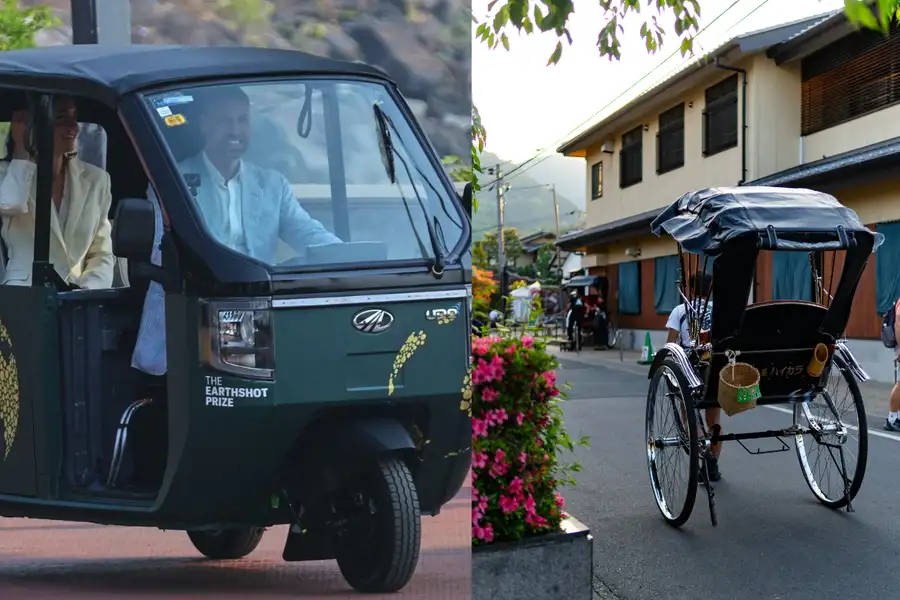
Mumbai saw a special sight today as Prince William took the driver's seat of a bright green electric three-wheeler, with Kate Middleton enjoying the ride in the back seat. Set against the Bandra-Worli Sea Link at Bandra Reclamation Garden, the royal couple met global innovators at the Earthshot Prize 2026 event. Driving the vehicle built by finalist Mahindra Last Mile Mobility, the Prince spoke about the colourful variety of world solutions, urging everyone to back real innovators who bring practical change.
Royalty rides into Mumbai's green future
This quiet green revolution is part of a story that began far away from electric motors. The word rickshaw comes from the Japanese Jin-rikisha, meaning a human-powered vehicle invented in Japan during the 1870s. While hand-pulled carts still carry tourists through Tokyo's historic Asakusa district, they first entered India through Shimla in 1880 and Calcutta in 1900. Initially used by Chinese traders to haul goods, these carts received official permission for passenger travel in 1914. By the 1930s and 1940s, pedal-powered cycle rickshaws took over, providing a faster and cheaper ride for everyday working people.
Everything changed after World War II. In Italy, aircraft designer Corradino D'Ascanio created the Vespa scooter and the three-wheeled Ape cargo carrier for Piaggio in 1947 to navigate narrow, damaged streets. Freedom fighter and industrialist N.K. Firodia spotted the vehicle in a trade magazine, brought samples to India, and demonstrated them to leaders Jawaharlal Nehru and Morarji Desai. Soon, production started in Pune alongside Bajaj Auto. By adding a simple passenger bench at the back in 1948, the domestic auto-rickshaw was born out of pure daily necessity. Bajaj introduced the first motor version in 1959, paving the way for larger share autos from makers like TVS, Mahindra, and Tata.
From Pune workshops to street corners worldwide
Built to withstand tough Indian roads and tight family budgets, these sturdy machines soon stepped onto the world stage. Following economic liberalisation in the 1990s, Indian manufacturers adapted engines and chassis for developing nations across Africa, Asia, and Latin America. Today, India exports over 600,000 three-wheelers every year to more than 60 countries. Depending on where you travel, you will hear them called the Tuk-Tuk in Thailand, the Bajaj in Tanzania, the Moto Taxi in Peru, or local names like Tam-Tam, Tempo, and Auto.
Harnessing clean batteries and the sun
Now, the humble three-wheeler is undergoing its biggest transformation yet. Under government push like the FAME scheme, Indian fleets are rapidly switching to clean electric power. Modern designs are even taking energy from the sun, featuring roof-mounted solar panels, swappable batteries, and plug-in ports that allow vehicles to travel up to 500 kilometres. From streets in Egypt to trials in the United Arab Emirates, solar and electric rickshaws are proving that affordable, clean mobility can carry millions into the future.
Published: 17 Nov 2026, 12:41 pm IST


Related Topics
Disclaimer: Kindly avoid objectionable, derogatory, unlawful and lewd comments, while responding to reports. Such comments are punishable under cyber laws. Please keep away from personal attacks. The opinions expressed here are the personal opinions of readers and not that of Mathrubhumi.
