
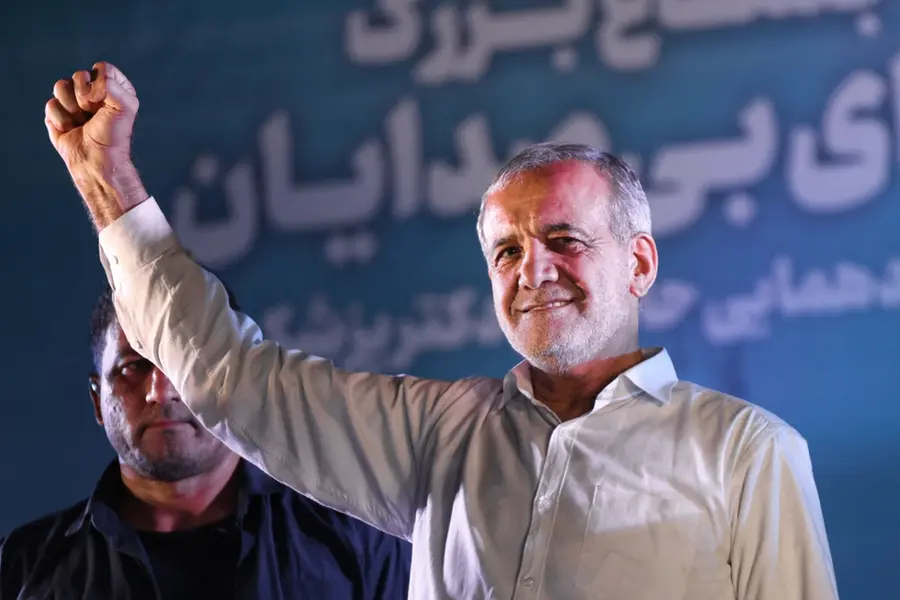
Tehran: Masoud Pezeshkian, Iran's sole reformist candidate in the recent presidential election, has risen from relative obscurity to become the ninth president of the Islamic Republic.
Pezeshkian, 69, won approximately 53.6 percent of the vote in a runoff election against the ultraconservative Saeed Jalili.
In the first round of Iran's snap elections on 28 June, Pezeshkian led the polls against three other conservative figures, surprising both supporters and rivals.
Pezeshkian's victory has invigorated Iran's reformist movement after years of conservative and ultraconservative dominance.
He will succeed the late ultraconservative president Ebrahim Raisi, who died in a helicopter crash in May.
"We will extend the hand of friendship to everyone; we are all people of this country; we should use everyone for the progress of the country," said Pezeshkian after he won the runoff.
"These people participated with love, they came to help, and I thank all these dear people."
In the run-up to the elections, Iran's main reformist coalition endorsed Pezeshkian, with former presidents Mohammad Khatami and the moderate Hassan Rouhani supporting his candidacy.
Pezeshkian assumes the presidency amid escalating regional tensions over the Gaza conflict, disputes with the West regarding Iran's nuclear programme, and domestic unrest due to the sanctions-hit economy.
The outspoken heart surgeon had publicly criticised the Raisi government for its handling of the death of Iranian Kurd Mahsa Amini, who had been detained for allegedly violating the Islamic republic's strict dress code for women.
In a Twitter post (now known as X), he urged the authorities to "set up an investigation team" to examine the circumstances of her death.
In recent campaigning, he has maintained his stance, criticising the enforcement of mandatory hijab laws which require women to cover their head and neck in public since shortly after the 1979 Islamic revolution.
"We oppose any violent and inhumane behaviour towards anyone, notably our sisters and daughters, and we will not allow these actions to happen," he said.
He also vowed to ease internet restrictions and to involve ethnic minorities in his government.
He also promised to ease internet restrictions and include ethnic minorities in his government.
Pezeshkian was born in 1954 to an Iranian father of Turkic origin and a Kurdish mother in the city of Mahabad, in the northwestern province of West Azerbaijan.
He has represented Tabriz in Iran's parliament since 2008, served as health minister in Khatami's government, and supervised medical teams during the Iran-Iraq conflict from 1980 to 1988.
In 1993, Pezeshkian lost his wife and one of his children in a car accident. He never remarried and raised his remaining three children -- two sons and a daughter -- alone.
Mohammad Javad Zarif, Iran's former foreign minister who secured the landmark 2015 nuclear deal with world powers, campaigned on Pezeshkian's behalf. The deal fell through three years later.
Pezeshkian has called for reviving the accord -- which sought to curb Tehran's nuclear activity in return for sanctions relief -- to get Iran "out of isolation".
"If we manage to lift the sanctions, people will have an easier life while the continuation of sanctions means making people's lives miserable," he said during a televised interview.
Pezeshkian will be tasked with applying state policy outlined by the supreme leader Ayatollah Ali Khamenei, who wields ultimate authority in the country. AFP
Published: 06 Jul 2024, 11:57 am IST
Related Topics
Disclaimer: Kindly avoid objectionable, derogatory, unlawful and lewd comments, while responding to reports. Such comments are punishable under cyber laws. Please keep away from personal attacks. The opinions expressed here are the personal opinions of readers and not that of Mathrubhumi.
