
A look at Khaleda Zia’s arrests under three regimes and how imprisonment shaped her enduring political influence.
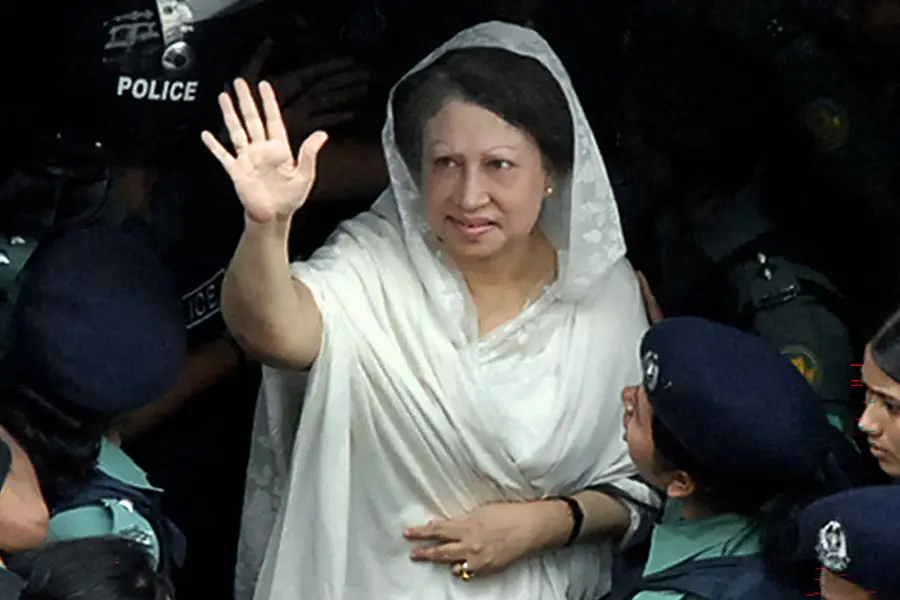
The longtime chief of the Bangladesh Nationalist Party (BNP) chairperson and three-time former prime minister Khaleda Zia passed away on Tuesday while receiving treatment at Evercare Hospital in Dhaka. She was 80. Her death marks the end of a political life shaped by repeated arrests and imprisonment under three different political regimes, underscoring both Bangladesh’s turbulent political journey and her enduring role at the centre of it.
Across more than four decades in public life, Khaleda Zia was arrested and imprisoned on five occasions. These arrests, spanning periods of military rule, caretaker governance and an elected administration, mirrored the intense power struggles that defined modern Bangladeshi politics and placed her repeatedly behind bars as a leading opposition figure.
Crackdowns during the Ershad-era uprising
Khaleda Zia formally entered politics on January 3, 1982, and quickly emerged as a prominent voice against the autocratic rule of then president Hussain Muhammad Ershad.
During the anti-Ershad movement, she was arrested three times while taking part in protests and political programmes. She was detained on November 28, 1983, May 3, 1984, and November 11, 1987. These detentions were short-lived, and she did not serve long prison sentences during this phase of political agitation.
Custody amid the emergency caretaker administration
Her next period of incarceration came after her government completed its term in 2006, when Bangladesh plunged into political instability marked by violence and delayed elections. In January 2007, a military-backed caretaker government took charge, during which corruption cases were filed against Khaleda Zia and her two sons.
She was arrested on September 3, 2007, from her home in Dhaka’s cantonment area. After being presented before the Chief Metropolitan Magistrate’s Court, her bail plea was rejected, and she was sent to a specially designated sub-jail inside the National Parliament complex.
During this incarceration, Khaleda Zia spent both major Islamic festivals of 2007 in custody—Eid-ul-Fitr on October 14 and Eid-ul-Azha on December 21. On both occasions, prison authorities permitted family visits and the delivery of essential items. At the same time, her sons Tarique Rahman and Arafat Rahman Koko were also being held in separate cases.
Following the death of her mother in Dinajpur on January 18, 2008, Khaleda Zia was granted temporary parole for six hours the next day to attend the funeral. After completing 372 days in prison, she was finally released on bail on September 11, 2008.
Jail terms under the Hasina-led Awami League rule
Her final imprisonment began a decade later under the Awami League government led by Sheikh Hasina. In 2018, courts sentenced Khaleda Zia to a cumulative 17-year jail term in the Zia Orphanage Trust and Zia Charitable Trust corruption cases. She was arrested on February 8, 2018, and sent to the old central jail on Nazimuddin Road in Dhaka.
As her physical condition worsened, she was later shifted from prison to Bangabandhu Sheikh Mujib Medical University Hospital, where she remained under guard. Despite the change in location, her legal status remained unchanged, keeping her effectively incarcerated for more than two years.
On March 25, 2020, the government temporarily suspended her sentence, allowing her to receive medical treatment at home. The decision came with strict conditions, meaning she was not fully freed and remained under legal limitations akin to house arrest.
Political developments following the 2024 student-led uprising altered the situation. Acting through executive authority, the president commuted her sentence. This was followed by a court decision on November 27, 2024, which cleared Khaleda Zia of corruption charges, formally ending her long-running legal ordeal.
Four decades at the helm of BNP and sustained political resistance
Parallel to her legal battles, Khaleda Zia maintained firm control over the BNP for nearly 41 uninterrupted years. She joined the party as a primary member on January 2, 1982, rising swiftly through the ranks. By March 1983, she had become senior vice-chairperson.
Her elevation to the party’s top post came in 1984. After President Justice Abdus Sattar fell ill, she was chosen unopposed as acting chairperson on January 12, before being formally elected chairperson on May 10. Party councils later reaffirmed her leadership in 1993, 2009 and 2016.
As BNP chief, Khaleda Zia played a central role in organising resistance against military rule. She was instrumental in forming a seven-party alliance in 1983, which later coordinated nationwide protests. By 1987, the movement had coalesced around a single demand—“Ershad Hatao”—placing sustained pressure on the regime.
Despite internal divisions and repeated crackdowns, the agitation continued, contributing to the collapse of Ershad’s rule and restoring parliamentary politics. The BNP’s victory in the February 27, 1991 general election brought Khaleda Zia to office as prime minister for the first time.
Her political life, marked by cycles of power and imprisonment, leaves behind a complex legacy. Few leaders in Bangladesh have spent as much time confronting the state from prison cells while remaining at the centre of national politics as Khaleda Zia.
Khaleda Zia visited India twice as the Prime Minister in 1992 and 2006 and once as the opposition leader in 2012 at the invitation of the Indian government.
Published: 30 Dec 2025, 09:49 am IST
Related Topics
Disclaimer: Kindly avoid objectionable, derogatory, unlawful and lewd comments, while responding to reports. Such comments are punishable under cyber laws. Please keep away from personal attacks. The opinions expressed here are the personal opinions of readers and not that of Mathrubhumi.
