
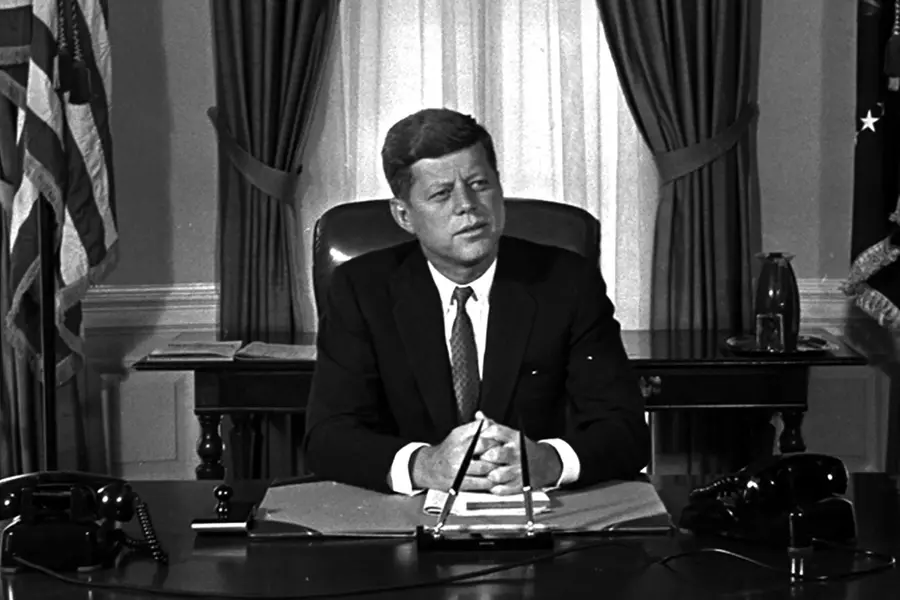
Dallas: Previously classified documents related to the 1963 assassination of President John F Kennedy were released on Tuesday evening, following an order by President Donald Trump shortly after he took office.
More than 1,100 files, consisting of over 31,000 pages, were posted on the website of the US National Archives and Records Administration. The majority of the National Archives' collection of over six million pages of records, photographs, motion pictures, sound recordings, and artefacts related to the assassination had already been released previously.
Time needed to analyse files
Larry J Sabato, director of the University of Virginia Centre for Politics and author of The Kennedy Half-Century, said his team had begun reviewing the documents, but it may take time to determine their full significance.
“We have a lot of work to do for a long time to come, and people just have to accept that,” he said.
Trump announced the release on Monday while visiting the John F Kennedy Centre for the Performing Arts in Washington, stating that his administration would be releasing around 80,000 pages.
“We have a tremendous amount of paper. You’ve got a lot of reading,” Trump said.
The National Archives stated on its website that, in accordance with the president's directive, the release would include “all records previously withheld for classification.”
Extent of withheld documents
Researchers have estimated that around 3,000 files had not been released in full or in part. Last month, the FBI announced it had discovered approximately 2,400 new records related to the assassination.
Many experts who have studied previous government releases have cautioned that the newly available documents are unlikely to contain any ground-breaking revelations. However, there remains strong public interest in details concerning the assassination and the events surrounding it.
Trump’s directive in January tasked the national intelligence director and the attorney general with developing a plan to release the records.
Kennedy assassination overview
Kennedy was assassinated on 22 November 1963, during a visit to Dallas. As his motorcade neared the end of its parade route in the city centre, shots were fired from the Texas School Book Depository building. Police arrested 24-year-old Lee Harvey Oswald, who had positioned himself on the sixth floor as a sniper. Two days later, nightclub owner Jack Ruby fatally shot Oswald during a jail transfer.
A year after the assassination, the Warren Commission, established by President Lyndon B Johnson to investigate the murder, concluded that Oswald acted alone and that there was no evidence of a conspiracy. However, this did not prevent a web of alternative theories from developing over the decades.
Oswald, a former Marine, had defected to the Soviet Union before returning to Texas.
Newly released documents
The newly released files include a memo from the CIA’s St. Petersburg station from November 1991. The memo states that earlier that month, a CIA official had befriended a US professor in the city, who had relayed information from a friend working for the KGB. According to the memo, the KGB official had reviewed “five thick volumes” of files on Oswald and was “confident that Oswald was at no time an agent controlled by the KGB.”
The memo also noted that, based on Oswald’s description in the files, the KGB official doubted “that anyone could control Oswald,” but added that the KGB had closely monitored him while he was in the Soviet Union. Additionally, the file mentioned that Oswald was a poor shot when he practised target firing in the USSR.
Government mandates and ongoing redactions
In the early 1990s, the federal government mandated that all assassination-related documents be kept in a single collection at the National Archives and Records Administration. The collection was required to be opened by 2017, except for any documents exempted by the president.
Approximately 500 documents, including tax returns, were not subject to the 2017 disclosure requirement.
Trump, who began his first term in 2017, initially stated that he would allow the release of all remaining records. However, he later withheld some, citing potential national security concerns. While President Joe Biden’s administration continued to release files, some remained classified.
Sabato stated that his team has a “long, long list” of sensitive documents they are examining, particularly those that previously contained heavy redactions.
“There must be something really, really sensitive for them to redact a paragraph or a page or multiple pages in a document like that,” he said. “Some of it’s about Cuba, some of it’s about what the CIA did or didn’t do relevant to Lee Harvey Oswald.”
Some of the previously released documents have provided insights into intelligence operations at the time. This includes CIA cables and memos discussing Oswald’s visits to the Soviet and Cuban embassies during a trip to Mexico City, just weeks before the assassination.
AP
Published: 19 Mar 2025, 07:41 am IST
Related Topics
Disclaimer: Kindly avoid objectionable, derogatory, unlawful and lewd comments, while responding to reports. Such comments are punishable under cyber laws. Please keep away from personal attacks. The opinions expressed here are the personal opinions of readers and not that of Mathrubhumi.
