
Donald Trump reportedly urged Jensen Huang to retain his Nvidia CEO position. Meanwhile, US intelligence officials remain divided over espionage allegations involving Alice Huang and a probe into Nvidia chip exports to China.
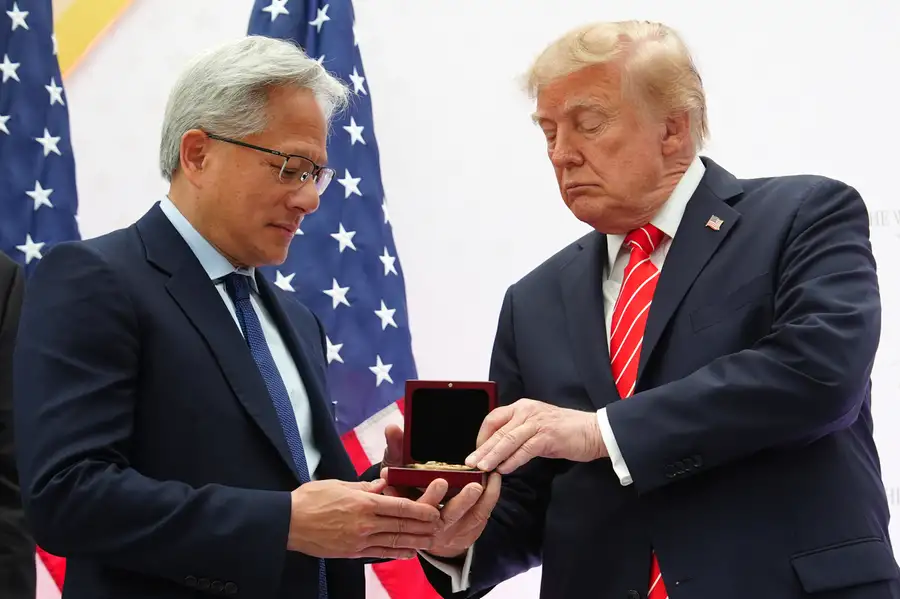
Washington DC: US President Donald Trump reportedly called Jensen Huang on Tuesday and urged him to fight to retain his position as chief executive of Nvidia, according to a report by The New York Times, which cited two people briefed on the conversation.
Huang, however, resigned on Thursday, ending his more than three-decade association with the artificial intelligence chipmaker he co-founded in 1993.
Also Read

Nvidia announced that its chief financial officer, Colette Kress, would serve as interim CEO while the company's board searches for a permanent successor. Harvey C Jones was also appointed as the company's first-ever board chair.
Trump's reported intervention came amid growing scrutiny of Huang's personal relationships and their potential implications for US national security.
The President had publicly defended the Nvidia chief earlier in the week, describing him as an honourable person. Trump also said he believed Huang was unaware of the alleged intelligence connections of the Chinese businesswoman linked to him.
Why Jensen Huang's personal relationships became a national security issue
The controversy centres partly on Alice Huang, a Chinese businesswoman and former executive associated with Singapore-based Megaspeed International.
US intelligence agencies reportedly examined whether she had connections to China's Ministry of State Security and whether her relationship with Jensen Huang could have been used to obtain sensitive information.
However, the allegations have not been established, and American intelligence officials remain divided over the strength of the evidence.
A CNN report said intelligence collected on Alice Huang, including intercepted communications, has not conclusively demonstrated that she knowingly passed information to Beijing.
Some officials within the Office of the Director of National Intelligence reportedly believe that describing her as a Chinese spy goes too far. CIA officials are also said to be uncertain whether the available material establishes that she knowingly worked for Chinese intelligence.
Other officials in the Trump administration reportedly consider her connections and access to influential American figures a significant counterintelligence concern.
China has rejected the espionage allegations.
FBI investigation and Trump's response
The FBI has reportedly been investigating the matter for at least a year.
US Attorney General Todd Blanche said on Thursday that neither the Justice Department nor he or FBI Director Kash Patel had reached a conclusion about Alice Huang's alleged intelligence connections.
Trump also avoided making a definitive assessment when asked about Jensen Huang's resignation by commentator Stephen A Smith.
He said the key question was whether the woman was a spy and acknowledged that this had not necessarily been established.
Trump said Huang's decision to step down could be viewed differently depending on whether the espionage allegations were proven.
Megaspeed investigation raises separate questions about Nvidia chips reaching China
The controversy has also drawn attention to Megaspeed International, the Singapore-based company associated with Alice Huang.
According to the CNN report, the Justice Department and Commerce Department opened an investigation into the company in 2024.
The inquiry forms part of a broader investigation into foreign shell companies suspected of purchasing restricted Nvidia processors and diverting them to China.
Megaspeed reportedly buys large quantities of Nvidia chips, raising questions about whether advanced American technology could have reached China through intermediaries.
The investigation has also prompted questions within the White House about why the Commerce Department did not place Megaspeed on the US government's Entity List.
The list restricts trade with companies considered threats to American national security or foreign policy interests.
The issue is particularly significant because advanced Nvidia processors are central to the development of artificial intelligence systems, making their export a major concern in the technological competition between Washington and Beijing.
Another controversy involving an Nvidia executive
The leadership crisis intensified after The New York Times reported that Huang had also been involved in an intimate relationship with Kimberly Powell, an Nvidia executive who reported to him.
Huang reportedly acknowledged being unfaithful to his wife in a message to employees and apologised to his family, colleagues and shareholders.
The revelations brought additional scrutiny to his personal conduct and leadership at the company.
Nvidia's board had already initiated an independent investigation into whether Huang had been targeted as part of a foreign intelligence operation.
The company had previously said it had no reason to believe its trade secrets or national security had been compromised.
Is the bigger issue Jensen Huang's resignation or the security of America's AI technology?
The developments raise three distinct questions that extend beyond the departure of one of the world's most influential technology executives.
1. An espionage allegation is not the same as an established intelligence operation
The uncertainty surrounding Alice Huang is significant. While some US officials reportedly consider her connections suspicious, others believe the available intelligence does not establish that she was recruited by Beijing.
This distinction matters because allegations involving foreign intelligence agencies can have serious consequences for individuals, companies and international relations.
The absence of a definitive finding also means that her alleged role should not be presented as proven.
2. The investigation exposes potential weaknesses in US chip-export controls
The Megaspeed investigation raises a separate question: whether restrictions on advanced Nvidia processors are sufficiently effective.
Washington has imposed controls on exports of sophisticated AI chips to China to limit Beijing's access to technology with potential military and strategic applications.
However, foreign intermediaries and shell companies can complicate enforcement.
If restricted processors are being diverted through third countries, the issue extends beyond individual relationships to the effectiveness of America's technology-export monitoring system.
3. Nvidia's leadership transition comes at a sensitive moment for the AI industry
Nvidia is a major supplier of processors used to train and operate advanced AI systems. Its products have become central to the global AI industry and the technological competition between the US and China.
Huang's departure therefore has implications beyond corporate succession.
The board's decision to appoint an interim CEO while searching for a permanent successor comes at a time when the company faces questions about governance, national security and its international business operations.
Ultimately, the central unresolved issue is not simply why Huang resigned. It is whether the allegations surrounding his personal relationships point to an actual foreign intelligence operation, and whether American authorities have adequately protected strategically important AI technology from reaching China.
Published: 13 Nov 2026, 07:25 am IST


ABOUT THE AUTHOR
Disclaimer: Kindly avoid objectionable, derogatory, unlawful and lewd comments, while responding to reports. Such comments are punishable under cyber laws. Please keep away from personal attacks. The opinions expressed here are the personal opinions of readers and not that of Mathrubhumi.