
Watson is remembered as one of the 20th century’s most renowned scientists for his 1953 discovery of the DNA double helix alongside Francis Crick
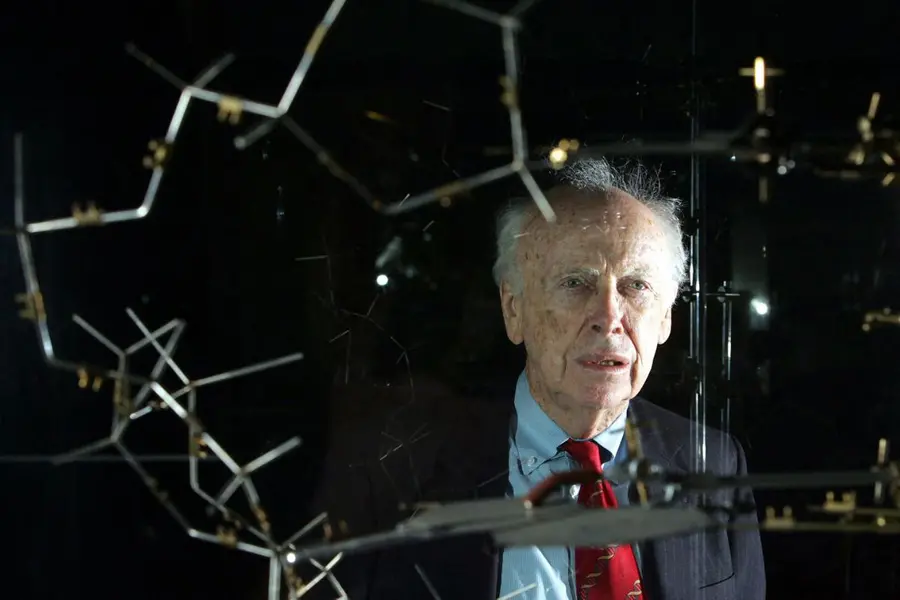
New York: James Watson, the Nobel Prize-winning scientist co-credited with discovering the double-helix structure of DNA but whose reputation was overshadowed by repeated racist comments, has died aged 97.
The American biologist passed away on Thursday in hospice care on Long Island, New York, according to the Cold Spring Harbor Laboratory, where he worked for much of his career.
Who is James Watson?
Watson is remembered as one of the 20th century’s most renowned scientists for his 1953 discovery of the DNA double helix alongside Francis Crick — a breakthrough that transformed modern biology.
Together with Crick and Maurice Wilkins, Watson received the 1962 Nobel Prize in Physiology or Medicine for their groundbreaking work, which paved the way for advances in genetics, medicine and biotechnology, from DNA testing in forensics to genetically modified crops.
Watson was just 25 when he took part in one of science’s greatest discoveries. He later made significant contributions to cancer research and played a key role in mapping the human genome.
His 1968 memoir The Double Helix became a bestseller, celebrated for its candid and lively portrayal of the fierce rivalries that drove scientific discovery.
Yet on a personal level, Watson developed a reputation for being outspoken, abrasive and, at times, deeply offensive. He was known for belittling female scientists, including Rosalind Franklin, whose X-ray diffraction images of DNA provided a crucial clue for Watson and Crick’s model.
Franklin, who worked with Wilkins, was not recognised by the Nobel committee. She died in 1958, and the prize is neither awarded posthumously nor shared among more than three people.
Watson largely escaped repercussions for his controversial views until 2007, when he told a newspaper he was “inherently gloomy about the prospect of Africa” because “all our social policies are based on the fact that their intelligence is the same as ours — whereas all the testing says not really.”
He later apologised, but was swiftly removed as chancellor of Cold Spring Harbor Laboratory. His reputation never recovered.
‘Twisting ladder’
Born on 6 April 1928 in Chicago, Illinois, Watson won a scholarship to the University of Chicago at the age of 15. He earned a PhD in zoology from Indiana University Bloomington in 1950 before moving to Europe, where he met Francis Crick at Cambridge and began their historic collaboration.
Working from X-ray images produced by Rosalind Franklin and Maurice Wilkins at King’s College London, Watson and Crick developed the model of DNA’s double-helix structure — a twisting ladder-like molecule capable of replicating itself.
Their findings, published in Nature in 1953, revolutionised genetics and were met with global acclaim.
Watson later taught at Harvard University for 15 years before becoming director of Cold Spring Harbor Laboratory, transforming it into a world-leading centre for molecular biology. From 1988 to 1992, he served as one of the directors of the Human Genome Project at the US National Institutes of Health.
He married Elizabeth Watson, with whom he had two sons, Rufus and Duncan.
Over his long career, Watson received numerous honorary degrees and awards, and was portrayed by Jeff Goldblum in the BBC film The Double Helix.
On Friday, Cold Spring Harbor Laboratory praised his “extraordinary contributions”, though it had long since severed ties with him — including revoking his emeritus status after he made further “reprehensible” remarks in a 2019 PBS documentary.
Published: 08 Nov 2025, 06:30 am IST
Related Topics
Disclaimer: Kindly avoid objectionable, derogatory, unlawful and lewd comments, while responding to reports. Such comments are punishable under cyber laws. Please keep away from personal attacks. The opinions expressed here are the personal opinions of readers and not that of Mathrubhumi.
