
Delhi’s image was released by the ISS alongside night-time photographs of other global urban centres like Singapore and Tokyo.
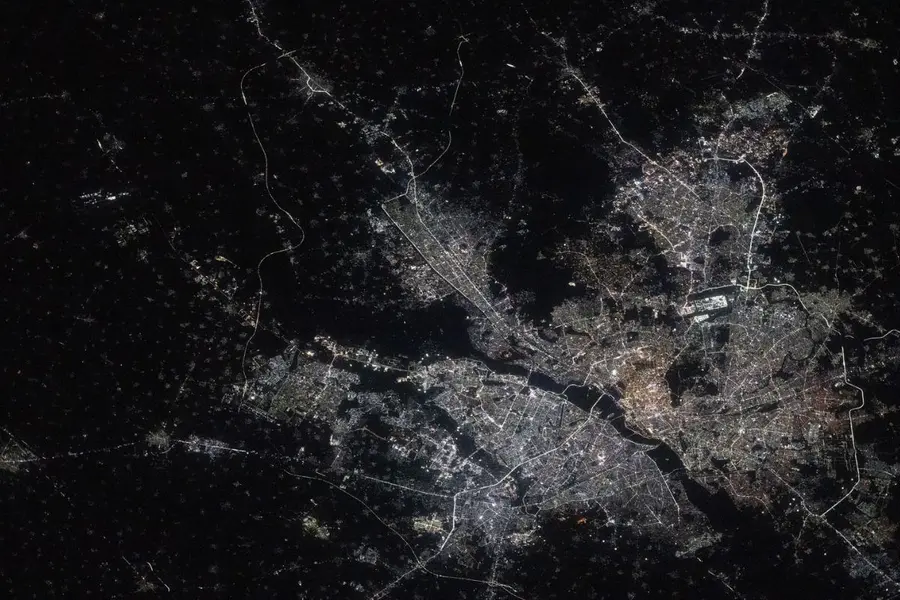
Washington: The International Space Station (ISS) has released a new set of night-time images capturing some of the world’s brightest cities after sunset, with Delhi appearing among the most striking. One photograph shows India’s capital glowing vividly, its dense web of lights forming a clear and elaborate pattern visible from orbit.
Delhi’s image was released alongside night-time photographs of other global urban centres. One shows Singapore separated from Malaysia’s Johor Bahru by the Johor Strait, while another depicts Tokyo and its surrounding suburbs lit up along Tokyo Bay.
Also Read

In a statement accompanying the visuals, the ISS said, “Cities like Delhi, Singapore, Tokyo, and São Paulo are among the most luminous urban centers seen from the International Space Station at night.” The comparison places Delhi firmly among the world’s brightest and most recognisable cityscapes as viewed from orbit.
On Delhi’s image, the ISS statement reads, “India's National Capital Territory of Delhi, home to approximately 34.67 million people, is the second-largest metropolitan area in the world after Tokyo.” The description underscores the immense scale and population density that make Delhi’s nightscape stand out so sharply from space.
Further details from the ISS note, “This nighttime view from the International Space Station, taken at approximately 10:54 pm local time, shows the city split by the Yamuna River. The bright rectangular area near the right center marks Indira Gandhi International Airport, one of the busiest aviation hubs in South Asia.” The photograph not only captures Delhi’s luminosity but also clearly delineates some of its major landmarks.
25 years of human presence in space
The release comes as the ISS marks a significant milestone. The station completed 25 years of continuous human presence on November 2, 2025. Its origins date back to design phases between 1984 and 1993, with construction contributions from the United States, Canada, Japan and European partners, reflecting decades of international cooperation.
Continuous habitation began when the Expedition 1 crew arrived on November 2, 2000. Since then, at least one astronaut or cosmonaut has lived aboard the station every day, making it the longest uninterrupted human presence in space. The first resident crew, NASA astronaut William Shepherd and Roscosmos cosmonauts Yuri Gidzenko and Sergei Krikalev, reached the ISS two days after launching from Kazakhstan on October 31, 2000, establishing the foundation for long-term scientific research.
Over its 25 years of occupancy, the ISS has welcomed nearly 300 visitors from 26 countries and supported thousands of experiments aimed at improving life on Earth and preparing for future missions to the Moon and Mars.
ANI
Published: 21 Nov 2025, 03:57 pm IST
Related Topics
Disclaimer: Kindly avoid objectionable, derogatory, unlawful and lewd comments, while responding to reports. Such comments are punishable under cyber laws. Please keep away from personal attacks. The opinions expressed here are the personal opinions of readers and not that of Mathrubhumi.