
Gaza’s Health Ministry reports that 3,785 people have been killed since the collapse of a temporary ceasefire in March
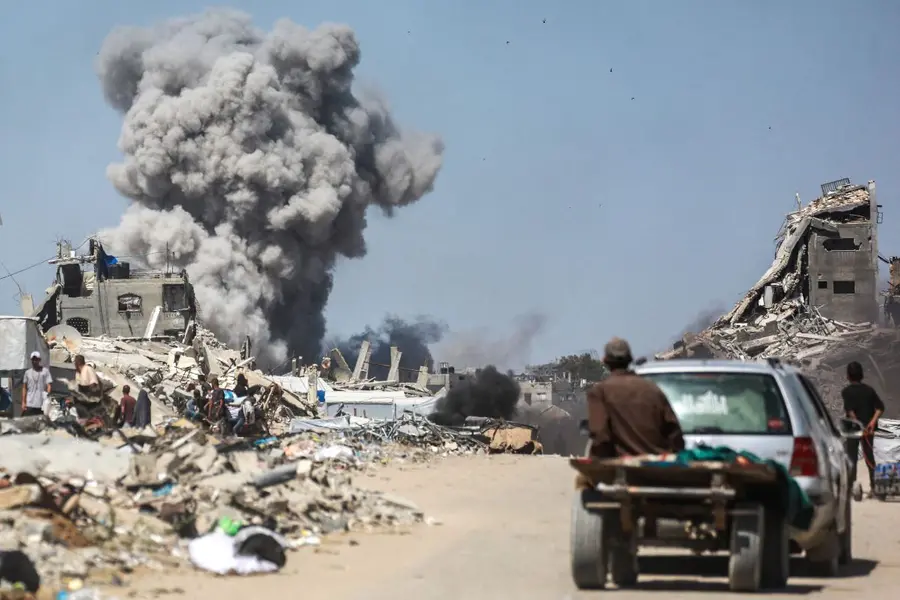
Gaza: Israeli airstrikes over the past 24 hours have killed at least 38 people in Gaza, including children, according to local health authorities. Access to northern Gaza’s hospitals remains cut off for a second day, leaving full casualty data unavailable.
Among the dead are nine of the ten children of Palestinian paediatrician Dr Alaa al-Najjar, whose home near Khan Younis was hit on Friday. Her only surviving child, aged 11, and her husband, also a doctor, were seriously injured. “They were innocent children,” said her brother-in-law, Ismail al-Najjar. “The youngest was just seven months old.”
Gaza’s Health Ministry reports that 3,785 people have been killed since the collapse of a temporary ceasefire in March, bringing the total Palestinian death toll to over 53,000 since the war began in October 2023. Women and children make up the majority of the dead, according to local authorities. The ministry does not distinguish between civilians and combatants in its figures.
The Israeli military said the claim of harm to uninvolved civilians is “under review.” It maintains that Hamas is responsible for civilian casualties due to its operations in densely populated areas. There was no immediate comment on the latest strikes, including one in Deir al-Balah that reportedly killed a mother and two children, and another in Jabaliya that left five dead, including two women and a child.
Humanitarian crisis deepens as aid official resigns
Israel, which had blocked all food, medicine, and fuel from entering Gaza for two and a half months, allowed a small quantity of aid in last week following warnings of impending famine and pressure from allies. However, the trickle is far from adequate: just 107 trucks entered on Sunday, compared to 600 per day during the ceasefire, according to the UN.
Efforts to improve aid delivery were dealt a blow on Sunday when Jake Wood, the American executive director of a newly formed, US-backed aid initiative, resigned. Wood said it had become clear that the plan could not be implemented while maintaining the core humanitarian principles of “humanity, neutrality, impartiality, and independence.”
His departure raises further concerns about Israeli control over aid distribution. The UN has rejected the Israeli-led plan, with World Food Programme executive director Cindy McCain stating she has seen no evidence to support Israeli claims that Hamas is looting aid trucks. “These people are desperate,” she said. “They see a World Food Programme truck and run for it.”
Voluntary migration plan sparks global concern
Israel has also signalled its intention to take full control of Gaza and facilitate what it calls the “voluntary migration” of over two million residents – a plan widely condemned by Palestinians and the international community.
Meanwhile, ceasefire negotiations have stalled. Hamas has insisted it will release the remaining 58 Israeli hostages only in exchange for a permanent ceasefire and complete Israeli withdrawal. Around a third of the hostages are believed to still be alive.
Red cross workers, civilians killed in ongoing strikes
The International Committee of the Red Cross (ICRC) confirmed that two of its staff members were killed on Friday when shelling struck their home in Khan Younis.
Israel’s military chief of staff, Lt Gen Eyal Zamir, who visited the city, stated: “This is not an endless war,” despite the growing death toll and diplomatic deadlock.
Tensions remain high
Separately, Israeli officials said on Sunday that a missile fired by Yemen’s Iran-backed Houthi rebels was intercepted. The missile triggered air raid sirens in Jerusalem and other areas, though no injuries or damage were reported.
The Houthis have launched multiple missile attacks targeting Israel and international shipping in the Red Sea in response to the Gaza conflict. Most of the vessels targeted have had no direct links to Israel. The United States recently paused its airstrikes on the group following a pledge from the Houthis to stop targeting commercial ships.
Hezbollah warns of escalation if Israel fails to withdraw
On the anniversary of Israel’s withdrawal from southern Lebanon in 2000, Hezbollah leader Naim Kassem warned that the group would not consider disarming unless Israel withdraws from five disputed border points and halts its airstrikes. He said Hezbollah had fully complied with a recent US-brokered ceasefire and would not make further concessions until Israel met its obligations.
Published: 26 May 2025, 08:30 am IST
Related Topics
Disclaimer: Kindly avoid objectionable, derogatory, unlawful and lewd comments, while responding to reports. Such comments are punishable under cyber laws. Please keep away from personal attacks. The opinions expressed here are the personal opinions of readers and not that of Mathrubhumi.
