
Iran described the strikes as retaliation for recent attacks on its own nuclear sites, signaling a shift in regional hostilities.
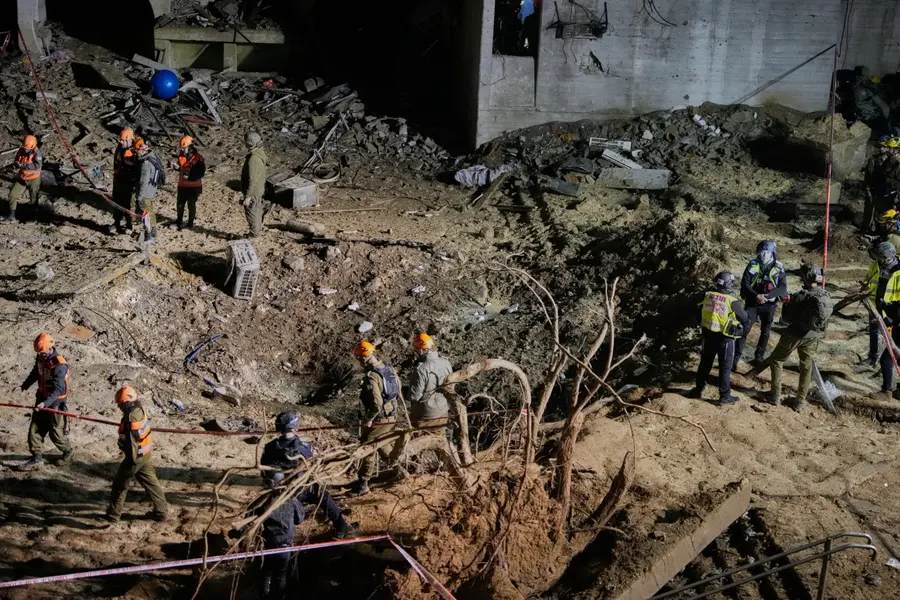
Arad: Iranian ballistic missiles struck two southern Israeli towns on Saturday, wounding more than 100 people after the nation’s advanced air defence systems failed to intercept the projectiles.
The direct hits, which targeted the towns of Arad and Dimona, sheared away the facades of residential buildings and left massive craters in the earth. First responders from Magen David Adom reported that 84 people were injured in Arad, with 10 in serious condition. This followed an earlier strike on nearby Dimona that wounded 33 residents.
Iranian state television characterised the bombardment of Dimona—home to a sensitive nuclear research facility—as a direct "response" to an earlier attack on Iran’s Natanz nuclear site.
Air Defence Failure Under Scrutiny
Footage from Arad showed emergency crews sifting through the skeletal remains of a bombed-out apartment complex while fire engines illuminated the rubble. Firefighters confirmed that while interceptors were launched in both Dimona and Arad, they failed to neutralise the incoming ballistic missiles, which carried "warheads weighing hundreds of kilograms."
The Israeli military has launched a formal inquiry into the malfunction. "The air defence systems operated but did not intercept the missile, we will investigate the incident and learn from it," military spokesman Brigadier General Effie Defrin wrote on X.
The local fire service reported "extensive damage" in Arad, where three buildings were severely impacted and at least one caught fire. In response to the strikes, the Home Front Command ordered all local schools to transition to online learning.
Chaos in the South
In Dimona, located approximately 25 kilometres (15 miles) southwest of Arad, rescue workers faced similar scenes of destruction. AFPTV footage revealed a deep crater surrounded by twisted metal and shattered glass from neighbouring facades. Among the 33 injured was a 10-year-old boy who remains in serious condition with shrapnel wounds.
Dimona is widely believed to house the Middle East's only nuclear arsenal, a claim Israel neither confirms nor denies under its long-standing policy of nuclear ambiguity.
Escalating Rhetoric
The strikes are part of a continuous wave of Iranian retaliation following the joint U.S.-Israeli offensive that began Feb. 28. Prime Minister Benjamin Netanyahu, describing the evening as "very difficult," vowed that Israel would persist in its campaign against Iran and its regional allies.
Meanwhile, Iranian officials claimed the strikes signalled a strategic shift. Major General Seyed Majid Moosavi, head of the IRGC Aerospace Force, declared that Iran now "dominates the skies of the occupied territories."
In a post on X, Moosavi warned that future waves of attacks using new launch systems would leave "American-Zionist commanders dumbfounded," promising that "the skies over the south... will remain illuminated for hours."
The Speaker of the Iranian Parliament, Mohammad Bagher Ghalibaf, echoed this sentiment, suggesting the failure to protect the heavily fortified Dimona area proves that "Israel's skies are defenceless." He added, "the time has come to implement the next pre-designed plans. Happy Nowruz to the Iranian nation."
With inputs from AFP
Published: 22 Mar 2026, 07:31 am IST
Related Topics
Disclaimer: Kindly avoid objectionable, derogatory, unlawful and lewd comments, while responding to reports. Such comments are punishable under cyber laws. Please keep away from personal attacks. The opinions expressed here are the personal opinions of readers and not that of Mathrubhumi.
