
A government investigation into the devastating Hong Kong apartment complex fire has revealed that sections of the renovation netting failed fire-safety standards.
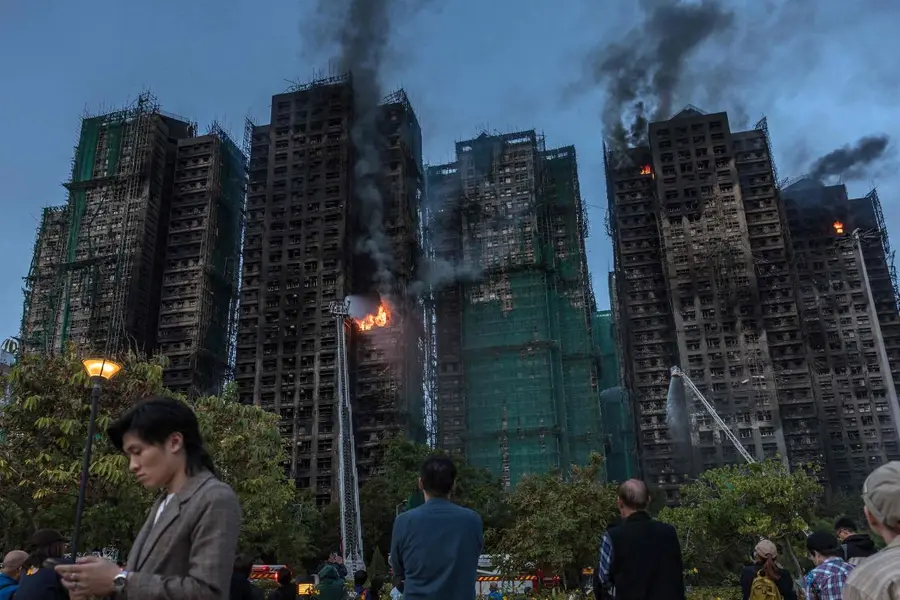
Hong Kong officials said their probe into last week’s catastrophic apartment complex blaze has uncovered that parts of the protective netting used during renovation works failed to comply with fire-safety standards. The revelation comes as public sympathy for victims grows, even as authorities tighten their response to online criticism.
Safety lapses discovered after access to upper floors
The fire, which broke out on Wednesday and raged until Friday, swept through the Wang Fuk Court housing complex in Tai Po, destroying seven of its eight high-rise towers. Investigators now believe the blaze escalated rapidly because the lower-level netting on the first affected building ignited, allowing flames to enter the interior as polystyrene panels burned and windows shattered. Strong winds carried the fire across the estate, home to around 4,600 residents.
Hong Kong’s Chief Secretary Eric Chan said initial tests indicated the materials met safety requirements, but subsequent inspections told a different story. After teams were able to reach previously inaccessible floors, samples taken from multiple areas showed that seven out of 20 pieces of netting failed standards.
“They just wanted to make money at the expense of people's lives,” he said, suggesting that contractors may have used cheaper, substandard materials for profit.
Secretary for Security Chris Tang added that investigators faced limitations during the early stages. “Because the fire is now out, we have been able to get to places that were not easily accessible before to take samples,” he said.
Death toll rises and hundreds remain displaced
By Monday, specialist officers from the police Disaster Victim Identification Unit had searched four of the charred towers, locating 30 additional bodies. The confirmed death toll now stands at 146, with about 100 residents still unaccounted for and 79 injured.
Authorities continue to assess the structural safety of the remaining blocks, including the first tower that caught fire and sustained the heaviest damage.
Thousands have been left without homes. As of Monday, officials said 683 residents were staying in hotels and hostels, while 1,144 others had moved into temporary housing. Emergency shelters remain open for those yet to be relocated.
Public grief met with tightening controls on dissent
Local residents and supporters have flocked to a makeshift memorial near the burned-out buildings, leaving flowers, notes and personal tributes. Donations for survivors have soared to 900 million Hong Kong dollars (US$115 million), with the government contributing an additional 300 million HK$ in seed funding to support long-term rehabilitation and rebuilding efforts. Cash subsidies have also been distributed to survivors to cover immediate needs, including funeral expenses.
“When something happens, we come out to help each other,” said Loretta Loh while paying her respects. “I have a heavy heart.”
Even as the city rallies around survivors, authorities have begun cracking down on what they describe as dangerous speculation. Tang accused unnamed individuals of spreading misinformation, saying: “There are rumors being spread by bad people giving fake news about the firefighters not employing the correct tactics to fight the fire, or victims being charged 8,000 Hong Kong dollars a night to stay in hotels - these are all false. We will arrest these rumor mongers.”
The Office for Safeguarding National Security issued a strongly worded statement on Saturday condemning what it called “evil schemes” intended to destabilise Hong Kong, though it did not provide details.
Arrests spark concerns over accountability and free expression
Public frustration has grown alongside calls for accountability, with some questioning whether officials should also bear responsibility. Jean-Pierre Cabestan, a political scientist and senior research fellow at the Paris-based Asia Centre, said, “People are angry and think that the HK (Hong Kong) government should be accountable.”
However, authorities have moved swiftly to contain dissent. According to local media reports from HK01 and Sing Tao Daily, a man who helped launch an online petition urging government accountability was arrested on suspicion of sedition on Saturday. Two more arrests followed on Sunday, including that of a volunteer who assisted residents in Tai Po.
Cabestan said the approach mirrors mainland China's strategy of anticipating and suppressing potential protests before they emerge.
Police declined to respond directly to the arrests, telling The Associated Press that “police will take actions according to actual circumstances and in accordance with the law.”
Hong Kong has seen a sweeping curtailment of public demonstrations and political opposition since mass protests in 2019, and authorities have continued to enforce national security measures to silence criticism.
Warnings ignored during year-long renovation project
The Wang Fuk Court complex had been surrounded by bamboo scaffolding and nylon netting for external renovation works for nearly a year. Residents had repeatedly raised concerns about the material, prompting Hong Kong’s Labour Department to carry out 16 inspections since July 2024. Officials had reportedly issued multiple written reminders to the contractors to comply with fire safety requirements, with the most recent warning coming just days before the fire.
The city's anti-corruption agency has since arrested 11 people linked to the construction works, including company directors and an engineering consultant, as part of an investigation into whether cost-cutting or negligence contributed to the disaster.
(With inputs from AP)
Published: 01 Dec 2025, 03:31 pm IST
Related Topics
Disclaimer: Kindly avoid objectionable, derogatory, unlawful and lewd comments, while responding to reports. Such comments are punishable under cyber laws. Please keep away from personal attacks. The opinions expressed here are the personal opinions of readers and not that of Mathrubhumi.
