
More than 55,000 people, including representatives from a record 120 countries and regions—among them Russia and Belarus—gathered at Hiroshima Peace Memorial Park for the annual ceremony
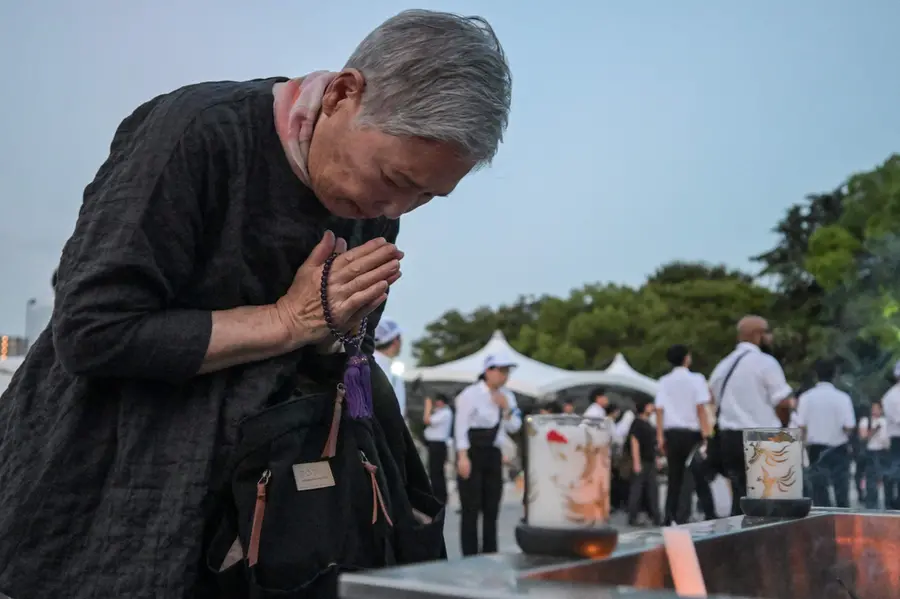
Hiroshima: The city of Hiroshima on Wednesday commemorated the 80th anniversary of the atomic bombing that devastated the western Japanese city in 1945. The solemn occasion was marked by growing concern among survivors over what they see as increasing global acceptance of nuclear weapons as tools of deterrence.
More than 55,000 people, including representatives from a record 120 countries and regions—among them Russia and Belarus—gathered at Hiroshima Peace Memorial Park for the annual ceremony. A minute of silence was observed at 8:15 a.m., the exact time when a U.S. B-29 bomber dropped the atomic bomb on the city, killing an estimated 140,000 people by the end of that year.
Last major anniversary for many survivors
With the average age of survivors now exceeding 86, this year’s anniversary is widely regarded as one of the final milestone commemorations that will include many first-hand witnesses. Survivors, known as hibakusha, have expressed urgency in sharing their accounts before it is too late.
“There will be nobody left to pass on this sad and painful experience in 10 years or 20 years,” said 94-year-old Minoru Suzuto, after praying at the cenotaph. “That’s why I want to share (my story) as much as I can.”
Calls to reconsider nuclear deterrence
Hiroshima Mayor Kazumi Matsui used his speech to caution against the growing global trend of strengthening military capabilities, including nuclear arsenals, citing Russia’s war in Ukraine and ongoing tensions in the Middle East.
“These developments flagrantly disregard the lessons the international community should have learned from the tragedies of history,” he said. “They threaten to topple the peacebuilding frameworks so many have worked so hard to construct.”
He called on Japan’s government to sign and ratify the Treaty on the Prohibition of Nuclear Weapons (TPNW), echoing demands from several survivor groups.
Government maintains deterrence-based stance
Japanese Prime Minister Shigeru Ishiba reiterated Japan’s commitment to a world without nuclear weapons but stopped short of endorsing the treaty. At a press conference later in the day, Ishiba defended Japan’s reliance on the U.S. nuclear umbrella, stating it was necessary due to the country’s proximity to nuclear-armed states. He maintained that this stance does not contradict Japan’s non-nuclear principles or its broader disarmament goals.
In a post on his official X account, the PM stated, “After the ceremony, I visited the Peace Memorial Museum again. As the only country capable of conveying the horrors of the atomic bomb to the world, we will pass down the memory of this tragic experience and lead international efforts to prevent such a calamity from happening again.”
The government’s position has drawn criticism from many survivors who view it as inconsistent with Japan’s historical experience and moral responsibility.
International and religious leaders call for disarmament
United Nations Secretary-General António Guterres, in a message delivered by UN Under-Secretary-General Izumi Nakamitsu, stressed the importance of preserving survivors’ testimony. He praised the Nobel Peace Prize-winning organisation Nihon Hidankyo and reaffirmed global commitments to nuclear disarmament under the “Pact for the Future”.
“There is hope,” Guterres said. “Remembering the past is about protecting and building peace today and in the future.”
Pope Leo XIV also issued a statement on Tuesday, calling on the international community to renew its commitment to peace, saying he was praying that the anniversary would serve as a catalyst for global reflection and action.
Frustration among survivors
Some survivors expressed disappointment over recent international rhetoric, particularly former U.S. President Donald Trump’s remarks comparing the Hiroshima bombing to a U.S. strike on Iran. They also criticised the Japanese government’s limited response to such statements.
“It’s ridiculous,” said Kosei Mito, a 79-year-old survivor exposed to radiation while still in the womb. “I don’t think we can get rid of nuclear weapons as long as it was justified by the assailant.”
Others, like 74-year-old Kazuo Miyoshi, who lost relatives in the bombing, called for a clear rejection of nuclear weapons: “We do not need nuclear weapons. That mistake should never be repeated.”
Civilian victims continue to seek recognition
Despite decades of advocacy, survivors continue to call for formal acknowledgment of civilian suffering and responsibility from the U.S. government. While Japan has offered compensation to war veterans and their families, no similar redress has been extended to civilian victims of the atomic bombings.
(With AP inputs)
Published: 06 Aug 2025, 10:07 am IST
Related Topics
Disclaimer: Kindly avoid objectionable, derogatory, unlawful and lewd comments, while responding to reports. Such comments are punishable under cyber laws. Please keep away from personal attacks. The opinions expressed here are the personal opinions of readers and not that of Mathrubhumi.
