
A senior adviser to Pakistan’s Prime Minister has revealed that the Indian BrahMos missile strike during Operation Sindoor left Pakistan's military just 30-45 seconds to assess whether it carried a nuclear warhead, raising fears of miscalculation and nuclear escalation
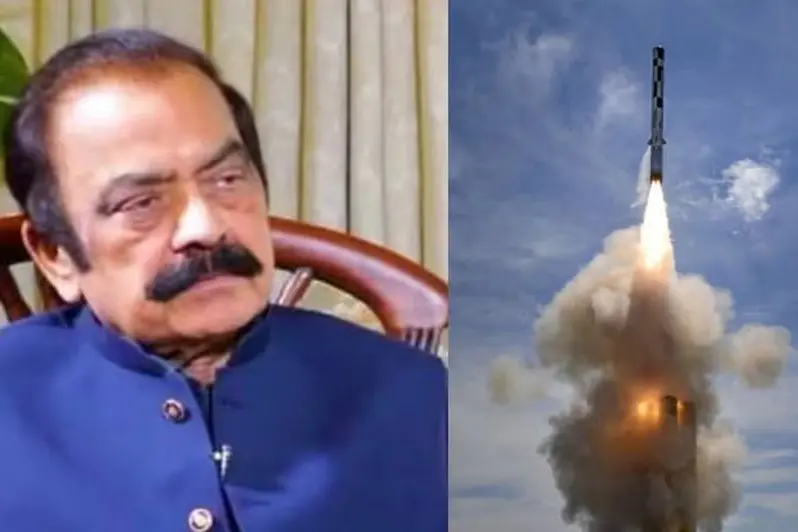
New Delhi: India’s use of the BrahMos supersonic cruise missile during Operation Sindoor caused panic and intense pressure within Pakistan’s military command, leaving them with just 30 to 45 seconds to determine whether the missile was nuclear-armed. The startling admission comes from Rana Sanaullah, senior adviser to Pakistan’s Prime Minister Shehbaz Sharif, who has for the first time revealed how close Islamabad felt to the edge of nuclear escalation.
“When India fired BrahMos at Nur Khan airbase, Pakistan's military had only 30-45 seconds to analyse whether the incoming missile may have a nuclear warhead. To decide anything on this in just 30 seconds was a dangerous situation,” Sanaullah told a Pakistani news channel.
Nuclear anxiety in Pakistan’s high command
The BrahMos strike on Nur Khan airbase, a key Pakistan Air Force facility in Rawalpindi, appears to have triggered a moment of sheer uncertainty and fear within Pakistan’s decision-making hierarchy. According to Sanaullah, the pressure of making a life-or-death decision in under a minute could have led to an accidental nuclear response, with devastating global consequences.
“I’m not saying they [India] did good by not using a nuclear warhead,” he said, “but at the same time the people on this side could have misunderstood it also, leading to the launch of the first nuclear weapon that could spark a global nuclear war.”
The statement lays bare the psychological and strategic impact of BrahMos, one of the fastest cruise missiles in the world, and highlights how its deployment during Operation Sindoor pushed Pakistan to the brink.
Operation Sindoor
India’s sudden and coordinated airstrikes on multiple Pakistani military bases during Operation Sindoor, in response to the killing of 26 Indian tourists in Pahalgam by Pakistan-backed terrorists, left a big footprint. Using air-launched and stand-off precision weapons, India hit targets at Nur Khan, Sargodha, Bholari, Sukkur, Jacobabad, and Rahim Yar Khan, causing substantial damage to infrastructure, including runways, hangars, and air traffic control facilities.
Intelligence reports confirmed that India also targeted and neutralised over 100 terrorists, including those from Lashkar-e-Taiba, Jaish-e-Mohammad, and Hizbul Mujahideen, who were preparing for infiltration and attacks.
Following India's initial strikes, Pakistan launched a series of drone and missile attacks on India's western regions, all of which were intercepted by India’s air defense systems. India then carried out a second wave of retaliatory precision strikes before the two nations agreed to a mutually brokered ceasefire after four days of escalation.
Published: 04 Jul 2025, 12:04 pm IST
Related Topics
Disclaimer: Kindly avoid objectionable, derogatory, unlawful and lewd comments, while responding to reports. Such comments are punishable under cyber laws. Please keep away from personal attacks. The opinions expressed here are the personal opinions of readers and not that of Mathrubhumi.
