
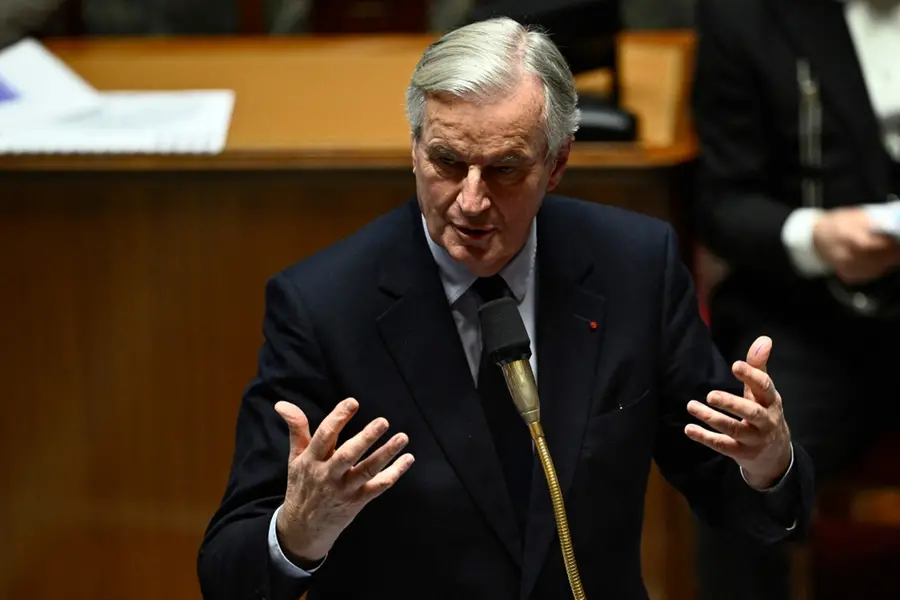
Paris: France’s government faced a no-confidence vote that could end the brief tenure of Prime Minister Michel Barnier on Wednesday, throwing the country into political uncertainty. If Barnier’s government is toppled after just three months in office, President Emmanuel Macron will face a difficult decision on how to proceed and who to appoint as the next prime minister.
The National Assembly is set to debate two motions of no-confidence, brought by the far-left and far-right. These motions stem from a standoff over the budget, where Barnier had pushed through the social security budget without a vote. The far-right National Rally (RN), led by Marine Le Pen, is expected to support the left’s motion, giving it enough votes to pass.
Barnier, asked on French television about the possibility of his government surviving the vote, said, “I want this and it is possible. It depends on the MPs... I think it is possible that there is this reflex of responsibility where – beyond political differences, divergences, the normal contradictions in a democracy – we tell ourselves that there is a higher interest."
However, most analysts predict that Barnier’s government will not survive, as the far-right and the left are expected to form an unusual alliance to bring it down. This political turmoil follows snap elections called by Macron earlier this year, which failed to stop the rise of the far-right and left France without a parliamentary majority.
Barnier’s administration has been under pressure from the far-right, with Le Pen’s party holding the power to topple the government. No new elections can be held for a year, limiting Macron’s options. Some have even speculated that Macron, currently on a state visit to Saudi Arabia, may consider resignation. However, Macron rejected these calls, saying, "It doesn't make sense... it's frankly not up to scratch to say these things."
Macron Stands firm
Macron defended his presidency, stating, "I am extremely proud of this and I will honour this trust with all the energy that is mine until the last second to be useful to the country," adding that he was elected twice by the French people and would continue serving until 2027.
While Macron dismissed suggestions of resignation, some opposition figures and even members of his own faction have called it a possible solution to the political crisis. Macron also criticised Le Pen’s party for supporting the no-confidence motion, calling it "unbearable cynicism" and emphasizing France's strong economy.
Future of the government
If Barnier’s government falls, it would be the first successful no-confidence vote since 1962, when President Charles de Gaulle’s government was overthrown. Barnier’s government would also be the shortest in the history of France’s Fifth Republic, which began in 1958.
The race for the next prime minister is uncertain, with loyalist Defence Minister Sebastien Lecornu and Macron’s centrist ally Francois Bayrou as possible candidates.
Le Pen’s strategy and legal troubles
Le Pen, 56, is believed to be playing a high-risk game to weaken Macron's presidency by toppling Barnier’s government. She is also facing a high-profile embezzlement trial, which, if she is found guilty, could block her from running in the 2027 presidential election.
Despite this, Le Pen insists her party’s opposition to the government is due to a budget that she claims will make the French poorer. “By following the ‘catastrophic continuity of Emmanuel Macron,’ the prime minister ‘could only fail,’” she wrote on social media.
AFP
Published: 04 Dec 2024, 09:15 am IST
Related Topics
Disclaimer: Kindly avoid objectionable, derogatory, unlawful and lewd comments, while responding to reports. Such comments are punishable under cyber laws. Please keep away from personal attacks. The opinions expressed here are the personal opinions of readers and not that of Mathrubhumi.
