
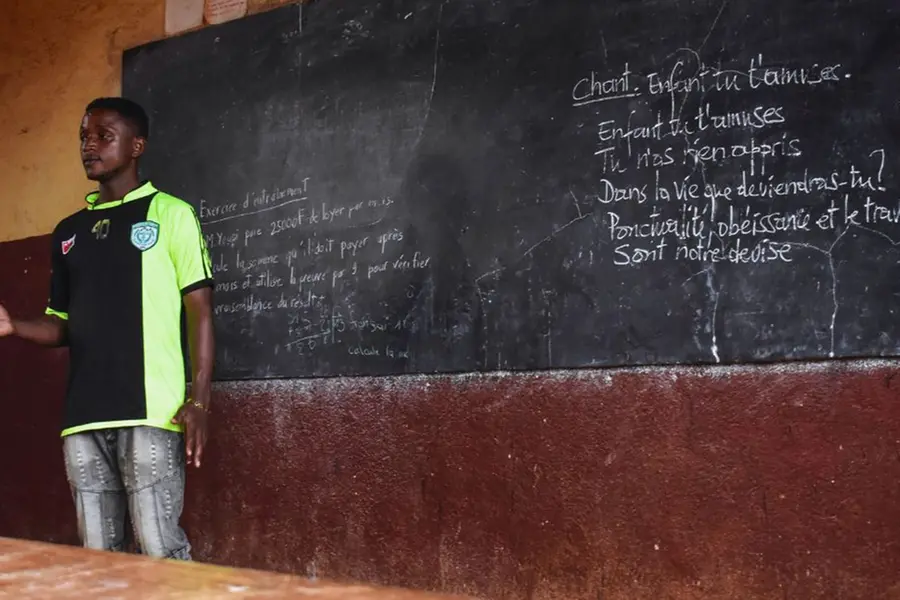
Dschang, Cameroon: In the lush highlands of Cameroon, a former rebel fighter now teaches philosophy and logic to students, a role far removed from the violence and destruction of his past. Ateasong Belts Tajoah, who once fought for the separatist Red Dragons militia, is now focused on promoting peace and education after surrendering his weapon in 2019.
Tajoah’s journey began in 2017, when he was 23 years old. Frustrated by what he saw as the marginalisation of English-speaking Cameroonians by the French-speaking government, he joined the Red Dragons militia in the southwest of the country. Tensions had been rising for years, with peaceful protests by lawyers and teachers spiralling into deadly violence after a government crackdown. As the separatist movement grew, it led to the formation of "Ambazonia," a self-declared breakaway region seeking independence.
Also Read

During his time with the militia, Tajoah endured harsh conditions. He lived in makeshift camps under plastic sheets, often in the rain, and fought in battles targeting both military and civilian sites. “You could never sleep with both eyes closed,” he recalls, pointing to scars on his neck and stomach, which serve as a reminder of the dangers he faced. The rebel group's tactics included destroying schools to undermine government control, a strategy that deeply impacted the education system. As a result, thousands of children were left without schooling, and many teachers lost their lives.
Turning point: Losing his child
Despite his involvement in the conflict, Tajoah’s perspective began to shift after the death of his 11-year-old child in an attack by government forces. Overcome with grief and disillusioned by the rebel leadership, Tajoah made the decision to surrender in early 2019. This moment marked a turning point, leading him to enter a government-run rehabilitation centre in Buea, where he spent 18 months reflecting on his actions and past choices.
However, reintegrating into society proved to be a difficult journey. The rehabilitation programme, although offering skills training, faced widespread criticism for its lack of resources and slow progress. Many ex-combatants like Tajoah found it challenging to move forward, with some even returning to armed groups due to frustration with the process.
Education as redemption
Despite these challenges, Tajoah persevered. In 2021, he earned a master’s degree in philosophy, and soon after, he began teaching. Today, he is an educator in the same region where he once fought, using his role as a platform to promote peace and prevent others from following his troubled path.
“Teaching is more than a job,” Tajoah says. “It is a way to confront my past and inspire others to avoid my mistakes.” His decision to teach philosophy and logic stems from a long-standing interest in critical thinking and human behaviour. “I was fond of these subjects before becoming a fighter,” he explains. Now, he uses them to challenge his students' thinking and guide them towards a more constructive future.
Teacher, advocate for peace
Tajoah’s story has not been without challenges. Initially, many of his students and their parents were wary of his past, fearing that former combatants were dangerous or uneducated. But through his honesty about his history and his dedication to teaching, Tajoah gradually earned their trust. His classroom has become a space where young minds are encouraged to think critically and embrace peace.
Outside the classroom, Tajoah has become an advocate for peace. Using social media, he shares the grim realities of armed conflict, posting images of fallen fighters to show the true cost of rebellion. He also travels to remote villages, urging young people to lay down their weapons. His efforts have led to the surrender of several fighters, and some villages have seen their schools reopen as a result of his outreach.
Personal sacrifices, challenges
However, Tajoah’s advocacy has come at a personal cost. His mother has been kidnapped twice by separatists, and he has received numerous death threats. Despite this, he continues to push forward with his mission to spread a message of peace.
“More people understand now he’s here to bring peace and encourage others to drop their guns,” says Ajiawung Columbus Fortulah, a traditional chief from Tajoah's home village. Tajoah’s influence has helped reopen schools and foster a more peaceful environment in his community.
Way forward: dialogue, not violence
Tajoah’s story highlights the need for dialogue and reconciliation in Cameroon, a country still grappling with the consequences of its ongoing conflict. “Anglophones are marginalized, but guns and kidnappings won’t solve it,” he says. “Dialogue and action are the only way forward.”
He hopes that his students, and others in his community, will embrace this message of peace, recognising that while the scars of the past will never disappear, they don’t have to define the future. “I fought to close schools, but now I teach to open minds,” Tajoah reflects. “The scars will always be there, but they don’t have to define you.”
Agency
Published: 26 Jan 2025, 11:23 am IST
Related Topics
Disclaimer: Kindly avoid objectionable, derogatory, unlawful and lewd comments, while responding to reports. Such comments are punishable under cyber laws. Please keep away from personal attacks. The opinions expressed here are the personal opinions of readers and not that of Mathrubhumi.